Search Header Logo
  1. Resource Library
  2. Science
  3. Chemistry
  4. Separating Mixtures
  5. Separating Of Mixtures
Separating of Mixtures

Separating of Mixtures

Assessment

Presentation

•

Science

•

4th Grade

•

Medium

•
NGSS
5-PS1-3, MS-PS1-2

Standards-aligned

Created by

PRAGYAN P

Used 20+ times

FREE Resource

14 Slides • 20 Questions

1

Separating of Mixtures

Slide image

2

Open Ended

Give any 2 examples of Mixtures you might see in everyday life.

3

Open Ended

Question image

How is a mixture made up of?

4

Fill in the Blank

Question image

A solution is a ______________________.

5

Fill in the Blank

Question image

Solution has two parts : a _____________ and a _______________.

6

Multiple Choice

Question image

Salt in salt solution is an example of

1

Solute

2

Solvent

7

Open Ended

Question image

Give two examples of solutions you might see in everyday life.

8

Multiple Choice

Question image

Is honey miscible in water?

1

Yes

2

No

9

Multiple Choice

Question image

Is MUSTARD OIL miscible in water?

1

Yes

2

No

10

Miscible liquids

Liquid that completely mixes in other liquid solvent.

Slide image

11

Immiscible Liquids


Liquid that does not dissolve in other liquid solvent.

Slide image

12

Separation of Mixtures

13

Slide image

14

Multiple Choice

Question image

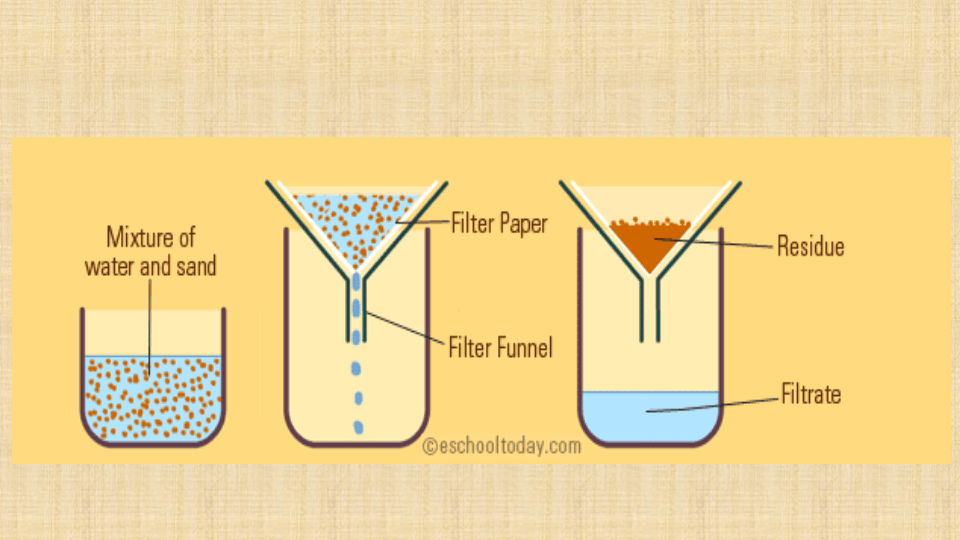
How can we separate sand and water?

1

Sieving

2

Filtration

3

Handpicking

15

Slide image

16

Slide image

17

Sedimentation

  • In this method, the mixture is allowed to stand so that insoluble substances can settle down.


  • The heavy impurities settle down at the bottom of the container.

18

Slide image

19

Decantation

  • In this method, water is gently poured out after sedimentation.

20

Slide image

21

Slide image

22

Slide image

23

Slide image

24

Multiple Choice

How to separate tea leaves and tea liquid?

1

Decantation

2

Evaporation

3

Sieving

4

Magnetic Attraction

25

Multiple Choice

How to separate needles and toothpicks?

1

Decantation

2

Distillation

3

Magnetic Attraction

4

Sieving

26

Multiple Choice

How to separate sugar and water?

1

Decantation

2

Distillation

3

Filtration

4

Evaporation

27

Multiple Choice

Question image

It involves separating a mixture based on different sizes of components.

1

Decantation

2

Sieving

3

Use of Magnets

4

Filtration

28

Multiple Choice

Question image

Which mixture would most likely be separated by this strainer?

1

Marbles and water

2

Salt and water

3

Sand and water

4

Sugar and water

29

Multiple Choice

Question image

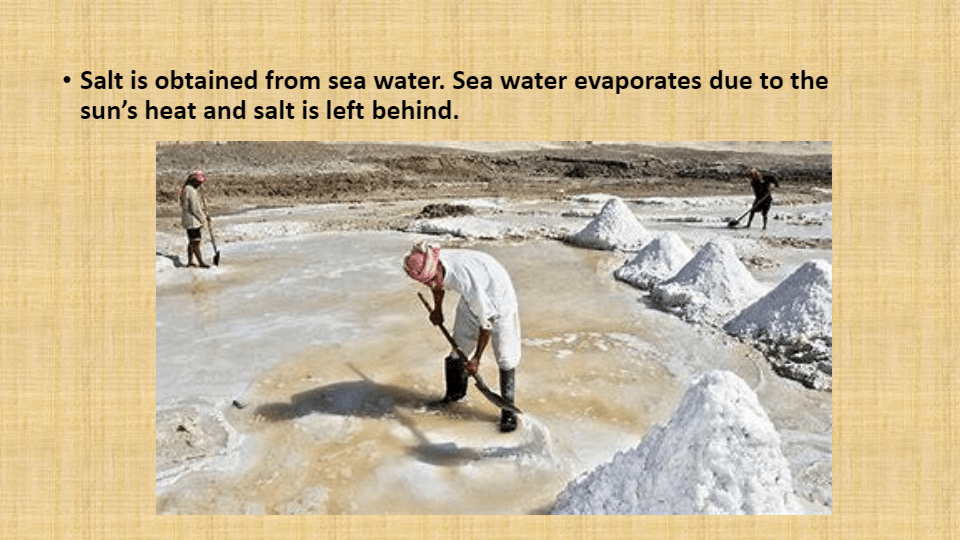
A student is given a beaker containing a mixture of salt and water. The salt is fully dissolved in the water. The student is instructed to separate the salt from the water. What should the student do to separate this mixture?

1

Evaporate the water to collect the salt

2

Pour the mixture through a paper filter

3

Use electrical energy to separate the salt from the water

4

Separate the salt and water with tweezers

30

Multiple Choice

Paper filters are used to separate certain mixtures. Which of these mixtures is most likely to be separated by a paper filter?

1

Sugar and salt

2

Sand and water

3

Sugar and water

4

Sand and salt

31

Multiple Choice

How to separate cooked noodles and water?

1

Decantation

2

Filtration

3

Evaporation

4

Sieving

32

Open Ended

Question image

Sonu accidently mixed sand and salt in water.

Can you suggest him some methods on how to separate the mixture?

33

Multiple Choice

Question image

Identify the following method of separation of mixtures:

1

Magnetic Separation

2

Sieving

3

Hand picking

4

Filtration

34

Multiple Choice

Question image

Identify the following method of separation of mixtures:

1

Magnetic Separation

2

Sieving

3

Hand picking

4

Filtration

Separating of Mixtures

Slide image

Show answer

Auto Play

Slide 1 / 34

SLIDE