

Plate Tectonics & Volcanoes

Presentation
•
Science
•
5th - 9th Grade
•
Practice Problem
•
Medium
+3
Standards-aligned

M Rice
Used 83+ times
FREE Resource
13 Slides • 18 Questions
1
Plate Tectonics & Volcanoes

2
Pangea & Plate Tectonics
All of the continents formed one major landmass called Pangaea.
Scientists have determined this using the fossils found on different continents of the same species, mountain formations, and similar climate signs.

3
Sea Floor Spreading
Cracks along the ocean floor allow magma to come up and cool.
The cooling magma forms a new crust.
The old crust breaks and the two parts move away from one another.
Oceanic crust is newer than continental crust.

4
Why is the Earth the same size?
New crust is being formed every day at mid-ocean ridges.
However, the old crust is dense and heavy so it sinks in subduction zones or trenches (deepest parts of the oceans).
The old crust is melted back into magma and the process begins again.

5
Multiple Choice
6
Multiple Choice
7
Multiple Choice
8
Multiple Choice
9
Plate Tectonic Theory
Earth's lithosphere (crust and upper mantle) is moving around on plates.
The plates move in different directions and at different speeds.
Some plates have whole continents, and some have only oceanic crust.

10
Plate Boundaries: Convergent
Convergent boundaries form where two plates COLLIDE or HIT.
3 things can happen at a convergent boundary.
1. Continent-Continent: the plates buckle and thicken forming mountains.
2. Continent-Oceanic: the oceanic crust subducts (sinks) because it is denser (heavier), volcanic mountains can be found here.
3. Oceanic-Oceanic: the oceanic crust that is denser (heavier) will subducts (sinks), volcanic islands can be found here.

11

12
Multiple Choice

The edges of plates are called....
13
Multiple Choice

When one plate forces it's way under another plate.
14
Multiple Choice

What geological feature would an oceanic-continental convergent boundary create?
15
Multiple Choice

What geological feature would an continental-continental convergent boundary create?
16
Multiple Choice

What geological feature would an oceanic-oceanic convergent boundary create?
17
Plate Boundaries: Divergent
Divergent Boundaries move away from one another.
Think of DIVIDE or SPLIT
This is common along mid-ocean ridges where the crust is thinner allowing for magma to rise.
On land, this occurs in rift valleys, when two continents move away from one another.

18

19

20
Plate Boundaries: Transform
When two plates move past each other horizontally, it is a transform boundary.
The plates don't slide smoothly and scrape on one another.
This is the common cause of earthquakes.

21

22
Multiple Choice
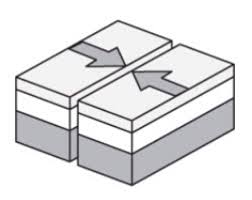
Name the boundary
23
Multiple Choice

What kind of plate boundary is shown here?
24
Multiple Choice
25
Multiple Choice
26
Multiple Choice
27
Multiple Choice
28
Multiple Choice

The diagram shows a landform on Earth. How did the movement of Earth’s plates form the landform?
29
Multiple Choice

What kind of plate boundary is shown here?
30
Multiple Choice
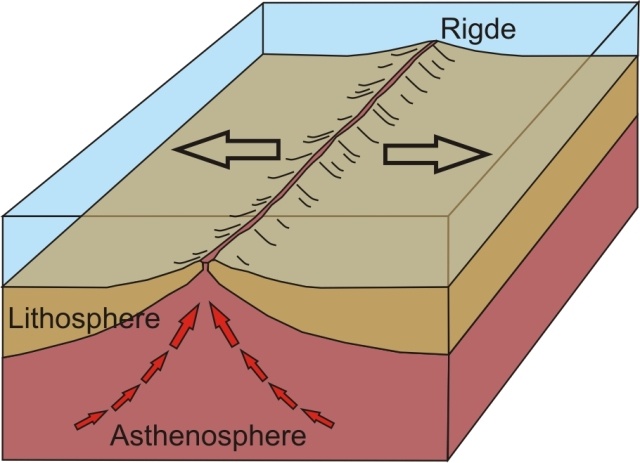
What kind of plate boundary is shown here?
31
What are Volcanoes?
A volcano is any place where gas, ash, or melted rocks come out of the ground.
They can be found everywhere on Earth- in the ocean or on land.
Magma is less dense so it rises to the surface and escapes through vents or openings.
Magma on land is called lava.

Plate Tectonics & Volcanoes
Show answer
Auto Play
Slide 1 / 31
SLIDE

