

Coasts Revision Part 1

Presentation
•
Geography
•
10th Grade
•
Practice Problem
•
Medium

Miss Goodyear
Used 12+ times
FREE Resource
12 Slides • 18 Questions
1
Coasts Revision Part 1
- Wave types and characteristics
- Coastal Processes: Weathering/ Mass Movement/ Erosion/ Transportation/ Deposition
- Erosional Landforms: Headlands and Bays/ Wave Cut Platforms/ Caves, Arches, Stack and Stumps.
- Depositional Landforms: Beaches/ Sand Dunes/ Spits and Bars.

2
3
Multiple Choice

What is the landform in the image called?
4
Multiple Choice

What is the feature in the image called?
5
Multiple Choice
6
Multiple Choice
7
Multiple Choice
8
Multiple Choice
9
Multiple Select
10
Multiple Select
11
Multiple Select
12
Poll
13
Constructive and Destructive Waves
Constructive - they build up the beach by putting more sediment on it. This means it has a strong swash but a weak backwash.
Destructive waves - they destroy the beach by taking the sediment away back into the sea. This mean they have weak swash but a strong backwash.
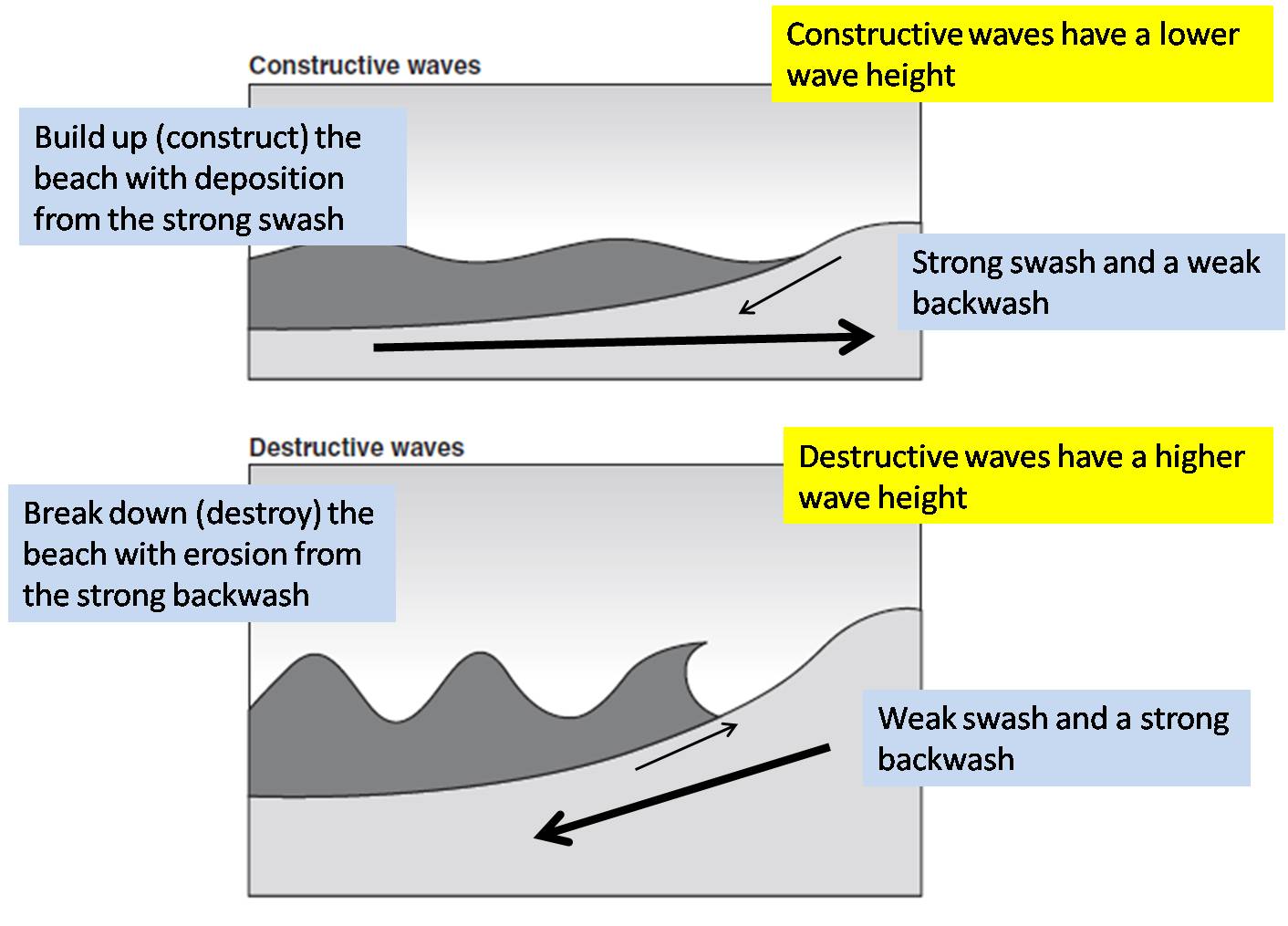
14
Multiple Choice
15
Multiple Choice
16
Weathering: Freeze Thaw/ Biological/ Chemical
Freeze Thaw - water gets inside the cracks in the rocks. When the temperature drops this will freeze and expand which will lead to the cracks increasing. Process will repeat until the rock splits completely.
Biological - plant roots get into the small cracks in the rock, as the plant roots grow causing small pieces of rock to break away.
Chemical - Rainwater and seawater can be a weak acid. Over time a coastline made up of rocks such as limestone or chalk can become dissolved by the acid in the water.

17
Erosion - Destructive Waves
Hydraulic action: Air may become trapped in joints and cracks on a cliff face. When a wave breaks, the trapped air is compressed which weakens the cliff and causes erosion.
Abrasion: Bits of rock and sand in waves grind down cliff surfaces like sandpaper.
Attrition: Waves smash rocks and pebbles on the shore into each other, and they break and become smoother.
Solution: Acids contained in sea water will dissolve some types of rock such as chalk or limestone.

18
Transportation - Longshore Drift
Waves can approach the coast at an angle because of the direction of the prevailing wind.
The swash of the waves carries material up the beach at an angle.
The backwash then flows back to the sea in a straight line at 90°.
This movement of material is called transportation.
Continual swash and backwash transports material sideways along the coast. This movement of material is called longshore drift and occurs in a zigzag.

19
Deposition
When the sea loses energy, it drops the sand, rock particles and pebbles it has been carrying. This is called deposition.
Deposition happens when the swash is stronger than the backwash and is associated with constructive waves.
Deposition is likely to occur when:
waves enter an area of shallow water; waves enter a sheltered area, e.g. a cove or bay; there is little wind; there is a good supply of material.

20
Multiple Choice
21
Multiple Choice
22
Multiple Choice
23
Multiple Select
24
Open Ended
25
Erosional Landforms: Headlands and Bays
Happen at discordant coastlines. Meaning there are bands or hard and soft rock which are perpendicular to the shore.
This means that different parts of the coastline erode at different rates.
As you can see from the image, the soft rock erodes much faster than the hard rock either side of it. This creates a bay in-between the headland.

26
Erosional Landforms: Wave cut Platforms
The sea attacks the base of the cliff between the high and low water mark.
A wave-cut notch is formed by erosional processes such as abrasion and hydraulic action - this is a dent in the cliff usually at the level of high tide.
As the notch increases in size, the cliff becomes unstable and collapses, leading to the retreat of the cliff face.
The backwash carries away the eroded material, leaving a wave-cut platform.
The process repeats. The cliff continues to retreat.

27
Depositional Landforms: Spits.
Spits are also created by deposition.
A spit is an extended stretch of beach material that projects out to sea and is joined to the mainland at one end.
Spits are formed where the prevailing wind blows at an angle to the coastline, resulting in longshore drift.
Longshore drift is when sediment is taken from the beach and deposited further down the coastline.
This results in a spit being formed when the coastline changed directions, and the sediment is deposited into shallow areas of the sea.
An example of a spit is Spurn Head, found along the Holderness coast in Humberside.

28
Depositional Landforms: Bars
Sometimes a spit can grow across a bay, and joins two headlands together. This landform is known as a bar.
They can trap shallow lakes behind the bar, these are known as lagoons.
Lagoons do not last forever and may be filled up with sediment.

29
Open Ended
30
Coasts Revision Part 1
- Wave types and characteristics
- Coastal Processes: Weathering/ Mass Movement/ Erosion/ Transportation/ Deposition
- Erosional Landforms: Headlands and Bays/ Wave Cut Platforms/ Caves, Arches, Stack and Stumps.
- Depositional Landforms: Beaches/ Sand Dunes/ Spits and Bars.
Show answer
Auto Play
Slide 1 / 30
SLIDE

