Search Header Logo
Relationships in Ecosystems Review

Relationships in Ecosystems Review

Assessment

Presentation

Science

6th - 7th Grade

Practice Problem

Medium

NGSS
MS-LS2-1, MS-LS2-3, MS-LS2-2

+2

Standards-aligned

Created by

Maryanne Amenhar

Used 15+ times

FREE Resource

1 Slide • 19 Questions

1

Relationships in Ecosystems Review

Slide image

2

Multiple Choice

How are changes in populations related to the availability of an ecosystem's resources?

1

Large populations need the same amount of resources as small populations.

2

As populations grow, ecosystems produce more resources in order to support the larger population.

3

Population sizes are limited by the amount of resources that are available.

4

Changes in population are independent of the availability of an ecosystem's resources.

3

Multiple Choice

Which of the following would most likely limit the number of mice in an ecosystem?

1

an increase in the amount of vegetation (food)

2

a decrease in the number of owls (predators)

3

a disease that infects baby mice

4

an increase in the amount of space available

4

Multiple Choice

All the different populations that live together in an area make up a(n)-

1

community

2

biome

3

ecosystem

4

biosphere

5

Multiple Choice

Which of the following is an example of an abiotic factor in an ecosystem?

1

roots

2

grass

3

birds

4

sunlight

6

Multiple Choice

What is the definition of abiotic?

1

non-living things in the ecosystem

2

producers

3

the place in an ecosystem where an organism lives

4

population

7

Multiple Choice

What is the definition of biotic?

1

living things in an ecosystem

2

nonliving things in an ecosystem

3

a characteristic that helps an organism survive and reproduce in its environment

4

squirrels

8

Multiple Choice

Question image

In this food web, which animals are in competition?

1

Hawks and coyotes

2

Squirrels and hawks

3

Antelopes and squirrels

4

Hawks and mountain lions

9

Multiple Choice

Question image

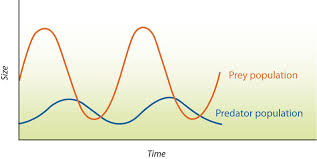
True or False: The population size of predators are equal to the population size of prey.

1

True

2

False

10

Multiple Choice

A tapeworm lives in human intestines absorbing the nutrients that would normally be absorbed by the person.  This eventually causes the person to experience health problems.  This relationship is -
1
predator/prey
2
parasite/host
3
herbivore/omnivore
4
consumer/producer

11

Multiple Choice

An organism that creates its own food through the process of photosynthesis is called a -
1
decomposer
2
prey
3
consumer
4
producer

12

Multiple Choice

Question image
Which of these populations is most likely to decrease if the number of grasshoppers decreases?
1
plants
2
frog
3
praying mantis
4
owl

13

Multiple Choice

Plants need light, water, and carbon dioxide for photosynthesis.  This is an example of an organism interacting with -
1
biotic factors
2
food webs
3
abiotic factors
4
dominant factors

14

Multiple Choice

What is prey?
1
An organism that is consumed
2
An organism that consumes
3
neither

15

Multiple Choice

What is a predator?
1
Neither
2
An organism that is consumed
3
An organism that does the consuming

16

Multiple Choice

Fleas and ticks are examples of what?
1
predators
2
prey
3
hosts
4
parasites

17

Multiple Choice

What is the type of symbiotic relationship that helps one organism, but does not harm or help the other?
1
parasitism
2
mutualism
3
commensalism
4
symbiosis

18

Multiple Choice

What is the organism that is harmed in a parasitic relationship?
1
parasite
2
host
3
consumer
4
producer

19

Multiple Choice

What is mutualism?

1

One organism benefits greatly and the other is not harmed

2

One organism benefits while the other is harmed

3

Close relationship where both organisms benefit

20

Multiple Choice

What is mutualism?

1

One organism benefits greatly and the other is not harmed

2

One organism benefits while the other is harmed

3

Close relationship where both organisms benefit

Relationships in Ecosystems Review

Slide image

Show answer

Auto Play

Slide 1 / 20

SLIDE