Search Header Logo
Cells and Cell Transport Review

Cells and Cell Transport Review

Assessment

Presentation

•

Biology

•

9th Grade

•

Practice Problem

•

Medium

•
NGSS
HS-LS2-5, HS-LS1-3, HS-LS1-2

+4

Standards-aligned

Created by

whitney gessel

Used 93+ times

FREE Resource

6 Slides • 21 Questions

1

Cells and Cell Transport Review

Please be sure to study!
Slide image

2

Cell Theory

  • All living things are made of cells.

  • Cells are the basic unit of life.

  • Cells must come from preexisting cells.

3

Multiple Choice

There are three tenets of the Cell Theory. Which of the following is NOT a tenet?

1

Cells are the basic structure and function of life.

2

All living things are made of one or more cells.

3

The cell is the basic unit of matter.

4

All cells come from preexisting cells.

4

Multiple Choice

Which answer shows the levels of organization from least complex to most complex?

1

cells, organelles, tissues, organism, organ system

2

organelles, cells, tissues, organ systems, organism

3

Organism, organ systems, tissues, cells, organelles

5

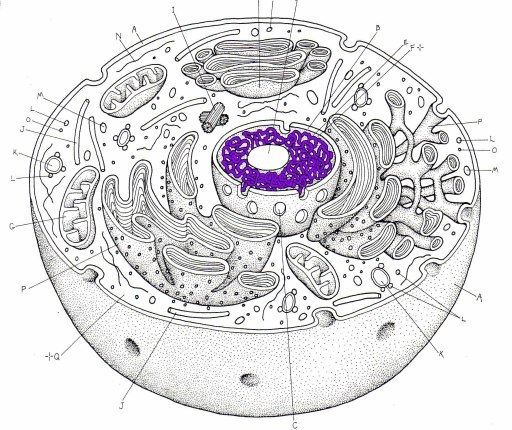
Cell Organelles You MUST Know

  • Nucleus: Control center of cell, contains DNA

  • Ribosome: synthesizes (makes) proteins

  • Chloroplast: Site of photosynthesis

  • Mitochondria: Site of cellular respiration-Breaks down nutrients to release energy in the form of ATP

  • Cell membrane: Controls what enters and exits the cell, involved in cell signaling, structure of cell

  • Vacuoles: storage

6

Multiple Choice

Which organelle uses energy from sunlight to make sugar?
1
mitochondria
2
nucleus
3
chloroplasts
4
vacuoles

7

Multiple Choice

Which organelle is responsible for releasing energy in the form of ATP?

1

mitochondria

2

nucleus

3

ribosome

4

vacuole

8

Difference between Eukaryotic and Prokaryotic Cells

  • Prokaryote=no nucleus, example: Bacteria

  • Eukaryote=true nucleus, examples: Plants, Animals, Fungi, Protists


9

Multiple Choice

Plants and animal cells are examples of ___ cells

1

prokaryotic cells

2

eukaryotic cells

10

Multiple Choice

Question image

What kind of cell is this?

1

Eukaryotic

2

Prokaryotic

11

Multiple Choice

Question image

What kind of cell is this?

1

Eukaryotic

2

Prokaryotic

12

Passive Transport

  • Does not require energy!

  • Molecules travel from a high concentration to a low concentration (with the concentration gradient)

  • Diffusion

  • Osmosis (Diffusion of water across a semipermeable membrane.)

  • Facilitated diffusion (molecules that are too big to cross the membrane alone will diffuse across the membrane using channel proteins)

13

Multiple Choice

Passive Transport means

1

Energy is used

2

No energy is used

3

Energy is created

14

Multiple Choice

If there is 5 percent water inside a cell and 5 percent water outside a cell
1
more water will move inside the cell
2
more water will move outside the cell
3
There will be no movement of water cells

15

Multiple Choice

Question image
Which way will the water molecules move during osmosis?
1
Out of the cell, so the cell shrinks.
2
Out of the cell, so the cell swells.
3
Into the cell, so the cell shrinks.
4
Into the cell, so the cell swells.

16

Multiple Choice

Question image
_______ regulates what enters and leaves a cell.  
1
Cell Membrane
2
Nucleus
3
Mitochondria
4
Cytoplasm

17

Multiple Choice

What is diffusion?

1

when molecules move from a low concentration to a high concentration

2

when molecules move from a high concentration to a low concentration.

3

no movement

4

molecules move everywhere

18

Multiple Choice

What is diffusion?

1

when molecules move from a low concentration to a high concentration

2

when molecules move from a high concentration to a low concentration.

3

no movement

4

molecules move everywhere

19

Active Transport

  • Requires energy

  • Moves molecules from a low to high concentration (against the concentration gradient)

  • Protein pumps

  • Endocytosis and exocytosis


20

Multiple Choice

Question image
Even though the concentration of salt is high in some gland cells and low in the blood, these cells can move salt out of blood and into the cells.  This is an example of
1
passive transport
2
active transport
3
diffusion
4
osmosis

21

Multiple Choice

Question image
What type of transport is this?
1
Endocytosis
2
Facilitated Diffusion
3
Active Transport Pump
4
Osmosis

22

Multiple Choice

A general term for the various types of active transport that move particles into a cell by enclosing them in a vesicle made out of plasma membrane.

1

Endocytosis

2

Exocytosis

3

Osmosis

4

Diffusion

23

Multiple Choice

Active transport across a cell membrane from low to high concentration, requires

1

energy (ATP)

2

no energy

3

water

4

oxygen

24

Multiple Choice

Active transport is the movement of large materials across a cell membrane from ______ to ______ concentration

1

high to low

2

low to high

3

high to high

4

low to low

25

Multiple Choice

What is the difference between active and passive transport?
1
Active does not need energy and passive uses ATP (energy)
2
Active uses ATP (energy) and passive does not need energy
3
Active stores transport proteins and passive releases 
4
Active uses hormones and passive does not 

26

Multiple Choice

Which type of transport requires an input of energy?

1

Passive Transport

2

Osmosis

3

Simple Diffusion

4

Active Transport

27

Multiple Choice

Which type of transport requires an input of energy?

1

Passive Transport

2

Osmosis

3

Simple Diffusion

4

Active Transport

Cells and Cell Transport Review

Please be sure to study!

Slide image

Show answer

Auto Play

Slide 1 / 27

SLIDE