

Causes of the Civil War - SS.912.A.2.1

Presentation
•
History
•
11th Grade
•
Practice Problem
•
Medium

Lindsay Jones
Used 12+ times
FREE Resource
52 Slides • 13 Questions
1
Causes of the Civil War
SS.912.A.2.1 - Review causes and consequences of the Civil War.

2
3

4

5

6

7

8
Multiple Select
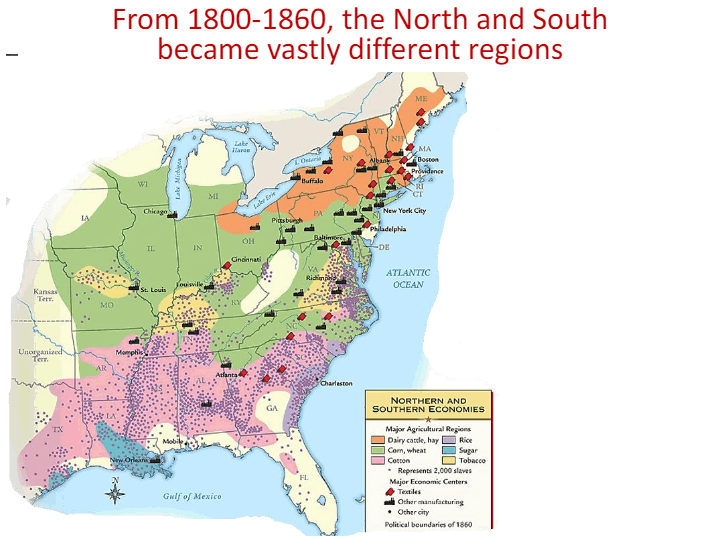
Select all of the true statements about the differences between the North and South during the antebellum (pre-civil war) period:
The South relied on the cotton industry.
The North had fewer cities.
Railroad lines were evenly established in both areas.
The North had more manufacturing and railroad lines.
The South had an economy that depended on slavery.
9

10
Multiple Choice
What is sectionalism?
The expansion of participation in local governments
The growth of polarized political parties
Having more loyalty toward one's region than one's country as a whole
The splitting of a political party into two new factions
11

12

13

14

15
Multiple Choice
At the time of the Missouri Compromise, there were 11 free states and 11 slave states. Where would the balance between free and slave states become unbalanced if Missouri was accepted as a slave state?
In the House of Representatives
In the Senate
In the Executive Branch
In the Judicial Branch
16

17
Fill in the Blanks
Southern states had little manufacturing, so they
Type answer...
18

19

20

21

22

23

24

25
Multiple Select
Select ALL of the provisions of the Compromise of 1850
The Fugitive Slave Law was created
California was admitted as a free state
Slave trade continued in Washington DC
People in new territories could vote to determine whether or not to allow slavery
26

27

28

29

30

31

32

33

34

35

36

37
Multiple Choice
Which of the following is NOT true about the abolition movement?
Harriet Beecher Stowe's novel caused many northerners to support abolition
The underground railroad caused many southerners to join the movement
The Fugitive Slave Act enraged northerners and increased support for abolition
Frederick Douglas and William Lloyd Garrison published abolitionist texts
38

39

40

41

42

43

44

45

46
Multiple Choice
Which of the following was one of the effects of the Kansas-Nebraska Act?
Kansas and Nebraska were united into one territory
Residents could vote on the issue of slavery
Banned slavery in both Kansas and Nebraska
Allowed slavery in both Kansas and Nebraska
47

48

49

50

51

52

53
Multiple Select
Select TWO effects of the Dred Scott decision:
Pro-slavery southerners were happy
Slavery was declared unconstitutional
Abolitionists were outraged
African Americans' citizenship was recognized
54

55

56

57

58

59

60
Exit Ticket
61
Multiple Choice
The greater loyalty that many Americans felt towards their region rather than the country as a whole is referred to as
sectionalism
abolitionism
racism
patriotism
62
Multiple Choice
The Missouri Compromise, the compromise of 1850, and the Kansas-Nebraska Act were all efforts to
end fighting between midwestern farmers and native American Indians
encourage manufacturing in the west
increase the number of people who voted in presidential elections
settle disputes over the spread of slavery to the western territories
63
Multiple Choice
In the 1850s, the phrase “Bleeding Kansas” was used to describe clashes between
proslavery and antislavery groups
Spanish landowners and new American settler
Chinese and Irish railroad workers
Native American Indians and white settlers
64
Multiple Choice
Which of the following contributed to an increase in support for the abolition movement?
The publication of "Uncle Tom's Cabin"
The Missouri Compromise
The Nat Turner rebellion
The passage of tariffs
65
Multiple Choice
What was the immediate cause of the secession of Southern states from the Union prior to the start of the Civil War?
election of Abraham Lincoln to the presidency
passage of the Kansas-Nebraska Act
raid on Harper's Ferry by John Brown
decision of the Supreme Court in the Dred Scott case
Causes of the Civil War
SS.912.A.2.1 - Review causes and consequences of the Civil War.
Show answer
Auto Play
Slide 1 / 65
SLIDE
Similar Resources on Wayground

61 questions
To Infinitive
Presentation
•
11th Grade
63 questions
CentLit L2: Philippine Literary Periods TOA
Presentation
•
11th Grade
65 questions
Biomolecules
Presentation
•
11th Grade
61 questions
US Involvement in WWI and Homefront
Presentation
•
11th Grade
65 questions
Pre-icfes intensivo 1
Presentation
•
11th Grade
59 questions
Env Sci ch8 -Populations Notes
Presentation
•
11th Grade
61 questions
Development of the Southern United States
Presentation
•
11th Grade
62 questions
APUSH Manifest Destiny Period 4/5 SMCQ
Presentation
•
11th - 12th Grade
Popular Resources on Wayground
10 questions
Safety Day 2026 – Student Review

Quiz
•
9th Grade
21 questions
Continents and Oceans
Quiz
•
6th Grade
20 questions
Parts of Speech
Quiz
•
5th Grade
16 questions
Subject & Predicate
Quiz
•
5th Grade
25 questions
Multiplication Facts
Quiz
•
5th Grade
12 questions
Map Skills
Quiz
•
3rd Grade
22 questions
Continents and Oceans
Quiz
•
5th Grade
15 questions
Rounding Decimals
Quiz
•
5th Grade
Discover more resources for History
15 questions
The Bill of Rights
Quiz
•
8th - 12th Grade
16 questions
Students of Civics Unit 2: The Constitution
Quiz
•
7th - 11th Grade
52 questions
Greece and Rome Review
Quiz
•
10th - 11th Grade
6 questions
Day 19 USH Do Now - US enters WWI
Quiz
•
11th Grade
21 questions
US History Unit 4 EOC Review
Quiz
•
11th Grade
50 questions
AP World Modern Unit 1: Global Tapestry
Quiz
•
10th - 12th Grade
12 questions
CE 2b Early Documents Review
Quiz
•
7th Grade - University