
Search Header Logo
Present tense irregular: tener & venir

Present tense irregular: tener & venir

Assessment

Presentation

World Languages

9th - 12th Grade

Easy

Created by

Sandra Cardenas

Used 390+ times

FREE Resource

6 Slides • 14 Questions

1
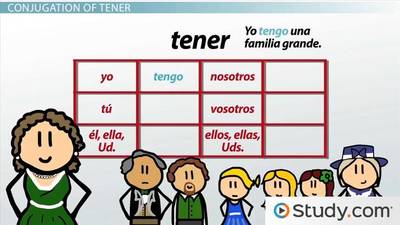
Present tense verbs: tener & venir

Irregular forms

media

2

Open Ended

Question image

Tener and venir are irregular verbs because they don't follow the present tense conjugation pattern for regular -er and -ir verbs. Let's start by reviewing their meanings. What do "tener" and "venir" mean in English?

3
media

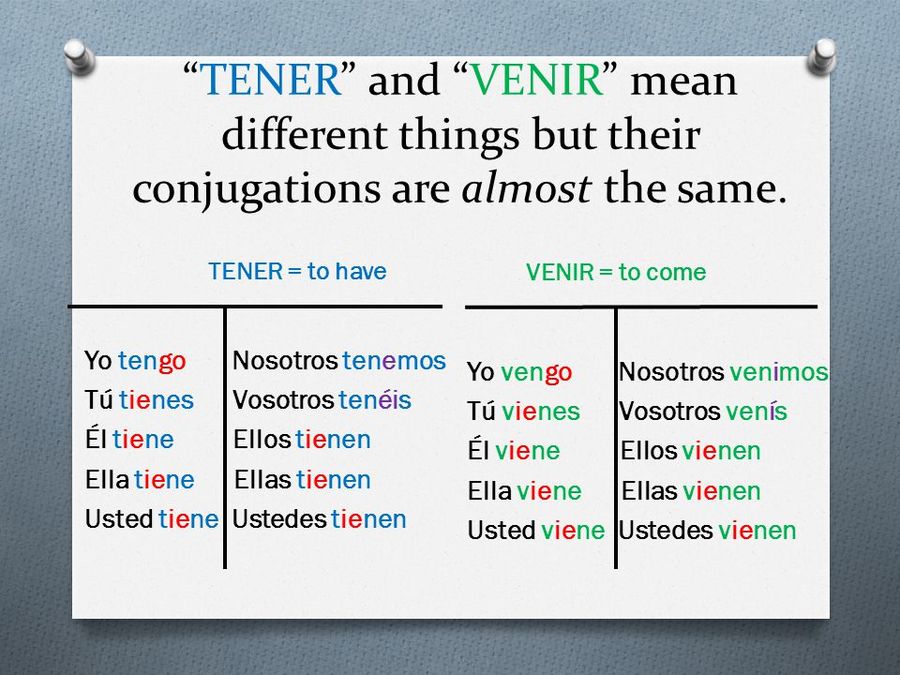
Notice that in the tú, él, ella, usted, ellos, ellas and ustedes forms, the e of the stem changes to ie. In the yo form, they add a -go ending.

4

Multiple Choice

Question image

How would you conjugate "tener" in the first person yo form to say "I have"?

1

tienes

2

tengo

3

tiene

4

tenemos

5

tenéis

5

Multiple Choice

Question image

How would you conjugate "tener" in the third person él form to say "He has red hair"?

1

tienes

2

tengo

3

tiene

4

tenemos

5

tenéis

6

Multiple Choice

Question image

How would you conjugate the verb "venir" in the nosotros form to say "We come to the family reunion?"

1

vengo

2

vienes

3

venimos

4

viene

5

vienen

7

Multiple Choice

Question image

How would you conjugate the verb "venir" in the ellas form to say "They come to school"?

1

vengo

2

vienes

3

venimos

4

viene

5

vienen

8

Poll

Question image

Responde: ¿Cuándo vienes a la clase de español?

Vengo lunes, martes y jueves.

Vengo lunes, miércoles y viernes.

Vengo todos los días (lunes a viernes)

Vengo sábado y domingo.

9

Tener + noun or adj.

  • being a certain age (tener catorce años)

  • being hot or cold (tener calor o frío)

  • being hungry or thirsty (tener hambre o sed)

  • being afraid or in a hurry (tener miedo o prisa)

  • being right or wrong (tener razón o no tener razón)

  • being sleepy or lucky (tener sueño o suerte)

media

10

Multiple Choice

Question image

¿Qué tiene el hombre?

1

Tienen calor.

2

Tiene frío.

3

Tengo hambre.

4

Tenemos sueño.

11

Multiple Choice

Question image

¿Qué tiene la niña?

1

Tenéis suerte.

2

Tengo razón.

3

Tiene sed.

4

Tienes miedo.

12

Multiple Choice

Question image

¿Qué tienen las personas impacientes?

1

Tienes miedo.

2

Tenemos cuidado.

3

Tengo siete años.

4

Tienen prisa.

13

Tener + que (to have to) expresses an obligation.

media

14

Open Ended

Question image

Traduce (Translate): Tengo que estudiar para el examen de biología.

15

Open Ended

Question image

Traduce (Translate): Mamá tiene que trabajar.

16

Tener ganas de (to feel like...)

Use this to express a desire to do something or to ask people what they feel like doing (tener ganas de + infinitive)

media

17

Multiple Choice

Question image

¿Tienes ganas de comer?

1

Do you feel like dancing?

2

Do you feel like eating?

3

Do you feel like cooking?

4

Are you cold?

18

Multiple Choice

Question image

Tengo ganas de bailar.

1

You feel like sleeping.

2

He feels like singing.

3

I feel like dancing.

4

They are in a hurry.

19

Follow these steps to express desire to do something. You still need to conjugate tener.

media

20

Open Ended

Question image

Escribe: Write a complete sentence in Spanish that expresses "I feel like reading".

Present tense verbs: tener & venir

Irregular forms

media

Show answer

Auto Play

Slide 1 / 20

SLIDE
