Search Header Logo
13.3 DNA Replication

13.3 DNA Replication

Assessment

Presentation

•

Biology

•

9th Grade

•

Practice Problem

•

Easy

•
NGSS.HS-LS3-2, NGSS.MS-PS1-1, CCSS.RI.3.5

+5

Standards-aligned

Created by

Chris Larson

Used 13+ times

FREE Resource

7 Slides • 35 Questions

1

13.3 DNA Replication

Slide image

2

Copying the Code

  • DNA is double-stranded

  • Semiconservative with replicated

  • 1 New (pink) and 1 Original (blue)

  • Just need 1 strand to get the other

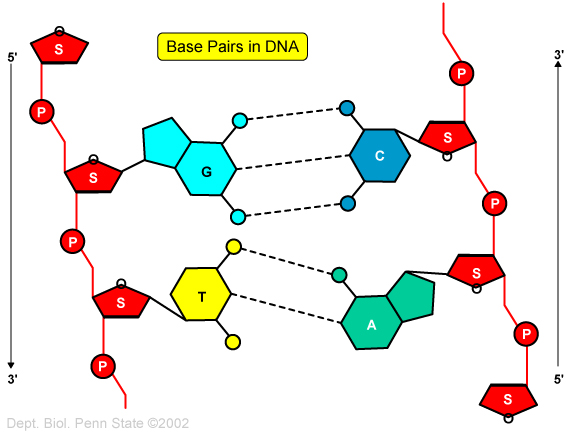
  • A always w/ T and C always w/ G

Slide image

3

Replication Enzymes

  • Helicase=Splits the Bases

  • Primase=Start point to copy

  • DNA Polyermase=Connects bases

  • Ligase=Glues lagging DNA

  • Telomerase=Adds telomeres to ends of the DNA strands

Slide image

4

Multiple Choice

What is the LAST step of the completion of DNA replication?

1

Telomeres are added to ends of DNA

2

Ligase glues Okazaki fragments

3

DNA polymerase proofreads

4

Topoisomerase relieves supercoiling

5

Multiple Choice

This enzyme synthesizes short RNA sequences to guide DNA Polymerase

1

Primers

2

DNA Primase

3

DNA Polymerase

4

Topoisomerase

6

Multiple Choice

This enzyme is responsible for creating telomeres added to the ends of DNA

1

Topoisomerase

2

Telomerase

3

DNA Helicase

4

DNA Primase

7

Multiple Choice

Why is it crucial that living things are able to replicate their DNA?
1
Each cell must have its own DNA
2
Less copies of DNA are needed when a new cell is created
3
A cell needs multiple copies of DNA
4
Only muscle cells need DNA 

8

Multiple Choice

Which enzyme seals okazaki fragments together on the lagging strand?
1
Topoisomerase
2
Helicase
3
Polymerase
4
Ligase

9

Multiple Choice

What is the purpose of DNA replication?
1
Cut the DNA 
2
Make more cells
3
Apoptosis
4
Duplicate the DNA

10

Multiple Choice

What is the shape of DNA?
1
Double helix
2
Triple helix
3
Flat, bilayer
4
Three-pronged rigid ladder

11

Multiple Choice

Question image
Nitrogenous bases are joined by which type of bond?
1
polar bonds
2
ionic bonds
3
covalent bonds
4
hydrogen bonds

12

Multiple Choice

Adenine bonds with ______________.
1
Guanine
2
Thymine
3
Cytosine
4
Adenine

13

Multiple Choice

Question image
Based on the diagram, the enzyme (represented in gray) is most likely...
1
DNA polymerase
2
DNA Ligase
3
Nuclease
4
Helicase

14

Multiple Choice

Which sequence of DNA bases would pair with this partial strand
CAT TCA CTG
1
ATG TGA CAG
2
TAC ACT GTC
3
GTA AGT GAC
4
CAT TCA CTG

15

Multiple Choice

Which enzyme is responsible for adding nucleotides?
1
Topoisomerase
2
DNA Polymerase
3
Ligase
4
Primase

16

Multiple Choice

What is the backbone of DNA made of?
1
Nitrogen bases
2
Amino acids
3
Double H
4
Sugar & Phosphate

17

Multiple Choice

This enzyme is capable of breaking Hydrogen bonds found between the bases of DNA

1

Topoisomerase

2

DNA Helicase

3

DNA Polymerase

4

Exonuclease

18

Multiple Choice

This enzyme is capable of breaking Hydrogen bonds found between the bases of DNA

1

Topoisomerase

2

DNA Helicase

3

DNA Polymerase

4

Exonuclease

19

Prokaryotic DNA Replication

  • Simple Interphase S Phase

  • One starting point

  • Copies in both directions

  • Produces 2 circular chromosomes

Slide image

20

Eukaryotic DNA Replication

  • Replicates in Interphase S phase

  • Many starting points in your 46 strands of DNA (23Mom/23Dad)

  • Copies in both directions until the entire chromosome is copied while enzymes check for errors

  • Chromosomes don't condense until Mitosis Prophase

  • Large amount of DNA=Complex

Slide image

21

Multiple Choice

Where is the DNA found in a eukaryotic cell? 
1
floating around in the cytoplasm 
2
in the nucleus 

22

Multiple Choice

DNA is found in the nucleus
1
Prokaryote
2
Eukaryote

23

Multiple Choice

DNA is a single strand and circular in shape
1
Prokaryote
2
Eukaryote

24

Multiple Choice

DNA is free floating, not in a nucleus
1
Prokaryote
2
Eukaryote

25

Multiple Choice

Question image

When in the Cell Cycle does DNA Replication occur?

1

S phase

2

M phase

3

Mitosis

4

Interphase

5

Cytokinesis

26

Multiple Choice

Question image

When in the Cell Cycle does DNA Replication occur?

1

S phase

2

M phase

3

Mitosis

4

Interphase

5

Cytokinesis

27

Multiple Choice

In rapidly dividing cells, telomerase helps to prevent genes near the ends of chromosomes from being ______ or _____during replication.

1

damaged or lost

2

copied or replicated

3

copied or lost

4

copied or damaged

28

Multiple Choice

Telomerase adds short, repeated DNA sequences to ____ as the chromosomes are replicated.

1

telomeres

2

chromeres

3

protermeres

4

eukaremeres

29

Multiple Choice

Because the ends of a DNA molecule are difficult to replicate, cells use a special enzyme, called ____, to do the job.

1

telomerase

2

colomerase

3

beoemerase

4

polymerase

30

Multiple Choice

The tips of eukaryotic chromosomes are known as ____

1

telomeres

2

solomeres

3

polymeres

4

trimeres

31

Multiple Choice

During DNA replication, the DNA molecule produces ___ new complementary strands.

1

two

2

one

3

four

4

countless

32

Multiple Choice

The principal enzyme involved in DNA replication is called _____

1

DNA polymerase

2

DNA replicator

3

DNA telomere

4

DNA solution

33

Multiple Choice

DNA replication is carried out during the S phase of the cell cycle by a series of ____

1

enzymes

2

molecules

3

pseudocells

4

polymemes

34

Multiple Choice

DNA replication is _____, which means that each DNA molecule resulting from replication has one of the two original strands and one new strand.

1

semiconservative

2

conservative

3

expansive

4

cohorting

35

Multiple Choice

During replication, each strand of the double helix of DNA serves as a ____ for the new strand.

1

template

2

cohort

3

energy source

4

axis

36

Multiple Choice

During replication, the two strands of each DNA molecule ____.

1

separate

2

join together

3

chemically change

4

physically change

37

Multiple Choice

Before a cell divides, it duplicates its DNA in a copying process called replication during the ___ phase of the cell cycle.

1

S

2

C

3

P

4

K

38

Multiple Choice

Because each strand can be used to make the other strand, the strands are said to be ______.

1

complimentary

2

supplementary

3

equal

4

twin

39

Multiple Choice

Before a cell divides, its DNA must first ____

1

be copied.

2

be joined.

3

be completed.

4

be isolated.

40

Multiple Choice

Before a cell divides, its DNA must first ____

1

be copied.

2

be joined.

3

be completed.

4

be isolated.

41

Eukaryotic Replication

  • DNA only copies in 5'-3' direction

  • Leading Strand-Continuously follows the helicase enzyme in the 5'-3' direction (longer strand)

  • Lagging Strand-Copies in the opposite direction of leading strand but still in 5'-3' direction (many short strands)

  • Okazaki Fragments-Short segments of lagging DNA

Slide image

42

Telomeres

  • Protects the ends of DNA strand

  • Short repeating segments of DNA that code for nothing meant to protect the real DNA code

  • Prevents gene loss or damage

Slide image

13.3 DNA Replication

Slide image

Show answer

Auto Play

Slide 1 / 42

SLIDE