Search Header Logo
Exponent/ Logarithm Quiz Review

Exponent/ Logarithm Quiz Review

Assessment

Presentation

Mathematics

11th - 12th Grade

Easy

CCSS
HSF-IF.C.7E, HSF-IF.C.8B, HSF.LE.B.5

+2

Standards-aligned

Created by

Mike Kool

Used 7+ times

FREE Resource

11 Slides • 11 Questions

1

Exponent/ Logarithm Quiz Review

Crash Course
Slide image

2

Basics of exponential functions.

  • General form:  y=abxy=a\cdot b^x  

  • The 'a': This is the y-intercept. If it is positive, your graph is above the x-axis. If it is negative, your graph will be below the x-axis.

  • The 'b': This determines if the graph is going to be growing or decaying. If b>1, you have exponential growth. If 0<b<1, you have exponential decay.

Slide image

3

Multiple Choice

Is the following function an example of decay or growth?

f(x) = 2(1.25)x

1

Exponential Growth

2

Exponential Decay

4

Multiple Choice

Is the following function and example of decay or growth?

f(x)=2(0.85)x

1

Exponential Decay

2

Exponential Growth

5

Multiple Choice

Identify the y-intercept (initial value) of the function f(x)=2(4)x.
1
2
2
4
3
(2)x
4
8

6

Multiple Choice

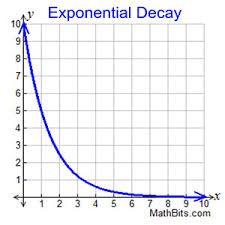
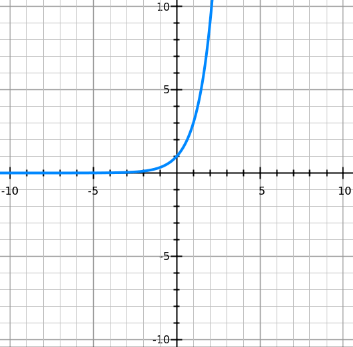
Question image
Is the pictured graph growth, decay, or linear or none?  
1
Growth
2
Decay
3
Linear
4
None

7

Multiple Choice

Question image
Is the pictured graph growth, decay, or linear or none?  
1
Growth
2
Decay
3
Linear
4
None

8

Basics of exponential functions. (continued)

  • Domain: For exponential functions, it will always be  (,)\left(-\infty,\infty\right)  !

  • Range: Look at the horizontal asymptote! In this picture it is y=0, meaning all possible y values will be  (0,)\left(0,\infty\right)  .

Slide image

9

Basics of exponential functions. (continued)

  • Asymptotes: Never vertical asymptotes. Always a horizontal asymptote. Where does the graph approach? (y=0)

  • x-intercept: Not every exponential function will have one!

  • y-intercept: when x=0, but a quick check is remember the 'a' in  y=abxy=a\cdot b^x  is the y intercept.

Slide image

10

Basics of exponential functions. (continued)

  • End behavior: Look at the graph as it approaches  -\infty   and  \infty   for its x values! 

  •  limx f(x)=0 \lim_{x\rightarrow-\infty}\ f\left(x\right)=0\   

  •  limx f(x)=\lim_{x\rightarrow\infty}\ f\left(x\right)=\infty  

Slide image

11

Multiple Choice

Question image

What is the range of this function?

1

(-∞,0)

2

(0,∞)

3

(-∞,4)

4

(4,∞)

12

Multiple Choice

Identify the y-intercept (initial value) in the function f(x)=13(.27)x
1
(.27)x
2
.27
3
13
4
3.51

13

Multiple Choice

Question image

What is the x-intercept of the exponential function?

1

(0,1)

2

(0,0)

3

There is not one

14

Transformations of Graphs

  • If you add a value to the whole function (i.e.  f(x)=2x+1f\left(x\right)=2^x+1  ) then your graph moves upward.

  • If you subtract a value to the whole function (i.e.  f(x)=2x1f\left(x\right)=2^x-1  ) then your graph moves downward.

Slide image

15

Transformations of Graphs

  • If you add a value to the exponent (i.e.  f(x)=2(x+1)f\left(x\right)=2^{\left(x+1\right)}  ) then your graph moves to the left.

  • If you subtract a value to the exponent (i.e.  f(x)=2(x1)f\left(x\right)=2^{\left(x-1\right)}  ) then your graph moves to the right.

Slide image

16

Applications

  • Growth formula:   A=P(1+r)tA=P\left(1+r\right)^t  

  • Decay Formula:   A=P(1r)tA=P\left(1-r\right)^t  

  • Compound interest (they will say explicitly 'compound' in the question with the rate at which it is compounding):   A= P(1+rn)tnA=\ P\left(1+\frac{r}{n}\right)^{tn}  

  • Continous compounding:  A=PertA=Pe^{rt}  

17

Multiple Choice

If $1,000 is invested at 16% interest, compounded continuously, for five years, what is the ending balance?
1
$1,225,54
2
$2,225.54
3
$22,255.40
4
$225.54

18

Multiple Choice

Suppose a culture of bacteria begins with 5000 cells and dies by 30% each year. Write an equation that represents this situation.
1
y=5000(0.7)x
2
y=30(5000)x
3
y=5000(1.3)x
4
y=5000xx

19

Multiple Choice

Most automobiles depreciate as they get older. Suppose an automobile that originally costs $14,000 depreciates by 20% of its value every year.

What is the value of this automobile after 5 years?

1

$264,539.52

2

$4.48

3

$4,587.52

4

$34,836.48

20

Graphing exponentials by hand.

  • ALWAYS HAS A HORIZONTAL ASYMPTOTE.

  • Diagnose the 'a' (above or below x-axis)

  • Diagnose the 'b' (growing or decaying)

  • Plug in x=0 and x=1 to find two guiding points.

Slide image

21

Graphing logarithms by hand.

  • ALWAYS HAS A VERTICAL ASYMPTOTE

  • Consider the vertical asymptote and how that will shape your graph.

  • Plug in two easy x-values like x=1 and x=2, and evaluate for the log to find the coordinate.

  • Use these coordinates as a guide for your line.

Slide image

22

Exponent/ Logarithm Quiz Review

Crash Course

Slide image

Show answer

Auto Play

Slide 1 / 22

SLIDE