
Class Activity Review - 8.PS4.3
Presentation
•
Science
•
8th Grade
•
Easy
Melody Hawkins
Used 19+ times
FREE Resource
7 Slides • 11 Questions
1
Radio Waves, Microwaves and Communication
Class Activity Review - 8.PS4.3
2
Poll
I feel prepared for the SBA.
Agree
Disagree
3
4
5
6
Multiple Choice
Satellites are located in the ionosphere just above the Earth. Based on the diagram, what type of wave do you think is transmitting signals to the satellite?
microwaves because they can only travel short distances.
radio waves because they can travel long distances.
infrared waves because they are used for electronics.
visible light waves because these are the waves we use to see.
7
Multiple Choice
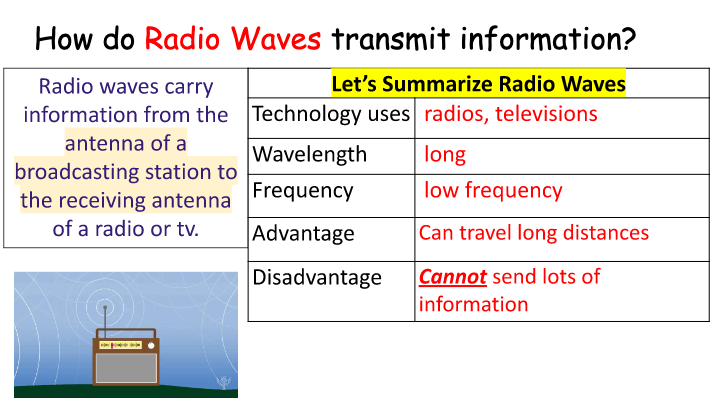
Cable television stations use radio wave signals to transmit signals to televisions.
Which of the following is advantage of using radio waves to transmit information to technology?
The radio wave signal can use rechargeable batteries.
The radio wave signal can travel long distances.
The radio wave signal can be activated in a brightly lit environment.
The radio wave signal can operate only in one component of the system.
8
Multiple Choice
Radio waves are often used to transmit information over long distance because radio waves are...
waves with small wavelengths.
waves with long wavelengths.
waves with high frequency.
waves with low amplitudes.
9
Multiple Choice
Radio waves are converted to an electrical signal to produce sound.
True
False
10
Multiple Choice
Based on the path of the signal, what type of wave is most likely used to transmit the information between Earth and the satellite? Remember: radio waves can travel long distances, microwaves travel short distances.
Microwave
Radio wave
Infrared Wave
Gamma ray
11
12
13
14
Multiple Choice
Why are microwaves better than radio waves for cellphone communication?
Microwaves have a higher frequency than radio waves and can carry more information.
Microwaves have been around on Earth for a longer time.
Microwaves are longer than radio waves.
Microwaves are controlled by the government.
15
Multiple Choice
What does radio communication, satellite communication, and cellphone communication all have in common?
They all use radio or microwaves to transmit and receive information through wave signals.
They all use radio waves only.
They all use microwaves only.
They all use the entire EM spectrum to transmit and receive information through wave signals.
16
Multiple Choice
Cellphones use microwaves to transmit information to other cellphones. What is ONE limitation of using a microwave signal?
Microwaves can travel far distances.
Microwaves must use satellites.
Microwaves cannot travel very far.
Radio waves require microwaves.
17
Multiple Choice
Satellites can use both microwaves and radio waves to transmit information?
True
False
18
Poll
I feel prepared for the SBA.
Agree
Disagree
Radio Waves, Microwaves and Communication
Class Activity Review - 8.PS4.3

Show answer
Auto Play
Slide 1 / 18
SLIDE

Similar Resources on Wayground
14 questions
8.PS.1.2-Spectral Lines-Composition of Elements in Stars
Lesson
•
8th Grade
13 questions
Organizational Patterns
Lesson
•
8th Grade
15 questions
Nonfiction Text Structures Review
Lesson
•
8th Grade
15 questions
Calculating wave energy
Lesson
•
8th Grade
10 questions
Erosion by Wind & Waves
Lesson
•
9th Grade
14 questions
8.E.1.1 Review
Lesson
•
8th Grade
15 questions
1.2.4 Nervous System
Lesson
•
8th Grade
14 questions
Measuring and Forecasting the Weather
Lesson
•
8th Grade
Popular Resources on Wayground
10 questions
5.P.1.3 Distance/Time Graphs
Quiz
•
5th Grade
10 questions
Fire Drill
Quiz
•
2nd - 5th Grade
20 questions
Equivalent Fractions
Quiz
•
3rd Grade
15 questions
Hargrett House Quiz: Community & Service
Quiz
•
5th Grade
20 questions
Main Idea and Details
Quiz
•
5th Grade
20 questions
Context Clues
Quiz
•
6th Grade
20 questions
Inferences
Quiz
•
4th Grade
15 questions
Equivalent Fractions
Quiz
•
4th Grade
Discover more resources for Science
20 questions
Recognizing Violence and Being an Upstander
Quiz
•
8th Grade
19 questions
Introduction to Properties of Waves
Lesson
•
6th - 8th Grade
16 questions
Interactions within Ecosystems
Lesson
•
6th - 8th Grade
10 questions
Exploring the Layers of the Earth
Interactive video
•
6th - 10th Grade
20 questions
Newton's Laws of Motion
Quiz
•
8th Grade
46 questions
8th Science STAAR Review
Quiz
•
8th Grade
10 questions
Exploring the Dynamics of Ocean Currents
Interactive video
•
6th - 10th Grade
23 questions
Newton's 3 Laws of Motion
Quiz
•
8th Grade