
Tracking Tropical Cyclone
Presentation
•
Science
•
8th Grade
•
Practice Problem
•
Easy
Ms. Alajid
Used 27+ times
FREE Resource
23 Slides • 29 Questions
1
Tracking of Tropical Cyclone
2
Recall
3
Multiple Choice
1. Which is better source of tropical cyclone?
a. Water vapor
b Landmasses
c. Ocean
4
Multiple Choice
2. Why do Philippines prone to typhoon?
a. Philippines is near the equator it receives direct sunlight and evaporation is faster
b. The Philippines ocean are warm which is 25.6 degrees suitable for the formation of typhoon
c. It surrounded by large bodies of water
d. The Philippines has cold ocean water suitable for the formation of typhoon
5
Multiple Choice
3.Landmasses and bodies of water affects typhoon. Which of these differentiate the characteristics of landmasses and bodies of water?
a. Landmasses have more water vapor than bodies of water.
b. Landmasses produce strong wind and heavy rain while bodies of water cannot
c. Landmasses strengthen typhoon while bodies of water disrupt the spin of a typhoon
d. Landmasses disrupt the spin of a typhoon while bodies of water strengthen typhoon.
6
Multiple Choice
4. Which of the following is the MOST probable cause why typhoons die out as it hit the landmass?
a. Its pressure remains constant
b. Its wind speed is affected by steep mountains
c. Its wind speed will be affected by the barrier trees
d. It has not enough fast rising water vapor to sustain it
7
Open Ended
1. Do you think typhoons can form in latitude away from the equator? Why or why not?
8
Study the map below. They tell us the tracks of four cyclones that enter the PAR in the past years.
9
Open Ended
Where did the tropical cyclone s form? in land or in water?
10
Open Ended
What can you say about the temperatures of bodies of water in the vicinity of the Philippines? is the water warm or cold?
11
Open Ended
In what direction did the tropical cyclones move?
12
Open Ended
Which part of the Philippines was hit by the four (4) tropical cyclones?
13
Open Ended
In the case of Agaton, Yoyong, and Huaning, where did they die out? Near land or in the middle of the ocean?
14
LEARNING OBJECTIVES
1. Trace and Plot the track of the tropical cyclone that enter the PAR using a map and tracking data
2. Understand the importance of tracking the tropical cyclone
3. Realized the effects of tropical cyclone and find ways how to lessen its effects
15
VOCABULARY WORDS
PAR- Philippine Area of the Philippines, the imaginary boundary in the pronouncement of incoming and outgoing of typhoon.
PAG-ASA-national institution dedicated to provide flood and typhoon warnings, public weather forecasts and advisories, meteorological, astronomical, climatological, and other specialized information and services primarily for the protection of life and property
Wind Speed-describes how fast the air is moving past a certain point.
Air pressure-the force exerted onto a surface by the weight of the air
16
Picture Analysis
What does the picture show?
17
Picture Analysis
What do you think is inside the tropical cyclone?
18
Picture Analysis
Explain what the picture is all about.
19
Acivity no. 1 Track the location of Tropical Storm Sendong and plot each latitude – longitude pair on the map with the PAR.
Procedure: Use the latitude and longitude (lat-long) in the table below to track the Location of Sendong. Plot each lat-long pair on the map with the PAR.
20
21
Open Ended
1. Where did tropical storm Sendong start form?
22
Open Ended
2. When did tropical storm Sendong enter the PAR?
23
Open Ended
3. When did tropical storm Sendong leave the PAR?
24
Open Ended
4. In what direction did tropical storm Sendong move?
25
Open Ended
5. Was your province hit by tropical storm Sendong?
26
27
Activity no. 2 Dissecting A Tropical Cyclone
28
What can you say about the two given illustrations?
The top one shows a tropical cyclone as seen at an angle. White rain bands move around the center or “eye”.
The bottom illustration shows a cross-section of a tropical cyclone. It is like slicing it in half and looking at it from the side.
29
Location E is within the eye of the tropical cyclone. Location F is within the clouds surrounding the eye. The clouds at F make up the eye wall. The wind speeds at the two locations are:
Location E- Wind speed (km/hr)=10
Location F- Wind speed( km/hr)= 200
Guide Question: Compare the wind speed within the eye and at the eyewall. What can you say?
30
Activity no.3 Use the latitude and longitude (lat-long) in the table below to track the location of Tropical storm “Auring”. ( DUJUAN) on Feb.20 as its latest track as monitored by PAG-ASA. Plot each lat-long pair on the map with the PAR.
31
32
33
Open Ended
What is the initial position of tropical cyclone Auring? Is it inside or outside the PAR?
34
Open Ended
Where do tropical cyclone Auring develop? Near land or in the middle of the ocean?
35
Open Ended
What are the places affected by tropical storm Auring on Feb.22, 2021
36
Open Ended
What is the direction of the tropical cyclone Auring?
37
Open Ended
According to the latest track of the tropical cyclone Auring will it affect the province of Cavite?
38
Open Ended
What precautionary measures will you do before it arrives?
39
Activity 5 Using the map of tropical storm track determine the latitude and longitude of the given storm
40
Tropical storm Sendong
41
Open Ended
Where is the Location of tropical storm Sendong on 16 Dec 2011
42
Tropical storm Pablo
43
Open Ended
Where is the Location of tropical storm Pablo on 16 Dec 2012
44
Super typhoon Yolanda
45
Open Ended
Where is the Location of super typhoon Yolanda on 18 Sept 2018
46
Assessment
47
Multiple Choice
Which statement is INCORRECT about tracking the typhoon?
A. Predicting the path as to where a typhoon will take its course.
B. It involves using a single weather instrument to predict its strength and movement.
C. It involves determining the position and strength of high-and-low pressure areas.
D. It involves predicting the movements of typhoons within 5 to 7 days, and in 6 to 12 hours whenever there is a storm.
48
Multiple Choice
Which best explains why the air in the surroundings moves towards the eye during the formation of typhoons?
A. Typhoons have no air pressure in the middle thus, pulling the air towards it.
B. Typhoons have normal air pressure in the middle thus, pulling the air towards it.
C. Typhoons have lower air pressure in the middle thus, pulling the air towards it.
D. Typhoons have higher air pressure in the middle thus, pulling the air towards it.
49
Multiple Choice
How often PAGASA monitors the weather and predicts typhoon movement in the Philippines?
A. daily
B. monthly
C. Yearly
D. Quarterly
50
Multiple Choice
Which part of the typhoon is a quiet, calm area at the center of it.
A. Eye
B. Eyewall
C. Rain band
D. outer rain band
51
Open Ended
As a student who has a concern on climate change and global warming. what should you do to lessen or minimize the effects of tropical cyclone?
52
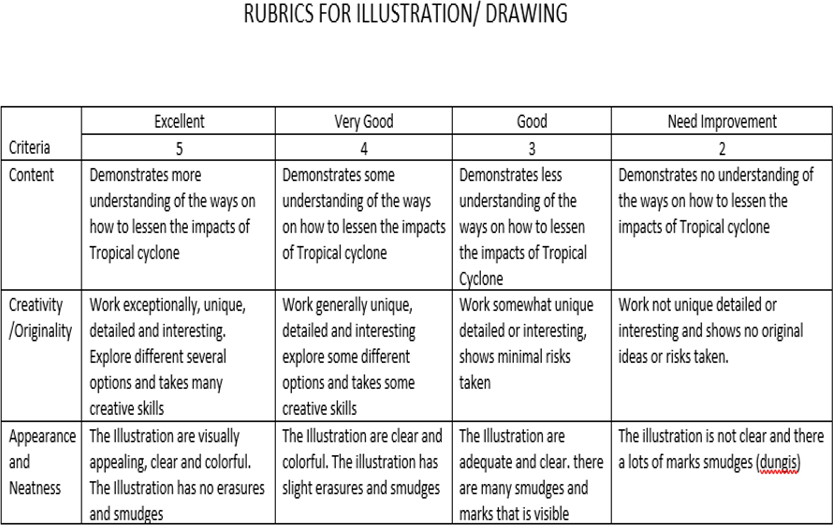
Rubrics for Illustration/Drawing
Illustrate or draw ways on how to lessen the impacts or effects of tropical cyclones. Submit your output at my deped gmail account. On or before Feb.26, 2021
Tracking of Tropical Cyclone
Show answer
Auto Play
Slide 1 / 52
SLIDE

Similar Resources on Wayground
48 questions
Renewable and Nonrenewable Energy Sources
Presentation
•
8th Grade
44 questions
Interaction of Light Waves
Presentation
•
8th Grade
45 questions
PMA 1 Review: 8th Grade
Presentation
•
8th Grade
47 questions
Sistem Pencernaan Pada Manusia
Presentation
•
8th Grade
47 questions
EMS- 5.1 Sun's Intensity
Presentation
•
8th Grade
44 questions
Unit 4 Waves Test Review
Presentation
•
7th Grade
46 questions
The Periodic Table and Elements
Presentation
•
8th Grade
47 questions
LT 5 HR Diagram Synchronous
Presentation
•
8th Grade
Popular Resources on Wayground
15 questions
Grade 3 Simulation Assessment 1
Quiz
•
3rd Grade
22 questions
HCS Grade 4 Simulation Assessment_1 2526sy
Quiz
•
4th Grade
16 questions
Grade 3 Simulation Assessment 2
Quiz
•
3rd Grade
19 questions
HCS Grade 5 Simulation Assessment_1 2526sy
Quiz
•
5th Grade
17 questions
HCS Grade 4 Simulation Assessment_2 2526sy
Quiz
•
4th Grade
20 questions
Equivalent Fractions
Quiz
•
3rd Grade
24 questions
HCS Grade 5 Simulation Assessment_2 2526sy
Quiz
•
5th Grade
20 questions
Math Review
Quiz
•
3rd Grade
Discover more resources for Science
20 questions
8th Grade Science STAAR Review
Quiz
•
8th Grade
16 questions
Interactions within Ecosystems
Presentation
•
6th - 8th Grade
20 questions
Earth Day
Quiz
•
3rd - 12th Grade
30 questions
GMAS Physical Science Review
Quiz
•
8th Grade
100 questions
GMAS Science Review
Quiz
•
8th Grade
5 questions
History of Earth Day
Passage
•
6th - 8th Grade
100 questions
STAAR Review
Quiz
•
8th Grade
10 questions
Exploring Earth's Seasons and Their Causes
Interactive video
•
6th - 8th Grade