Classification of Vertebrates

Classification of Vertebrates

Assessment

Presentation

Science

3rd - 5th Grade

Medium

NGSS
MS-LS4-2

Standards-aligned

Used 1K+ times

FREE Resource

8 Slides • 12 Questions

1

Classification of Vertebrates

Ms. Hernandez

Slide image

2

Let's Review! Vertebrates

  • Backbone

  • Skeletons inside their bodies, help them stand and move around

  • Examples: giraffe, people, Dog, shark, bird, fish

3

Let's Review! Invertebrates

  • No backbone

  • Some have:

    •Skeletons outside their body

    •Grow shells

    •No hard parts in or outside of their body

  • Examples: beetle, snail, worm

4

Multiple Choice

Question image

Marcy sees the following animal on her hike. She decides the animal must be an invertebrate. What made her decide it was an invertebrate?

1

It has a backbone

2

It has an exoskeleton

3

It has fur

4

It can use its limbs to walk

5

Multiple Choice

Scientists are classifying a group of animals in two categories: vertebrates and invertebrates. Which characteristic should they use to decide in which group to place the animals?

1

Number of limbs

2

Body covering

3

Backbone

4

The way they reproduce

6

Slide image

7

Multiple Choice

How do fish reproduce?

1

Lay eggs

2

Give birth to live young

8

Multiple Choice

What are fish covered with?

1

Smooth skin

2

wet scales

3

dry scales

4

fur

9

Slide image

10

Multiple Choice

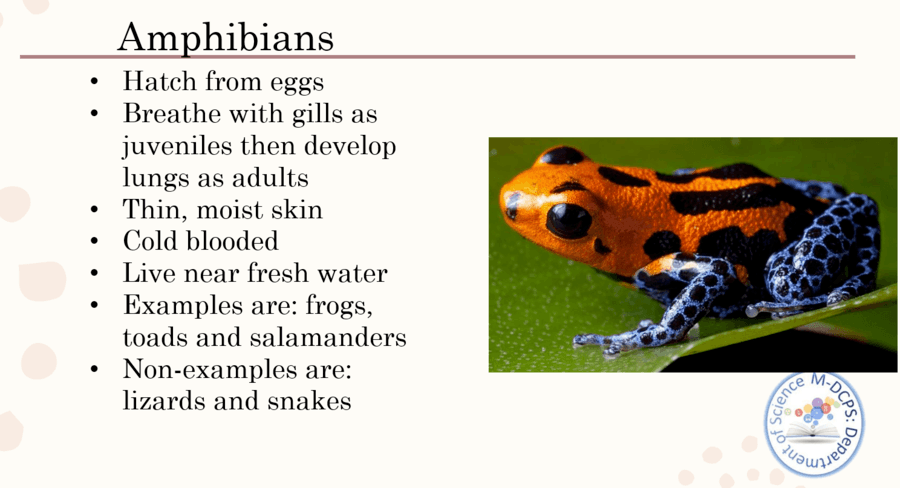
Max knows that frogs are amphibians. What characteristic of amphibians lets Max know that frogs belong to this group?

1

Frogs have a backbone

2

Frogs are mammals. Max is wrong

3

Frogs begin their lives as tadpoles breathing with gills and later develop lungs

4

Frogs give birth to live young

11

Multiple Choice

The giant salamander has a backbone, is covered in moist skin, has lungs and gills, and lays eggs. To what group of vertebrates does it belong?

1

Amphibians

2

Birds

3

Mammals

4

Fish

12

Slide image

13

Multiple Choice

The American alligator is covered in dry scales. It lays leathery eggs, near water. This animal must stay in warm regions as it is cold blooded. What group of vertebrates does the American alligator belong to?

1

Fish

2

Amphibian

3

Reptile

4

Mammal

14

Multiple Choice

Which of these animals is an example of a reptile?

1
2
3
4

15

Slide image

16

Multiple Choice

Which of the following animals is an example of a bird?

1
2
3
4

17

Multiple Choice

Carly saw an animal under a tree. The animal seemed to be hurt. She called the veterinarian clinic in her neighborhood. They asked her what kind of animal it as and she said it was a bird. Which characteristic most likely helped Carly identify the animal as a bird?

1

Feathers

2

Warm blooded

3

Lays eggs

4

Fur

18

Slide image

19

Multiple Choice

Because they live in the ocean, many people confuse dolphins for fish. What characteristics classify dolphins as mammals rather than fish?

1

Dolphins breathe the oxygen in the water with gills and lay eggs

2

Dolphins are cold blooded, have scales and breathe with gills

3

Dolphins are warm blooded, give live births, feed their young milk and breathe with lungs

4

Dolphins are warm blooded, lay eggs and breathe with gills

20

Multiple Choice

Question image

This picture shows an egret hunting for fish. What characteristic does this predator share with its prey?

1

They are both cold blooded

2

They both lay eggs

3

They both breathe with gills

4

They are both warm blooded

Classification of Vertebrates

Ms. Hernandez

Slide image

Show answer

Auto Play

Slide 1 / 20

SLIDE