

EMW Whis/Dan

Presentation
•
Science
•
8th Grade
•
Hard
+5
Standards-aligned

Adrian Whisnant
Used 1+ times
FREE Resource
74 Slides • 21 Questions
1
EMW Whis/Dan
2

3

4

5

6
7

8

9

10

11

12

13

14

15
Multiple Choice
What are electromagnetic waves?
They are waves that do need matter to transfer energy and can travel through space by transferring energy by vibrating through matter.
They are waves that travel from my brain to my fingers telling me to click this wrong answer!
They are waves that do not need matter to transfer energy and can travel through space by transferring energy between vibrating electric and magnetic fields.
I do not know anything about Electromagnetic waves because I am rebelling against myself and refuse to learn!
16
Multiple Choice
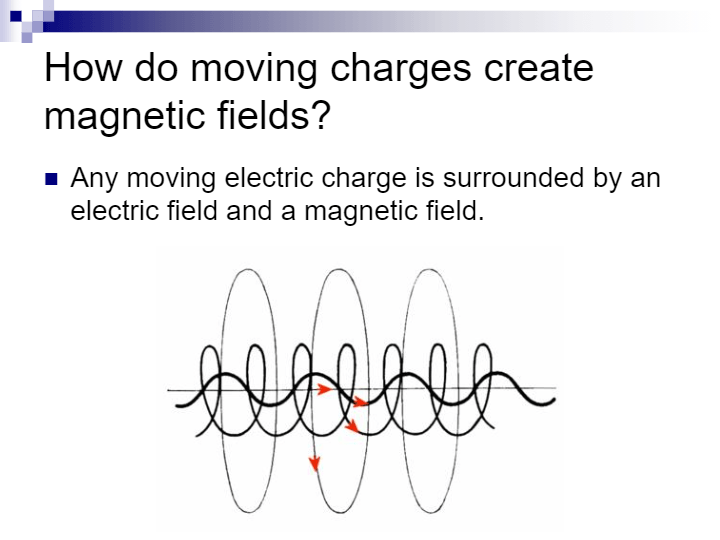
Any moving electric charge is surrounded by an electric field and a magnetic field.
I don't think so!
Yes! That is correct!
False
The are both one field!
17
Multiple Choice
What happens when electric and magnetic fields change?
A changing magnetic field creates a destroyed the electric field.
A changing magnetic field creates another new non-electric field.
A changing magnetic field creates a changing electric field.
I have no clue so I chose this one to get it wrong!
18
Multiple Choice
An EM wave travels in all directions. The electric and magnetic fields vibrate at right angles to the direction the wave travels so it is a transverse wave.
That is true!
That is totally a wrong answer!
Who knows? Not me!
What was the question?
19

20

21

22

23

24

25

26

27

28

29

30

31

32

33

34

35

36
Multiple Select
Which are true about the properties of EM Waves?
All matter contains charged particles that are always moving; therefore, all objects emit EM waves.
The wavelengths become shorter as the temperature of the material increases.
EM waves have no radiant energy.
EM waves carry radiant energy.
37
Multiple Choice
What is the speed of EM waves?
All EM waves travel
3,000,000 km/sec in space. (speed of light nature’s limit!)
All EM waves travel
3,000 km/sec in space (speed of light nature’s limit!)
All EM waves travel
300,000 km/sec in space (speed of light nature’s limit!)
All EM waves travel
30,000 km/sec in space (speed of light nature’s limit!)
38
Multiple Choice
What is the wavelength & of an EM wave?
Wavelength= distance from crest to trough.
Wavelength= distance from crest to crest.
Wavelength= number of wavelengths that pass a given point in 1 s.
The distance from the resting position to the crest!
39
Multiple Choice
What is the frequency of an EM wave?
Frequency= number of F's that I get in class on any given day in 1 s.
As F's increase, my grade becomes smaller.
Frequency= number of troughs in a wavelength x 10 = given point in 1 s. As frequency decreases, wavelength becomes smaller.
Frequency= length of wavelengths that pass a given point in 1 s.
As frequency increases, wavelength becomes larger.
Frequency= number of wavelengths that pass a given point in 1 sec. As frequency increases, wavelength becomes smaller.
40
Multiple Choice
Can a wave be a particle?
EM waves do not behave as a particle called a photon whose energy depends on the frequency of the waves.
EM waves can behave as a particle called a photon whose energy depends on the frequency of the waves.
One example of this is a transformer which transfers electric energy from one circuit to another circuit.
Yes! This is the wrong answer!
41
Multiple Choice
True or False. All matter contains charged particles that are always moving; therefore, all objects emit EM waves.
False
True
42

43

44

45

46

47

48

49

50

51

52

53

54

55

56

57

58

59

60

61

62

63

64

65

66

67

68

69

70
Multiple Choice
The whole range of EM wave Frequencies is called the electromagnetic spectrum.
Truth
False
71
Multiple Choice
Different parts of the electromagnetic spectrum interact with matter in different ways.
False
True
Maybe
72
Multiple Choice
The EM waves humans can see are called Microwaves, a small part of the whole
spectrum.
No, it is Gamma rays!
No, it is Visable light.
False, it is Radio waves!
True! I see it on my kitchen counter.
73
Multiple Choice
Radio waves are high frequency EM waves with wavelengths shorter than 1mm. These waves must be turned into sound waves by a radio before you can hear them.
Yes!
No way because they are long, low frequency waves, but they do radio to make them into sound!
74
Multiple Choice
What are microwaves?
Satellites can ID types of plants growing in a region with microwave detectors
EM with wavelengths between 1mm & 750 billionths of a meter.
Microwaves are radio waves that are low frequency EM waves with wavelengths longer than 1mm.
Microwaves are radio waves with wavelengths less than 30 cm and higher frequency & shorter wavelength.
75
Multiple Choice
What are Infrared Waves?
EM with wavelengths between 1 mm & 50 hundreths of a meter.
Used daily in remote controls, to read CD
ROMs.
EM with wavelengths between 50 mm & 750 millionths of a meter.
Used daily in cell phones to read your mind!
EM with wavelengths between 1mm & 750 billionths of a meter.
Used daily in remote controls, to read CD
ROMs.
EM with wavelengths between 1mm & 750 billionths of a meter.
Used daily in microwaves, to cook your food.
76
Multiple Choice
In order of increasing frequency and decreasing wavelength, the EM spectrum consists of:
very long, low frequency- wave infrared (heat) radiation, visible light; ultraviolet light, x rays & gamma rays wave radio, FM radio, television and radar; on the short high frequency
The short high frequency radio, FM radio, television and radar; infrared (heat) radiation, visible light; ultraviolet light, x rays & gamma rays on very long, low frequency- waves.
Very long, low frequency- wave radio, FM radio, television and radar; infrared (heat) radiation, visible light; ultraviolet light, x rays & gamma rays on the short high frequency
They are all wrong!
77
Multiple Choice
What is the name of the street corner on waves town picture?
Corner of Big, and wave
Corner of Electro AVE and Magnetic St.
Corner of Elm and Main
What picture?
78

79

80

81

82

83

84

85

86

87

88

89

90

91

92

93
Multiple Choice
How does a radio receive different
stations?
Sound waves convert to microphones to a changing electronic signal containing the base code. The modified carrier wave vibrates electrons in the station’s antennae creating a radio wave that travels out in all directions at the speed of a cheetah carrying it to your radio antennae.
Microphones convert sound waves to a changing electric current or electronic signal containing the words & music. The modified carrier wave vibrates electrons in the station’s antennae creating a radio wave that travels out in all directions at the speed of light to your radio antennae.
Microphones convert sound waves to a changing laser current or laser signal containing the words & music. The modified carrier lasers in the station’s antennae creating an infrared wave that travels out in all directions at warp speed faster than light to your radio antennae.
94
Multiple Choice
True or false cell phones use waves to communicate in the following sequence;
Cell phones > Sound waves > microphone > electric signal > radio waves > transmitted to and from microwave tower > receiver >electric signal > speaker > sound wave
True
False
95
Multiple Choice
GPS is a system of 24 satellites, ground monitoring stations and portable receivers that use waves to find what?
The signal from your TV and controls and monitors your actions in your house.
Determine you depth under the sea!
To see you in your house with infrared waves.
Your exact location on earth.
EMW Whis/Dan
Show answer
Auto Play
Slide 1 / 95
SLIDE
Similar Resources on Wayground

93 questions
REVISION FOR THE SECOND EXAMINATION - PART 1
Presentation
•
9th Grade
88 questions
Physics Waves Lesson
Presentation
•
9th - 10th Grade
79 questions
Living Things in the Biosphere
Presentation
•
9th Grade
83 questions
How to Ask Questions in English
Presentation
•
9th Grade
82 questions
Mod 6--8th Grade Intro
Presentation
•
8th Grade
82 questions
Light Waves
Presentation
•
9th Grade
89 questions
Science 8 Quarter 2 L1-B
Presentation
•
8th Grade
90 questions
Art del Romànic
Presentation
•
8th Grade
Popular Resources on Wayground
10 questions
Safety Day 2026 – Student Review

Quiz
•
9th Grade
21 questions
Continents and Oceans
Quiz
•
6th Grade
20 questions
Parts of Speech
Quiz
•
5th Grade
16 questions
Subject & Predicate
Quiz
•
5th Grade
25 questions
Multiplication Facts
Quiz
•
5th Grade
12 questions
Map Skills
Quiz
•
3rd Grade
22 questions
Continents and Oceans
Quiz
•
5th Grade
15 questions
Rounding Decimals
Quiz
•
5th Grade
Discover more resources for Science
20 questions
Newton's Laws of Motion
Quiz
•
8th Grade
15 questions
potential and kinetic energy
Quiz
•
8th Grade
21 questions
Newton's Laws of Motion
Quiz
•
8th Grade
20 questions
Elements, Compounds and Mixtures
Quiz
•
8th Grade
10 questions
Exploring Chemical and Physical Changes

Interactive video
•
6th - 10th Grade
20 questions
Physical vs Chemical Changes
Quiz
•
8th Grade
20 questions
Conduction, convection, and Radiation Practice
Quiz
•
8th Grade
21 questions
Waves and Wave Properties
Quiz
•
6th - 8th Grade