

Unit 2 Section 1 Review

Presentation
•
Social Studies
•
9th - 12th Grade
•
Practice Problem
•
Medium

Marlee McNamee
Used 3+ times
FREE Resource
6 Slides • 23 Questions
1
Unit 2 Section 1 Review

2
Absolutism in Europe

3
Multiple Choice
A standing army is one that is
available only in times of war.
permanent and available at all times.
available only after the harvests have been collected.
independent from the government.
4
Multiple Choice
Louis XIV called himself the "Sun King" because he
believed he could control the weather.
was regarded as having a warm, friendly personality.
thought that, like the sun, he was at the center of the French universe.
frequently took long vacations on the southern coast of France.
5
For the next question, you will need to read the following quotations from Catholic bishop Jacques-Bénigne Bossuet at the court of Louis XIV.
"Rulers then act as the ministers of God and as his lieutenants on earth. It is through them that God exercises his empire. . . . Consequently, as we have seen, the royal throne is not the throne of a man, but the throne of God himself."
6
Multiple Choice
What best summarizes the bishop’s point of view?
The king should leave the throne immediately.
Kings on Earth rule with God's authority.
There should be no kings at all.
Kings have greater authority than God.
7
Multiple Choice
Louis XIV is considered a perfect example of an absolute monarch because he
gave more political power to ordinary French citizens.
reigned during a period of peaceful relations with France's neighbors.
held all power in France and claimed to represent God on Earth.
left the throne and called for free elections to choose a successor.
8
Multiple Choice
Peter the Great reduced the power of the boyars by
ending all plans for conquest and territorial expansion.
introducing the Eastern Orthodox religion to Russia.
hiring European military advisers.
introducing a merit system of nobility.
9
Multiple Choice
Which was Peter the Great responsible for?
reforming Russia and making it a republic
giving power to Russia’s highest ranking noblemen
turning Russia into a modern, powerful nation
following a policy of peace with Russia’s neighbors
10
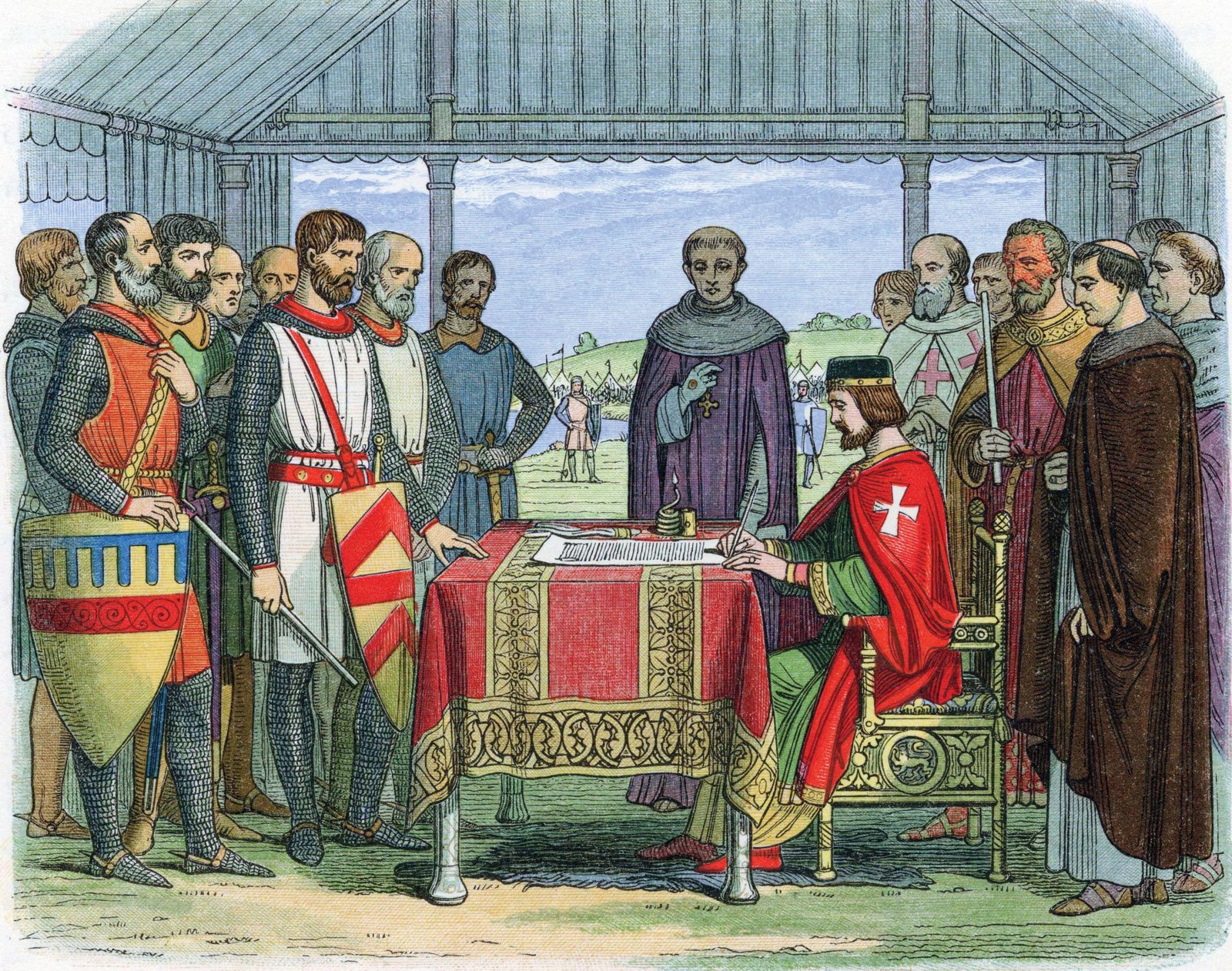
Growing Democracy in England
11
Fill in the Blanks
Type answer...
12
Multiple Select
What did the Petition of Right aim to prevent the monarch from doing? Choose three answers.
restricting freedom of religion
negotiating with foreign powers
establishing martial law in peacetime
imprisoning people without just cause
raising taxes without Parliament approval
13
Multiple Select
Which of the king’s actions prompted nobles to force the king to sign the Magna Carta? Check all that apply.
He raised taxes to pay for wars.
He took rights from the nobility.
He was tyrannical.
He restricted voting rights.
He confiscated church lands.
14
Multiple Choice
Both the Magna Carta and the Petition of Right addressed issues related to
war.
property.
taxation.
religion.
15
Multiple Choice
Which best describes the significance of free-speech rights granted to members of Parliament by the Bill of Rights?
These rights empowered Parliament to propose laws that favored nobility.
These rights gave Parliament more power to undermine the monarchy.
These rights enabled Parliament to say anything, regardless of the law.
These rights allowed Parliament to oppose the monarch’s position.
16
Multiple Choice
The Petition of Right confirmed the supremacy of law specifically over whom?
the monarch
the people
the nobles
the church
17
The Scientific Revolution

18
Multiple Choice
During the Scientific Revolution, both Copernicus and Galileo
opposed a new theory of the universe related to the motion of Earth and other planets.
opposed the study of the sun, moon, and stars because it was considered heresy.
supported a theory of the universe that contradicted the teachings of the Catholic Church.
supported the geocentric theory in opposition to the beliefs of most Christians at the time.
19
Multiple Choice
Who discovered how gravity affects objects on Earth?
Francis Bacon
René Descartes
Robert Boyle
Isaac Newton
20
Multiple Choice
Boyle’s law explains
the way to develop an idea and design an experiment.
the impact of gravity on the motion of objects on Earth.
the relationship between pressure and the volume of gas.
the elliptical orbit of Earth and other planets around the sun.
21
Multiple Choice
Which list states achievements from the Scientific Revolution in the correct order?
i. The heliocentric theory is published.
ii. Galileo argues for Copernicus.
iii. Isaac Newton develops calculus.
iv. The scientific method is invented.
i. Galileo argues for Copernicus.
ii. The heliocentric theory is published.
iii. The scientific method is invented.
iv. Isaac Newton develops calculus.
i. Galileo argues for Copernicus.
ii. Isaac Newton develops calculus.
iii. The heliocentric theory is published.
iv. The scientific method is invented.
i. The heliocentric theory is published.
ii. The scientific method is developed.
iii. Galileo argues for Copernicus.
iv. Isaac Newton develops calculus.
22
Fill in the Blanks
Type answer...
23
Multiple Choice

The image shows a diagram developed by a German astronomer in the 1600s. How did this diagram advance scientific thinking?
The diagram showed that planets move in circular orbits around the sun, disproving the Copernican model.
The diagram showed that Earth is closer to the sun than other planets, disproving the heliocentric theory.
The diagram demonstrated the first law of planetary motion, proving the heliocentric theory.
The diagram demonstrated the first law of planetary motion, proving the geocentric theory.
24
The Enlightenment

25
Multiple Choice
How did the events of the Reformation affect the Enlightenment?
People challenged cultural institutions during the Reformation, which led them to challenge educational facilities during the Enlightenment.
People challenged educational facilities during the Reformation, which led them to challenge cultural institutions during the Enlightenment.
People challenged governmental authority during the Reformation, which led them to challenge religious institutions during the Enlightenment.
People challenged religious institutions during the Reformation, which led them to challenge governmental authority during the Enlightenment.
26
Multiple Choice
Who created the concept of a social contract?
Thomas Hobbes
John Locke
Baron de Montesquieu
Jean-Jacques Rousseau
27
Multiple Choice
Which statement best characterizes the ideas of Voltaire?
People are naturally reasonable.
People are naturally selfish and violent.
Governments create unequal societies.
Government should be separate from religion.
28
Multiple Choice
How did Rousseau differ from Voltaire?
Rousseau was a French philosopher in the 1700s, while Voltaire was a French monarch in the 1600s.
Rousseau was a French monarch in the 1600s, while Voltaire was a French philosopher in the 1700s.
Rousseau argued against inequality among the classes, while Voltaire argued for freedom of speech and religion.
Rousseau argued for freedom of speech and religion, while Voltaire argued against inequality among the classes.
29
Multiple Choice
Which list states events of the Enlightenment in the correct order?
i. Locke builds on the ideas of Hobbes.
ii. The English Civil War comes to an end.
iii. Rousseau publishes The Social Contract.
iv. Montesquieu publishes Spirit of Laws.
i. Montesquieu publishes Spirit of Laws.
ii. Rousseau publishes The Social Contract.
iii. The English Civil War comes to an end.
iv. Locke builds on the ideas of Hobbes.
i. The English Civil War comes to an end.
ii. Locke builds on the ideas of Hobbes.
iii. Montesquieu publishes Spirit of Laws.
iv. Rousseau publishes The Social Contract.
i. Locke builds on the ideas of Hobbes.
ii. Montesquieu publishes Spirit of Laws.
iii. Rousseau publishes The Social Contract.
iv. The English Civil War comes to an end.
Unit 2 Section 1 Review
Show answer
Auto Play
Slide 1 / 29
SLIDE
Similar Resources on Wayground

22 questions
Population Data Lesson
Presentation
•
9th - 12th Grade
22 questions
Verbo IR (to go)
Presentation
•
9th - 12th Grade
22 questions
Effective Communication
Presentation
•
9th - 12th Grade
24 questions
Colombian exchange
Presentation
•
9th - 12th Grade
23 questions
Saving vs Investing
Presentation
•
9th - 12th Grade
21 questions
Introduction to Economic Systems
Presentation
•
8th - 12th Grade
23 questions
Buying a Home with a Mortgage
Presentation
•
9th - 12th Grade
23 questions
Trans-Atlantic Slave Trade
Presentation
•
KG
Popular Resources on Wayground
6 questions
Secondary Safety Quiz
Presentation
•
9th - 12th Grade
10 questions
Afterschool Activities & Sports

Quiz
•
6th - 8th Grade
19 questions
ROAR Week 2026
Quiz
•
9th - 12th Grade
20 questions
Lab Safety Quiz
Quiz
•
6th Grade
15 questions
Cool Tool:Chromebook
Quiz
•
6th - 8th Grade
22 questions
would you rather
Quiz
•
3rd - 11th Grade
21 questions
Continents and Oceans
Quiz
•
6th Grade
20 questions
Parts of Speech
Quiz
•
5th Grade
Discover more resources for Social Studies
36 questions
Unit 1 Topic 1 Vocab: Purpose and Types of Government
Quiz
•
10th Grade
55 questions
(I) USHC 1 Key Terms
Quiz
•
11th Grade
16 questions
Economics: Choices & Scarcity
Quiz
•
12th Grade
40 questions
Word Association Unit 1
Quiz
•
11th Grade
15 questions
Unit 1 Quiz: Foundations
Quiz
•
9th - 12th Grade
20 questions
Unit 1 Stimulus Question Practice World History
Quiz
•
10th Grade
21 questions
AgApps Obj. 1.02- FFA Ways
Presentation
•
12th Grade
20 questions
U1T1 Part 1 Quiz
Quiz
•
10th Grade