

Time Signatures

Presentation
•
Arts
•
6th Grade
•
Easy

Halie Weaving
Used 495+ times
FREE Resource
12 Slides • 8 Questions
1
Time Signatures
Today we will learn about some different time signatures.
2
Time Signature
Convention used in Western notation to specify how many beats are contained in each measure, and which note value is equivalent to a beat
Appears at the beginning of the piece, following the key signature

3
Multiple Choice
4
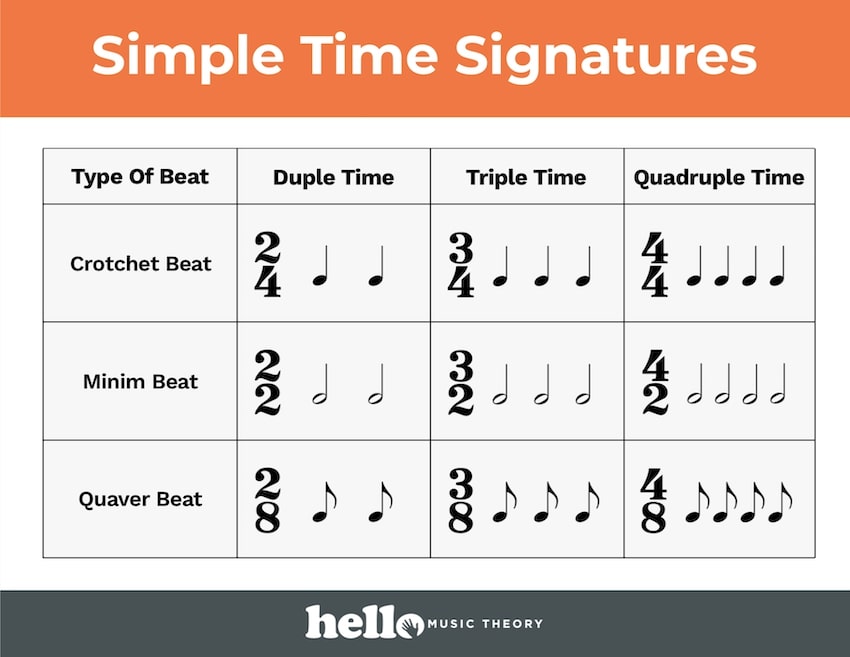
Simple
Beats can be broken down into two-part rhythms
Easiest to count
5
4/4
4 beats in a measure
Quarter note gets the beat

6
3/4
3 beats per measure
Quarter note gets the beat

7
2/4
2 beats per measure
Quarter note gets the beat

8
2/2
2 beats per measure
Half note gets the beat

9
Multiple Choice

How many beats?
10
Multiple Choice

How many beats
11
Multiple Choice

How many beats
12
Multiple Choice

What note gets the beat
13
Compound
Beat is broken down into three-part rhythms
Top number is divisible by 3

14
6/8
6 beats per measure
Eighth note gets the beat

15
9/8
9 beats per measure
Eighth note gets the beat

16
12/8
12 beats per measure
Eighth note gets the beat

17
Multiple Choice

How many beats?
18
Multiple Choice

How many beats?
19
Multiple Choice

How many beats?
20
Review
Convention used in Western notation to specify how many beats are contained in each measure, and which note value is equivalent to a beat
Appears at the beginning of the piece, following the key signature
There is Simple and Compound
Top number is the beats, bottom number is which note gets the beat

Time Signatures
Today we will learn about some different time signatures.
Show answer
Auto Play
Slide 1 / 20
SLIDE


