

Physics: Force, Acceleration, and FBD's

Presentation
•
Mathematics
•
9th - 12th Grade
•
Practice Problem
•
Medium
Standards-aligned

John Phillips
Used 12+ times
FREE Resource
11 Slides • 12 Questions
1
Physics: Force, Acceleration, and FBD's
Connecting Force, Mass, and Acceleration

2
3
Linear Relationship
If we keep force (F) constant (for example, 100N in the graph), then we can analyze the following relationship:
If mass goes up, acceleration decreases. Think about pushing a matchbox car vs pushing a full size car. Your force can still move the full size car, just much more slowly! Similarly, as mass goes down, acceleration increases. This illustrates what we call an INVERSE relationship.

4
Or think about it this way...
The 3 different slopes pertain to three different situations with different masses
Clearly, we can see the greatest mass of 3 carts (1/3m) results in the smallest acceleration values

5
More Force = More Acceleration!
For a constant mass value, if we "push harder", we accelerate faster. This is a direct, linear relationship
Examine the green point: 0.4N force creates a 0.5 m/s/s acceleration
Examine the red point: a 0.8N force creates a 1 m/s/s acceleration

6
Fill in the Blanks

Type answer...
7

8
Multiple Choice
9
Multiple Choice

If a 2kg bird is pushed by the wind with a force of 2N, how fast does the bird accelerate?
10
Multiple Choice

What is the net force?
11

43 is supposed to be a 42...the answer is correct!
12
Multiple Choice
13
Multiple Choice

What is the magnitude (size) and direction of the net force?
14
Multiple Choice
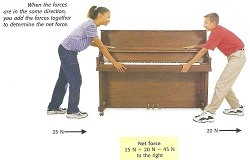
What is the net force?
15
Free Body Diagrams!
Simple representations of the situation
Draw and label forces as VECTORS to indicate magnitude and direction using arrows

16
17
Add the Force Vectors to find the NET force
Only a net force can cause acceleration (unbalanced)
When forces balance each other out, there is no net force and thus, no acceleration caused
Net force here is 40N to the left; THIS is what we would use in conjunction with the F = ma formula to determine acceleration

18
19
Fill in the Blanks

Type answer...
20
Multiple Choice

Is there a net force on this satellite?
21
Fill in the Blanks
Type answer...
22
Multiple Choice

The parachuter is FALLING. Which value for the force due to drag (D) would cause the parachuter to "fall faster"?
23
Multiple Choice
The parachuter is FALLING. Which value for the force due to drag (D) would cause the parachuter to "fall slower"?
Physics: Force, Acceleration, and FBD's
Connecting Force, Mass, and Acceleration
Show answer
Auto Play
Slide 1 / 23
SLIDE


