Newton's 3rd Law of Motion
Presentation
•
Science
•
6th Grade
•
Medium
+2
Standards-aligned
Used 6+ times
FREE Resource
3 Slides • 55 Questions
1
Newton's 3rd Law of Motion
2
3
Multiple Choice
When a small car pushes a big truck, the truck applies an equal and opposite force on the car.
False
True
4
Multiple Choice
How is this an example of Newton's 3rd Law?
Only his head is pushing on the ball
Only the ball is pushing on his head
Both the ball and the head are exerting equal force on each other
5
Multiple Choice
The Law of Conservation of Momentum states:
The total momentum before a collision is equal to the total momentum after a collision.
The total momentum before a collision is greater than the total momentum after a collision.
The total momentum before a collision is less than the total momentum after a collision.
The total momentum before a collision is not related to the total momentum after a collision.
6
Multiple Choice
7
Multiple Choice
8
Multiple Choice
Which of the 0.5kg spheres in the image experiences the greater change in velocity?
Black
White
Same
Not Enough Info
9
Multiple Choice
Which of the 0.5kg spheres in the image experiences the greater force?
Black
White
Same
Not Enough Info
10
Multiple Select
Pick all of the scenarios below that are collisions.
A catcher catches a baseball.
A pitcher throws a baseball.
Two cars smash into each other.
Two students on roller skates push away from each other.
A bug smashes into a windshield.
11
Multiple Choice
If two objects collide or explode, they experience
the same force for the same amount of time.
different forces for the same amount of time.
different forces for different amounts of time.
the same force for different amounts of time.
12
Multiple Choice
According to Newton's Laws, for every action there is an ....
equal and opposite reaction.
equal and parallel reaction.
unequal and opposite reaction.
unequal and unrelated reaction.
13
Multiple Choice
The Law of Conservation of Momentum states:
The total momentum before a collision is equal to the total momentum after a collision.
The total momentum before a collision is greater than the total momentum after a collision.
The total momentum before a collision is less than the total momentum after a collision.
The total momentum before a collision is not related to the total momentum after a collision.
14
Multiple Choice
If a person pushes down on a trampoline, why do they move back up into the air?
The trampoline pushes back with a greater force than the person
The trampoline pushes back with less force than the person
The trampoline pushes back with an equal and opposite force as the person
15
Multiple Choice
If the person is pushing backwards with the paddle, why do they move forward?
The person will actually move backwards, they need to paddle the other way
The water pushes back with an equal and opposite force
The person is pushing harder than the water
The water pushes back with a greater force than the person
16
Multiple Choice
The two paired forces in Newton's third law:
act on different objects
are equal in size
are opposite in direction
are the same type
all of the above
17
Multiple Choice
What happens to the balloon if the air is released ?
Balloon goes right
Balloon goes up
Balloon goes down
Balloon goes left
18
Multiple Choice
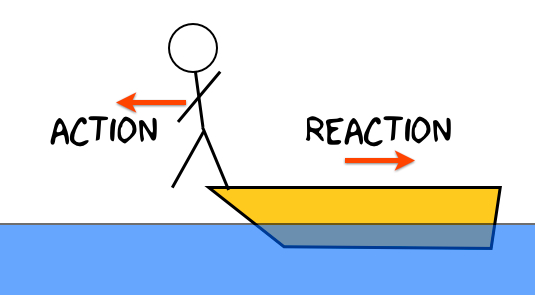
What will happen if the Action is greater than the Reaction?
The man will fall
The boat will sink
Nothing will happen
19
Multiple Choice
This picture shows .............
Newton 2nd law of motion
Newton 3rd law of motion
Newton 1st law of motion
I don't know
20
Multiple Choice
21
Multiple Choice
22
Multiple Choice
23
Multiple Choice
The forces in a force pair are in _______ direction
opposite
same
24
Multiple Choice
When a heavy football player and a light one run into each other, who exerts more force
The light one
Their force are equal
The heavy one
25
Multiple Choice
Force always come in________
waves
triplets
pairs
26
Multiple Choice
When the person pushes the ground with their foot, the equal and opposite reaction force is
the ground pushing back on their foot
when they start to move forward
27
Multiple Choice
If two people with the same mass collide, they experience the same amount of force.
True
False
28
Multiple Choice
How is this an example of Newton’s Third law?
Only the ball is using the head
They are both exerting an equal force on each other
Only the head is pushing the ball
29
Multiple Choice
Action reaction forces never cancel each other out because
They act on different objects.
They act on the same objects
They do not act on objects.
30
Multiple Choice
When a cannon fires a cannonball we observe Newton's third law. Which is the reaction force?
The cannon moving forward
The cannon moving backwards
The cannonball moving backwards
The cannonball moving forward
31
Multiple Choice
When a small car pushes a big truck, the truck applies an equal and opposite force on the car.
False
True
32
Multiple Choice
Newton’s law states that for every action, there is an ________ reaction.
unequal and opposite
equal and similar
stronger and opposite
equal and opposite
33
34
Multiple Choice
35
Multiple Choice
Which law best explains why more force must be applied to the bowling ball to make it accelerate at the same rate as the tennis ball.
Newton's 1st Law
Newton's 2nd Law
Newton's 3rd Law
36
Multiple Choice
You are carrying a lunch tray when you bump into the edge of a table. Although the tray did not tip, your milk falls off of the front of the tray.
Newton's
1st
Law of Motion
Newton's
2nd
Law of Motion
Newton's
3rd
Law of Motion
37
Multiple Choice
You push against a wall and the wall is pushing back on you.
Newton's 1st Law
Newton's 2nd Law
Newton's 3rd Law
38
Multiple Choice
The harder you hit a baseball, the faster it accelerates.
Newton's 1st Law
Newton's 2nd Law
Newton's 3rd Law
39
Multiple Choice
A skater pushes another skater forward, but the one pushing moves backwards.
Newton's 1st Law
Newton's 2nd Law
Newton's 3rd Law
40
Multiple Choice
When the force on a car is doubled, the acceleration is doubled.
Newton's 1st Law
Newton's 2nd Law
Newton's 3rd Law
41
Multiple Choice
42
Multiple Choice
43
Multiple Choice
44
Multiple Choice
45
Multiple Choice
46
Multiple Choice
47
Multiple Choice
48
Multiple Choice
49
Multiple Choice
50
Multiple Choice
51
Multiple Choice
52
Multiple Choice
53
Multiple Choice
54
Multiple Choice
55
Multiple Choice
56
Multiple Choice
57
Multiple Choice
58
Multiple Choice
Newton's 3rd Law of Motion
Show answer
Auto Play
Slide 1 / 58
SLIDE

Similar Resources on Wayground
49 questions
Egyptian Mummification
Lesson
•
6th Grade
50 questions
Classification of Organisms
Lesson
•
6th Grade
52 questions
Ecology & Ecosystems
Lesson
•
6th Grade
53 questions
Density Review
Lesson
•
6th Grade
51 questions
Motivation science presentation
Lesson
•
KG
51 questions
Unit2:Cell Specialization
Lesson
•
6th Grade
51 questions
Rock and Minerals
Lesson
•
6th Grade
55 questions
Classification of Matter
Lesson
•
6th - 7th Grade
Popular Resources on Wayground
8 questions
Spartan Way - Classroom Responsible
Quiz
•
9th - 12th Grade
15 questions
Fractions on a Number Line
Quiz
•
3rd Grade
14 questions
Boundaries & Healthy Relationships
Lesson
•
6th - 8th Grade
20 questions
Equivalent Fractions
Quiz
•
3rd Grade
3 questions
Integrity and Your Health
Lesson
•
6th - 8th Grade
25 questions
Multiplication Facts
Quiz
•
5th Grade
9 questions
FOREST Perception
Lesson
•
KG
20 questions
Main Idea and Details
Quiz
•
5th Grade
Discover more resources for Science
20 questions
Rocks and The Rock Cycle
Quiz
•
6th Grade
20 questions
Waves and Wave Properties
Quiz
•
6th - 8th Grade
10 questions
Exploring the Rock Cycle: Types and Formation
Interactive video
•
6th - 8th Grade
15 questions
Punnett Squares
Quiz
•
6th Grade
20 questions
Phases of the Moon
Quiz
•
6th Grade
9 questions
Seasons and Earth's Tilt
Lesson
•
6th - 8th Grade
10 questions
Exploring the Evolution of the Peppered Moth
Interactive video
•
6th - 10th Grade
26 questions
Amplify Chemical Reactions
Quiz
•
6th - 8th Grade