Exponential and Logarithmic Graphs
Presentation
•
Mathematics
•
11th Grade
•
Medium
+11
Standards-aligned
Jim Cross
Used 34+ times
FREE Resource
24 Slides • 51 Questions
1
Exponential and Logarithmic Graphs

2
Growth:
Always Increasing as
x's go up
Heading towards HA as x's go down
3
Decay:
Always decreasing, heading to HA
as x's go up
as x's go down
going to
infinity
4
Multiple Choice
Classify the following graph.
Exponential Growth
Exponential Decay
Logarithmic
5
Multiple Choice
6
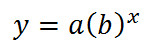
b is the multiplier , when b is bigger than 1 we have exponential growth.
If b is between 0 and 1, then we have exponential decay
or y intercept
or y intercept
y is the ending amount
7
Multiple Choice
What is y intercept, the initial amount,
for the function:
f(x) = 300(1.16)x?
8
Multiple Choice
What type of function is
y = 7(5/4)x?
9
Multiple Choice
A=1200(.85)6
10
Multiple Choice
What type of function is
f(x)=2(1/7)x ?
11
Multiple Choice
In an exponential function,
what does the 'a' represent?
ENDING AMOUNT
MULTIPLIER
12
13
Multiple Choice
y=4x+5
What is the transformation from
y=4x ?
Left 5
Right 5
Up 5
Down 5
14
Multiple Choice
y=4x−3
What is the transformation from
y=4x ?
Left 3
Right 3
Up 3
Down 3
15
Multiple Choice
y=4x+3−3
What is the transformation from
y=4x ?
Left 3
down 3
Right 3
down 3
Right 3
Up 3
Left 3
Up 3
16
Multiple Choice
y=−4x
What is the transformation from
y=4x ?
reflected over
x axis
reflected over
y axis
Right 4
Down 4
17
18
Multiple Choice
What is the Horizontal Asymptote
of
y = 2x
y = 0
y = −3
x = 0
x = −3
19
Multiple Choice
What is the asymptote of y = 2x - 3
y = 0
y = -3
x = 0
x = -3
20
Multiple Choice
What is the Horizontal Asymptote
of y = 2x +3
y = 0
y = 3
x = 0
x = 3
21
Multiple Choice
Where would the asymptote be for this graph?
f(x)=2x+3−4
y = 4
y = −4
x = 3
x = −3
22
The y intercept is where x = 0.
Given an exponential function, set the
x = 0 to find the
y intercept
23
Multiple Choice
What is the y intercept of
y = 2x
(2 , 0)
(0 , 2)
(0 , 1)
(1 , 0)
24
Multiple Choice
What is the y intercept of
y = 2x − 3
(−2, 0)
(0, −3)
(0, −2)
(−3, 0)
25
Multiple Choice
Find the y intercept for this graph
f(x)=2x+3−4
(0, 4)
(0,−4)
(0, 2)
(0, 1)
26
if the x's are going up consistantly,
and the y's go up and there is a constant multiplier
y= 2(3)x
27
28
Multiple Choice
Given the following table of values, construct the function that represents the sequence.
y = 3(4)x
y = 3x + 4
y = 4(3)x
y = 4x + 3
29
Multiple Choice
Write a function represented by this table?
f(x) = 36(3)x
f(x) = 108(3)x
f(x) = 36(2)x
f(x) = 108(2)x
30
Multiple Choice
31
Multiple Choice
Write the function that best models the table?
y = (1/4)x
y = 4x
y = 4x
y = 64(1/4)x
32
To solve any equation in Desmos:
Enter each side of the equal sign as y = on a separate line.
Find the point of intersection.
You may have to zoom out several times.
The x of the intersection point is the solutions
33
Multiple Choice
34
Multiple Choice
7n+10- 8 = 6
round to 3 places
35
36
37
38
Multiple Choice
Rewrite 34 = 81 in
logarithmic form.
log34 = 81
log813 = 4
log381 = 4
log481 = 3
39
Multiple Choice
Rewrite in Logarithmic notation
3x=27
log327=x
ln27=x
log273=x
logx(3)=27
40
41
Multiple Choice
Rewrite log28 = 3
in exponential form.
28 = 3
23 = 8
32 = 8
83 = 2
42
Multiple Choice
Rewrite log381 = 4
in exponential form.
43 = 81
34 = 81
814 = 3
3(8)x = 81
43
Exponential graphs always have a horizontal asymptote.
Logarithmic graphs always have a vertical asympote
In this case the vertical asymptote is x = 0
If there is no number added or subtracted from the x, the vertical aysmptote will be x = 0
44
Exponential graphs always have a horizontal asymptote.
Logarithmic graphs always have a vertical asympote
Notice how the orange graph
f(x) = log2(x) has a vertical aysmptote of x = 0
While the blue graph
f(x) = log2 (x + 1)
has shifter left 1, so the VA is x = -1
45
Multiple Choice
Which of the following has a vertical asymptote at x=4
Hint: exponential functions have horizonal aysmptotes
y=2x−4
y=log2(x−4)
y=log2(x+4)
46
47
Multiple Choice
Logarithmic functions are the inverse of...
Linear Functions
Exponential Functions
Quadratic Functions
Polynomial Functions
48
If it is a multiple choice question, you can also use Desmos to determine the inverse.
49
Multiple Choice
Find the inverse of the function:
f(x) = 103x
f-1(x) = log(3x)
f-1(x) = 3log(x)
f-1(x) = ⅓ log(x)
50
Multiple Choice
Which is the inverse for the function?
f(x) = 22x-3
f-1(x) = log2(x) − 6
f-1(x) = log2(x) + 6
f-1(x)=½log2(x) + 3/2
51
y is the ending amount
a is the starting amount
r is the interest rate % as a decimal (divided by 100)
n is the number of times interest is applied in a year
t is the number of years
Compound Interest
This is used when interest is applied more than once a year
52
Multiple Choice
What does the n stand for in this formula?
Initial amount
Final amount
Rate
Time
The number of times compounded in 1 year
53
Multiple Choice
What does the t stand for in this formula?
Initial amount
Final amount
Rate
Time, numbet of
years
The number of times compounded per year
54
Multiple Choice
What does the a stand for in this formula?
Initial amount
Final amount
Rate
Time, numbet of
years
The number of times compounded per year
55
56
Multiple Choice
What is the formula for annual exponential growth?
f(x)=a(1−r)x
f(x)=a(1+r)x
57
Multiple Choice
What is the formula for annual exponential decay?
f(x)=a(1−r)x
f(x)=a(1+r)x
58
Multiple Choice
Exponential growth is y=a(1+r)x , and exponential decay is y=a(1−r)x .
What does "a" represent?
Initial amount
Rate of growth or decay
Time
End amount
59
Multiple Choice
Exponential growth is y=a(1+r)x , and exponential decay is y=a(1−r)x .
What does "r" represent?
Initial amount
Rate of growth or decay as a decimal
Time
End amount
60
Multiple Choice
Convert the percent to a decimal. Remember: move the decimal two places to the left!
3.5%=
.35
3.5
.035
.0035
61
Multiple Choice
Convert the percent to a decimal:
27%=
2.7
.27
270
.027
62
Multiple Choice
Convert the percent to a decimal:
9%=
.9
900
.009
.09
63
Multiple Choice
Which of the following functions shows an initial amount of
$15 and an increase of 35% each year?
64
Multiple Choice
The value of a car is $15,000 and depreciates at a
rate of 8% per year.
What is the exponential equation?
y = 15,000(1.08)x
y = 15,000(0.92)x
y = 15,000(.08)x
65
Multiple Choice
Suppose a culture of bacteria begins with 5000 cells and
dies by 30% each year.
Write an equation that represents this situation.
y = 5000(0.7)x
y = 30(5000)x
y = 5000(1.3)x
y = 5000xx
66
Multiple Choice
Write an equation that models:
Samantha's hair was known to grow very rapidly.
It began at a length of 6 in and grew at a rate of 14% a week.
y = 6(0.14)x
y = 6(1+14)x
y = 6(1.14)x
y = 6(0.86)x
67
to find the rate %
Subtract 1 from the multiplier and multiply times 100
1.25 - 1 = .25 (100) = 25%
68
to find the rate %
Subtract 1 from the multiplier and multiply times 100
.54 - 1 = -.46
-.46 (100) decrease by 46%
69
.54 - 1 = -.46
-.46 (100) decrease by 46%
1.35 - 1 = .35
.35(100) = increase by 35%
70
.54 - 1 = -.46
-.46 (100) decrease by 46%
1.35 - 1 = .35
.35(100) = increase by 35%
.67 - 1 = -.33
-.33(100) = decrease by 33%
71
Multiple Choice
Find the increase or decrease %
y = 3(0.85)x
15% increase
15% decrease
85% increase
85% decrease
72
Multiple Choice
Find the increase or decrease %
y = 3(1.25)x
25% increase
25% decrease
125% increase
125% decrease
73
Multiple Choice
When do you use this formula? Select all
used when compounded more than once a year
used when compounded continously
when given the multiplier with a word like double or triple
used when increasing or decreasing by a % rate
74
Multiple Choice
A particular type of cell triples in number every hour.
Which function can be used to find the number of cells present
at the end of h hours if there are initially 6 of these cells?
f(h) = 3(6)h
f(h) = 6xh
f(h) = 6(3)h
f(h) = 3(6h)
75
Multiple Choice
A tennis tournament begins with 128 players. At the end of round one,
there will be 64 players. There are 32 players at the end of round 2 and 16
players remaining after round 3.
Write the equation that best models this situation.
y = −64x + 128
y = 0.5x + 128
y = 128(0.5)x
y = 128(2)x
Exponential and Logarithmic Graphs

Show answer
Auto Play
Slide 1 / 75
SLIDE

Similar Resources on Wayground
69 questions
PELUANG
Presentation
•
10th - 12th Grade
68 questions
Trigonometric equations with calculator
Presentation
•
11th Grade
70 questions
Berry - Gilded Age STAAR review
Presentation
•
11th Grade
72 questions
Transformasi Geometri (Refleksi)
Presentation
•
11th Grade
69 questions
KLASIFIKASI ALAT MUSIK BARAT
Presentation
•
11th Grade
74 questions
[PSAT] 5-MONTH Revision
Presentation
•
11th Grade
68 questions
TOPIC 2 QUIZ REVIEW
Presentation
•
KG
Popular Resources on Wayground
20 questions
STAAR Review Quiz #3
Quiz
•
8th Grade
20 questions
Equivalent Fractions
Quiz
•
3rd Grade
6 questions
Marshmallow Farm Quiz
Quiz
•
2nd - 5th Grade
20 questions
Main Idea and Details
Quiz
•
5th Grade
20 questions
Context Clues
Quiz
•
6th Grade
20 questions
Inferences
Quiz
•
4th Grade
19 questions
Classifying Quadrilaterals
Quiz
•
3rd Grade
12 questions
What makes Nebraska's government unique?
Quiz
•
4th - 5th Grade
Discover more resources for Mathematics
16 questions
Circles - Equations, Central & Inscribed Angles
Quiz
•
9th - 12th Grade
35 questions
Venn Diagrams, Theoretical, & Experimental Review
Quiz
•
9th - 12th Grade
15 questions
Calculate and Classify Arc Measures
Quiz
•
9th - 12th Grade
20 questions
April 1st 2026 Transformations of Rational Functions
Quiz
•
9th - 12th Grade
6 questions
Intro to Step Functions
Quiz
•
10th - 12th Grade
11 questions
Solving Quadratic Equations by Factoring
Quiz
•
9th - 12th Grade
6 questions
Equations of Circles
Quiz
•
9th - 12th Grade
8 questions
Week 3 Memory Builder 1 (Term 3) Solving simple equations
Quiz
•
9th - 12th Grade