Search Header Logo
Force and Friction: Part 1 Review

Force and Friction: Part 1 Review

Assessment

Presentation

•

Physics

•

9th - 12th Grade

•

Medium

•
NGSS
HS-PS2-1, MS-PS2-1, HS-PS2-4

+1

Standards-aligned

Created by

John Phillips

Used 11+ times

FREE Resource

11 Slides • 18 Questions

1

Force and Friction: Part 1 Review

Reviewing concepts and problems involving free body diagrams, Newton's 2nd Law (F = ma), and friction.

Slide image

2

Types of Forces

  • Applied

  • Gravity

  • Normal

  • Friction

  • Drag

  • Tension

Slide image

3

Multiple Choice

Question image

A man pushes a box across the floor at a constant velocity. Which formula describes the vertical forces on the box?

1

 FP − Fg = 0F_P\ -\ F_g\ =\ 0 

2

Fp+Fg − Ff = 0F_p+F_g\ -\ F_f\ =\ 0

3

 Fn −10Fg = 0F_n\ -10F_g\ =\ 0 

4

 Fn−mg = 0F_n-mg\ =\ 0 

4

Multiple Choice

Question image

A man pushes a box across the floor at a constant velocity. There is a force from the man pushing on the box. This is the ...

1

force of gravity

2

normal force

3

force of friction

4

applied force

5

Multiple Choice

Question image

A man pushes a box across the floor at a constant velocity. There is a force on the box resisting its motion. This is the ...

1

force of gravity

2

normal force

3

force of friction

4

applied force

6

Multiple Choice

Question image

A man pushes a box across the floor at a constant velocity. There is a force on the box from the floor pushing the box up. This is the ...

1

force of gravity

2

normal force

3

force of friction

4

applied force

7

Multiple Choice

Question image

A man pushes a box across the floor at a constant velocity. There is a force on the box pulling it toward the center of the earth. This is called the

1

force of gravity

2

normal force

3

friction force

4

applied force

8

FBD: Free Body Diagrams

  • Analyze problem for ALL present forces

  • Balanced forces cancel out such as the case here with gravity and the normal force.

  • This results in NO vertical acceleration due to a net force of 0 N.

  • Applied and friction forces act horizontally opposed...this allows capacity for acceleration...IF there is a net force above 0 Newtons.


Slide image

9

Friction Formula

  • Friction is based on a formula using the Normal Force (N or FnF_n  )

  • The "number" associated with the strength of the friction force based on the surface is called the friction coefficient 

  • Static friction coefficient =  μs\mu_s  

  • Kinetic (moving) friction coefficient =  μk\mu_k  

Slide image

10

Multiple Choice

Question image

A man pushes a box across the floor at a constant velocity. If another box were put on top of this box, what would happen to the force of friction?

1

It would increase

2

It would decrease

3

It would remain unchanged

11

Multiple Choice

What is the unit called that measures force?

1

weight

2

meter

3

Newton

4

kilogram

12

Multiple Choice

What direction does friction act relative to motion?

1

in the same direction

2

in the opposite direction

3

need more information

4

depends on the force

13

Calculate Force due to Friction

  • You need the Normal Force

  • You need the friction coefficient

Slide image

14

Slide image

15

Multiple Choice

 What is the force of friction between a block of ice that weighs 950 N and the ground if μ = .12? 
1
65 N
2
226 N
3
175 N
4
114 N

16

Multiple Choice

What is the coefficient of static friction if it takes 44 N of force to move a box that weighs 86 N? 
1
0.78
2
0.51
3
0.78 N
4
0.58 N

17

Applied Forces vs. Friction

  • Using the given coefficient for STATIC friction, we first consider: "Is the push or pull strong enough to overcome friction?"

  • If not, the object doesn't move. We are done!

  • If it does, then we move on to using the KINETIC coefficient to determine net acceleration.

Slide image

18

Multiple Choice

Question image

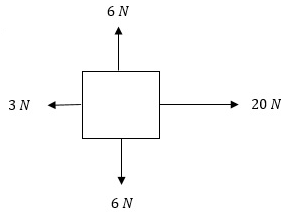
What is the NET FORCE of this diagram?

1

17 N, right

2

17 N, left

3

23 N, right

4

12 N, up

19

Multiple Choice

Question image
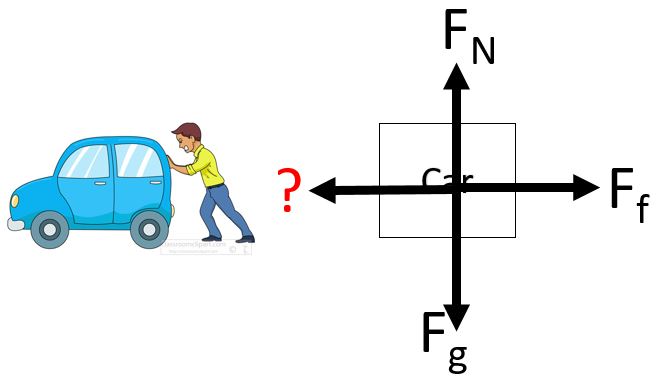
Name the missing force...
1
applied force
2
weight force
3
tension force
4
drag

20

Multiple Choice

Question image
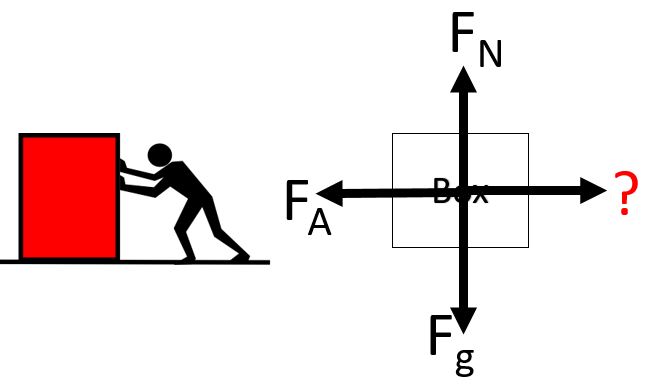
Name the missing force...
1
frictional force
2
weight force
3
thrust
4
buoyant force

21

Multiple Choice

A box slides across a floor at a constant velocity. What forces act on the box?
1
friction, gravity
2
friction, tension, gravity
3
friction, normal force, gravity
4
friction, normal force, net force

22

Sample Problem: Does it Move?

A 5 kg box sits on a floor that has a static friction coefficient of 0.45 and a kinetic coefficient of 0.32. If I push the box horizontally with a force of 20N, will it move?

23

Slide image


24

Sample Problem 2: Does it Move? How fast?

The same 5kg box in the same room with the static coefficient = 0.45 and the kinetic = 0.32 is pushed. This time, I use a 30N force. Will it move? If so, what is the net acceleration?

25

Slide image


26

Fill in the Blanks

A 10kg desk sitting a carpeted floor. Jovani wants to push it but can only apply a maximum of 80N horizontally. Based on the static friction coefficient of 0.75, determine the maximum force friction can apply.


(Round to the nearest tenth.)

Type answer...

27

Multiple Choice

A 10kg desk sitting a carpeted floor. Jovani wants to push it but can only apply a maximum of 80N horizontally. Based on the static friction coefficient of 0.75, will Jovani be able to move the desk?

1

yes

2

no

3

can't conclude yet

28

Multiple Choice

A 10kg desk sitting a carpeted floor. Jovani wants to push it but can only apply a maximum of 80N horizontally. Based on the static friction coefficient of 0.75 and a kinetic friction coefficient of 0.60, what net force is Jovani actually going to be applying to the desk as it moves?

1

80 N

2

21 N

3

6.5 N

4

25 N

5

32N

29

Multiple Choice

A 10kg desk sitting a carpeted floor. Jovani wants to push it but can only apply a maximum of 80N horizontally. Based on the static friction coefficient of 0.75 and a kinetic friction coefficient of 0.60, with what acceleration will the box move?

1

0 m/s/s

2

2.1 m/s/s

3

0.210 m/s/s

4

0.65 m/s/s

pattern-tertiary

Force and Friction: Part 1 Review

Reviewing concepts and problems involving free body diagrams, Newton's 2nd Law (F = ma), and friction.

Slide image

Show answer

Auto Play

Slide 1 / 29

SLIDE