

Lesson 9 : Section 4 Egyptian Scribes

Presentation
•
Social Studies
•
6th - 8th Grade
•
Practice Problem
•
Medium

Dave Metzger
Used 24+ times
FREE Resource
8 Slides • 6 Questions
1
Lesson 9 : Section 4 Egyptian Scribes
Let's take a look at the social status position of scribe on the Egyptian social pyramid.
2
Egyptian Scribes
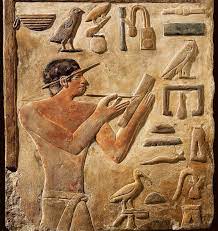
In the social pyramid, scribes, Egypt's official writers and record keepers, were one level below priests. They were highly respected and well paid. Most scribes worked for the government, while others worked for priests or nobles.
Only men were allowed to be scribes, but they came from all classes of society. Becoming a scribe was one of the few ways that men could rise above their parents' social class.
3
Multiple Choice
4
Egyptian Scribes
Boys who wanted to become scribes had to attend scribe schools run by priests. Most students came from artisan or merchant families, and very few came from the peasant class.
Starting around the age of five, students typically spent 12 years or more learning hieroglyphs, the symbols used in the Egyptian system of writing. Because this writing system was quite complicated, most students first mastered a simpler form of writing before progressing to hieroglyphs.

5
Multiple Choice
6
Egyptian Scribes
Students were required to memorize over 700 hieroglyphs. They spent as many as four years repeatedly copying the signs. They practiced their writing on pieces of wood, flakes of stone, and even broken bits of pottery. As their skills improved, students were permitted to write on papyrus, a type of paper made from the papyrus plant. Egyptians preferred writing on papyrus more than on clay tablets, which were used in Mesopotamian culture.

7
Fill in the Blanks
8
Egyptian Scribes
Students in scribe schools did not have an easy life since classes sometimes lasted from dawn until sunset. Teachers were strict and often treated their students harshly, punishing them for being lazy or distracted. Beatings were common. One stern schoolmaster wrote, “A youngster's ear is on his back; he only listens to the man who beats him. ”

9
Poll
10
Egyptian Scribes
The Work of the Scribes Ancient Egyptians kept all kinds of records, so scribes held a wide variety of jobs. They recorded accounts of the grain and food supply and even documented the results of the government census, which reported the size of Egypt's population. Some scribes calculated and collected taxes. Legal scribes recorded court cases and helped enforce laws, while military scribes kept track of the army's soldiers and food supply, and the number of enemies killed in battle.

11
Multiple Choice
12
Egyptian Scribes
Every scribe used the same tools. For pens, a scribe used finely sharpened reeds. For paper, he used a sheet of papyrus laid on a writing tablet. Made of wood or stone, each tablet contained two wells, one for black ink and one for red. A small container held water that was used to wet the ink.
A scribe carried his tools with him wherever he traveled. His tablet hung from a cord slung over his shoulder. Attached to the tablet were leather bags and cases that contained his other tools.

13
Egyptian Scribes
Additionally, scribes carried rolls of paper made from papyrus, a remarkable Egyptian invention. The Egyptians made paper by first cutting the inner part of the papyrus plant into strips. These strips were soaked in water for several days until they were soft. The soft strips were laid out in a crisscross pattern, and then pressed between two sheets of cloth until they absorbed all the water. Finally, the papyrus strips were pressed one more time to form a sheet of paper.

14
Multiple Choice
Lesson 9 : Section 4 Egyptian Scribes
Let's take a look at the social status position of scribe on the Egyptian social pyramid.
Show answer
Auto Play
Slide 1 / 14
SLIDE


