Search Header Logo
Biology 1_Unit 3_Milestone and Final Exam Review_Genetics

Biology 1_Unit 3_Milestone and Final Exam Review_Genetics

Assessment

Presentation

•

Biology

•

9th - 12th Grade

•

Hard

•
NGSS
HS-LS3-2, MS-LS3-2, HS-LS1-1

+3

Standards-aligned

Created by

Mariz Rondina

FREE Resource

10 Slides • 29 Questions

1

Biology 1_Unit 3_Milestone and Final Exam Review_Genetics

Biology 1_Unit 3_Milestone and Final Exam Review_Genetics
Slide image

2

3

Multiple Choice

Which sequence of DNA bases would pair with this partial strand

ATG TGA CAG

1

ATG TGA CAG

2

TAC ACT GTC

3

GTA AGT GAC

4

CAT TCA CTG

4

Multiple Choice

Question image

The following picture must be

1

DNA because it's double stranded

2

RNA because it's single stranded

3

DNA because it's single stranded

4

RNA because it's double stranded

5

Multiple Choice

I include the bases Guanine, Cytosine, Adenine and Uracil .

1

DNA

2

RNA

6

Multiple Choice

I include the bases Guanine, Cytosine, Adenine and Thymine.

1

DNA

2

RNA

7

8

Multiple Choice

The nucleic acid DNA is composed of

1

sugar, protein, and nitrogenous bases.

2

protein, nitrogenous bases, and phosphate.

3

nitrogenous bases, phosphate, and RNA.

4

sugar, phosphate, and nitrogenous bases.

9

Multiple Choice

Place the following in sequential order

1. Recoil

2. Straightens the double helix

3. Breaks Hydrogen bonds

4. Adds Free nucleotides

1

1, 2, 3, 4

2

3, 4, 2, 1

3

3, 2, 4, 1

4

2, 3, 4, 1

10

Multiple Choice

DNA replication results in two DNA molecules,

1

each one with two original strands

2

each one with two new strands

3

each one with one new strand and one original strand

4

one with two new strands and the other with two original strands

11

12

Multiple Choice

Which of the following is an example of a beneficial mutation?

1

When an organism's lifespan becomes shorter.

2

When an organism becomes unable to reproduce.

3

When an organism's body becomes deformed.

4

When an organism develops immunity to a disease.

13

Multiple Choice

Question image

A permanent change in the DNA sequence

which can affect a single gene or group of genes

1

Homeostasis

2

Somatic Cell

3

Chromosomal Mutation

4

Gene Mutation

14

Multiple Choice

Question image

A permanent change in the DNA sequence

which can affect a single gene or group of genes

1

Homeostasis

2

Somatic Cell

3

Chromosomal Mutation

4

Gene Mutation

15

16

Multiple Choice

Nondisjunction

1

When a segment of a chromosome breaks off.

2

When a segment of a chromosome breaks off, flips, and reattaches.

3

When a segment of a chromosome is copied or doubles.

4

When a segment of a chromosome breaks and attaches to a non homologous chromosome.

5

When entire chromosomes don't separate evenly during meiosis.

17

Multiple Choice

When can a mutation be passed on to offspring?

1

only when the mutation is present during or occurs during mitosis

2

only when the mutation is present during or occurs during meiosis

3

when the mutation occurs during mitosis or meiosis

4

when the mutation occurs in somatic cells

18

Multiple Choice

Question image

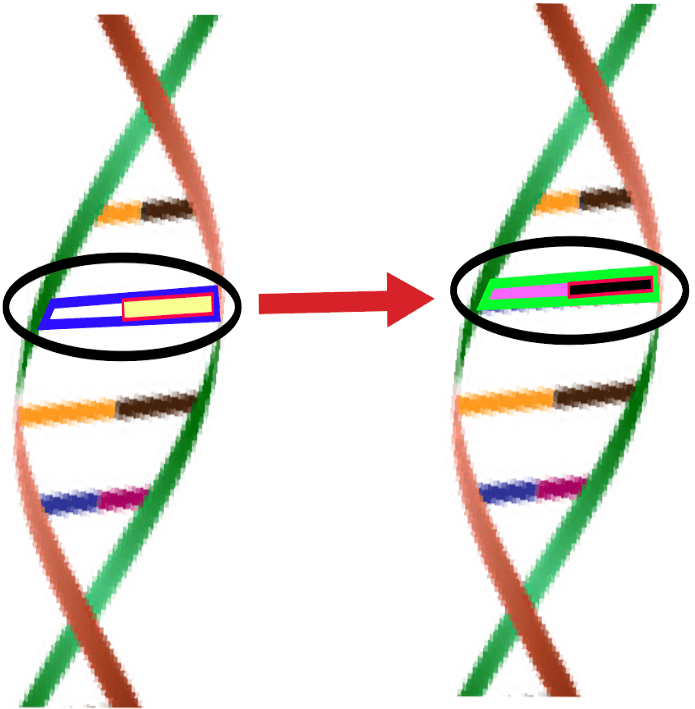
Identify the mutation in the picture.

1

Inversion

2

Duplication

3

Deletion

4

Translocation

19

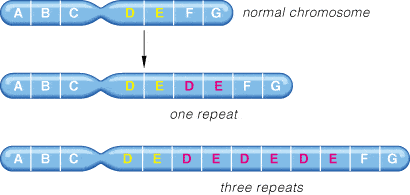
Multiple Choice

Question image

Identify the mutation in the picture.

1

Inversion

2

Duplication

3

Deletion

4

Translocation

20

21

Multiple Choice

What causes mutations?

1

Mistakes in replication or environmental substances

2

The amino acids

3

Passed down by genetics

4

It's how your born

22

Multiple Choice

What causes mutations?

1

Mistakes in replication or environmental substances

2

The amino acids

3

Passed down by genetics

4

It's how your born

23

24

Multiple Choice

What is the effect of crossing over and independent assortment during meiosis?

1

increased genetic diversity of gametes

2

decreased genetic diversity of gametes

3

increased number of daughter cells

4

decreased number of daughter cells

25

Multiple Choice

Question image

During meiosis, nonsister chromatids of a homolgous pair exchange DNA. This is called _____________.

1

crossing over

2

trading places

3

criss cross apple sauce

4

breaking places

26

Multiple Choice

Question image

During meiosis, nonsister chromatids of a homolgous pair exchange DNA. This is called _____________.

1

crossing over

2

trading places

3

criss cross apple sauce

4

breaking places

27

28

Multiple Choice

Question image

In cacti, long arms (A) are dominant to short arms (a). Suppose 2 heterozygous cacti are crossed. What percentage of their offspring are expected to have short arms?

1

0%

2

25%

3

75%

4

100%

29

Multiple Choice

Question image

In cacti, long arms (A) are dominant to short arms (a). Suppose 2 heterozygous cacti are crossed. What percentage of their offspring are expected to have short arms?

1

0%

2

25%

3

75%

4

100%

30

31

Multiple Choice

Question image

This type of inheritance pattern shows BOTH traits in possible offspring

1

co-dominance

2

incomplete dominance

32

Multiple Choice

In cattle red coats are represented as RR, and white coats are represented as WW.


What is the genotype for Roan color?

1

RR

2

RW

3

WW

33

Multiple Choice

When one allele is not dominant over another, resulting in a blended phenotype for heterozygous offspring is considered....

1

Incomplete Dominance

2

Codominance

34

Multiple Choice

When one allele is not dominant over another, resulting in a blended phenotype for heterozygous offspring is considered....

1

Incomplete Dominance

2

Codominance

35

36

Multiple Choice

Very little genetic variation among offspring. Can result in extinction of species if the environment changes

1

advantages of asexual reproduction

2

advantages of sexual reproduction

3

disadvantages of asexual reproduction

37

Multiple Choice

Which of the following describes the main advantages of sexual reproduction?

1

requires lots of time/energy

2

no new gene combos can arise

3

diversity

4

looks identical to the parent

38

Multiple Choice

Where does an off spring get its traits in asexual reproduction?

1

From both parents

2

From only one parent

3

From neither parent

4

There are no traits handed down

39

Multiple Choice

Where does an off spring get its traits in asexual reproduction?

1

From both parents

2

From only one parent

3

From neither parent

4

There are no traits handed down

Biology 1_Unit 3_Milestone and Final Exam Review_Genetics

Biology 1_Unit 3_Milestone and Final Exam Review_Genetics

Slide image

Show answer

Auto Play

Slide 1 / 39

SLIDE