
Reporting Category 3 Earth and Space

Presentation
•
Science
•
8th Grade
•
Practice Problem
•
Medium
+4
Standards-aligned

Naomi Garcia
Used 18+ times
FREE Resource
10 Slides • 21 Questions
1
Reporting Category 3 Earth and Space
TEKS 8.7A, 8.7B, 8.7C, 6.11B, 8.8A, 8.8B. 8.8D
2
Rotation of Earth
The Earth rotates once every 24 hours or 1 day.
The rotation of the Earth causes day and night since the side facing the sun is always moving.
The rotation of the the Earth DOES NOT cause seasonal changes.

3
Multiple Choice
4
Multiple Choice
5
Multiple Choice
6
Revolution of Earth
It takes just over 365 days or one year for the Earth to complete one revolution around the Sun.
However because of its tilt, the Sun's rays hit the Northern Hemisphere longer and more directly in the Summer then in the Winter. When it's Summer in the Northern Hemisphere, it is Winter in the Southern Hemisphere.
The revolution of the Earth DOES NOT casues day and night

7
Multiple Choice
8
Multiple Choice
9
Multiple Choice
10
Multiple Choice
11
Phases of the Moon
The Moon revolves around the Earth once every month(29.5days).
There are 8 Lunar phases.
New Moon to 1st Quarter=7 days
New Moon to Full Moon= 14 days
New Moon to 3rd Quarter=21 days.
From New Moon to Full Moon the light is coming from the RIGHT (WAXING ON)
Full Moon to New Moon the light is coming from the Left (WANING OFF)

12
Multiple Choice
13
Multiple Choice
14
Multiple Choice

15
Multiple Choice

16
Gravity
Gravity is the force that holds the solar system together.
The mass ( and thus gravity) of the Sun keeps all the planets orbiting around it.
The mass ( and the gravity) of the Earth keeps the Moon orbiting around it.
Mass=Gravity

17
Multiple Choice
18
Tidal Forces-Moon and Sun
The Moon has the GREATEST affect on the Earth's tides because it is closer to the Earth.
When the Moon, Sun, and Earth are aligned (New and Full Moon), the tides are the greatest (Spring Tide=Straight Line) high High Tides , low Low tides
When the Moon, Sun ,and Earth are right(90%) angles , the tides are weak (1st & 3rd Quarter) low High tides, and high Low tides (Neap Tide=Ninety)

19
Multiple Choice

20
Multiple Choice
21
Multiple Choice

22
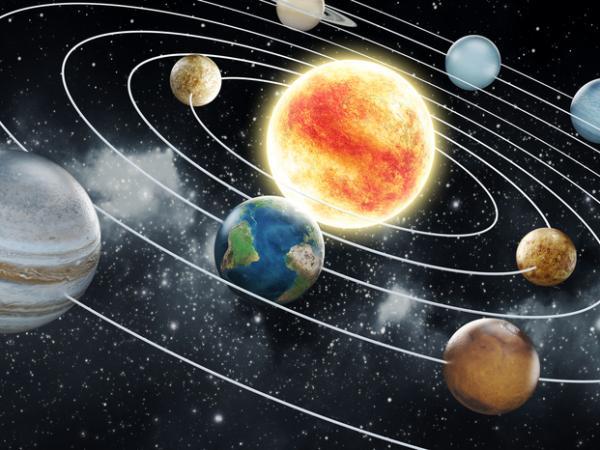
Solar System
Our solar system is extremely tiny compared to the Milky Way Galaxy

23
Multiple Choice
24
A Star is Born
1. Nebula: Cloud of gas and dust "Star Nursery"
2. Protostar: a baby star
3. Main Sequence: Largest part of the Star life cycle. (4-7 less mass)
4. Red Giant: all fuel used us the beginning of the END.
5. Planetary Nebula: release outer layer.
6. White Dwarf: last light before eternal darkness
7. Black dawrf: No Light
4a. Red Super Giant: Largest star in Universe (4a-7a High Mass)
5a. Supernova: expands and increase brightness.
6a. Neutron Star: High density
7a. Black Hole: Nothing comes out "Star Eater"

25
H-R Diagram
Shows us how stars change over time.
Classifies on 2 characteristics:
1. Temperature of Star
Red (Hot)------> Blue(Cool)
2. Luminosity (Brightness)

26
Multiple Choice
27
Multiple Choice

28
Multiple Choice
29
Galaxies
is a cluster of stars, gas, and dust held together by gravity.
Our galaxy, the Milky Way Galaxy (Spiral) is made up of BILLIONS of stars.
There are BILLIONS of galaxies in the universe.
Types of galaxies include:
1. Irregular: no defines shape-lot of gas and dust
2. Spiral: Pinwheel shaped with arms that spiral
3. Elliptical: Round or Flattened
4. Barred Spiral: Look like a "S"

30
Multiple Choice

31
Multiple Choice
Reporting Category 3 Earth and Space
TEKS 8.7A, 8.7B, 8.7C, 6.11B, 8.8A, 8.8B. 8.8D
Show answer
Auto Play
Slide 1 / 31
SLIDE


