Search Header Logo
Wave obj 1-2

Wave obj 1-2

Assessment

Presentation

Science, Physics

6th - 8th Grade

Medium

Created by

Su Ha

Used 1+ times

FREE Resource

14 Slides • 18 Questions

1

Wave obj 1

Properties of a wave

Slide image

2

Slide image

3

Slide image

4

Slide image

5

Multiple Choice

Question image

During a baseball game, fans in the stands create a “wave” by standing up from their chairs when the wave arrives at their location. Which sentence classifies this type of wave and its particle motion?

1

It is a transverse wave in which the particles of the wave move in a direction parallel to the wave motion.

2

It is a longitudinal wave in which the particles of the wave move in a direction perpendicular to the wave motion.

3

It is a transverse wave in which the particles of the wave move in a direction perpendicular to the wave motion.

4

It is a longitudinal wave in which the particles of the wave move in a direction parallel to the wave motion.

6

Slide image

7

Slide image

8

Multiple Choice

Question image

Which of the following best describes a longitudinal wave?

1

A disturbance that moves the medium along its line of travel.

2

A wave that is caused by regularly repeating disturbance of the medium.

3

A disturbance that moves the medium outward in all directions from a center.

4

A disturbance that moves the medium perpendicular to its line of travel.

9

Multiple Choice

Question image

The waves that are produced by a person’s voice are similar to the waves produced by an earthquake because both are...

1

caused by physical vibrations.

2

types of electromagnetic waves.

3

moved by the force of gravity.

4

of the same frequency.

10

Multiple Choice

Jon is holding a rope from one end. He is swinging it up and down steadily.


What kind of a wave is Jon making?

1

Mechanical, transverse.

2

Mechanical, longitudinal.

3

Electromagnetic, longitudinal.

4

Electromagnetic, transverse.

11

Multiple Choice

Which of the following describes a characteristic of ALL waves?

1

All waves move energy from one place to another.

2

All waves travel through a vacuum.

3

All waves cause particles to move back and forth.

4

All waves carry matter from one place to another.

12

Multiple Choice

Which of the following best describes a transverse wave?

1

A wave that is caused by regularly repeating disturbance of the medium.

2

A disturbance that moves the medium outward in all directions from a center.

3

A disturbance that moves the medium perpendicular to its line of travel.

4

A disturbance that moves the medium along its line of travel.

13

Slide image

14

Slide image

15

Multiple Choice

Question image

The image shows a mechanical wave.


Which number indicates the wavelength of this wave?

1

1

2

2

3

3

4

4

16

Multiple Choice

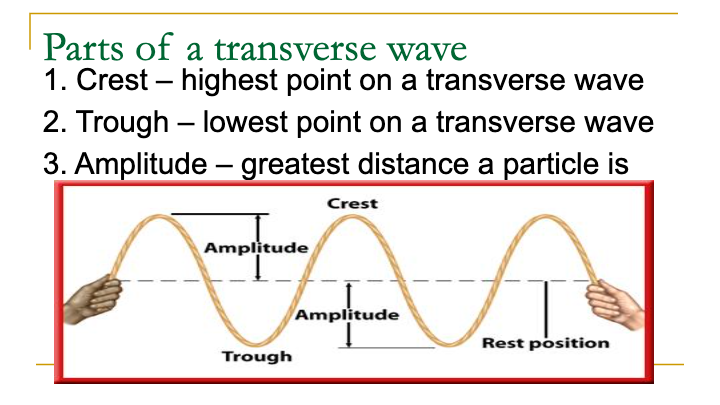
A __________ is the highest point of a transverse wave. The lowest point of such a wave is called a _________.

1

amplitude; longitudinal

2

amplitude; trough

3

crest; trough

4

crest; longitudinal

17

Multiple Choice

Question image

Which wave has the highest energy?

1

A high-amplitude, high-wavelength wave.

2

A high-amplitude, low-wavelength wave.

3

A low-amplitude, low-wavelength wave.

18

Slide image

19

Slide image

20

Multiple Choice

Seismic waves carry energy from earthquakes through the earth's crust. Seismic waves are...

1

both transverse and longitudinal waves.

2

longitudinal waves only.

3

transverse waves only.

4

neither transverse nor longitudinal waves.

21

Multiple Choice

When an earthquake occurs, the speed of the seismic waves changes as they...

1

are pulled by the force of gravity.

2

lose energy to surrounding rocks.

3

move through different materials.

4

reflect off boundaries.

22

Slide image

23

Multiple Choice

After an earthquake, the last waves to arrive at a distant location are _________.

1

P-waves

2

surface waves

3

S waves

4

sound waves

24

Multiple Choice

Which statement correctly describes the main difference between body waves and surface waves?

1

Surface waves are less damaging to man-made structures than body waves.

2

Surface waves travel across the earth’s surface, and body waves travel through the earth’s interior.

3

Surface waves only travel across oceans, and body waves travel across the earth’s crust.

4

Surface waves are only longitudinal waves, and body waves are only transverse waves.

25

Slide image

26

Multiple Choice

P-waves move fastest through the inner core of the earth.


What does this tell us?

1

The inner core is the densest part of the earth.

2

P-waves cannot move through the outer core.

3

The mantle is denser than the inner and the outer core.

4

P-waves are the fastest seismic waves.

27

Multiple Choice

P-waves slow down when entering less dense medium. P-waves slow down when entering the outer core.


What does this tell us about interior of the earth?

1

The outer core is denser than the mantle.

2

The outer core is denser than the inner core.

3

The outer core is less dense than the inner core.

4

The outer core is less dense than the mantle.

28

Slide image

29

Multiple Choice

How do scientists use data from earthquake S waves to study the earth?

1

S waves pass through liquids but not solids, so scientist can determine the location of the core.

2

S waves pass straight up from where an earthquake occurs, so scientists can identify the location of the core.

3

S waves cannot pass through solids or liquids, so scientists can determine the location of the mantle.

4

S waves pass through only solid rock, not liquid, so scientists can determine that the outer core is liquid.

30

Slide image

31

Multiple Choice

lose energy to surrounding rocks.

1

S waves move faster than P-waves.

2

P-waves can only travel through solids; S waves can travel through all mediums.

3

S waves are transverse waves, and P-waves are longitudinal waves.

4

P-waves are transverse waves, and S waves are seismic waves.

32

Poll

In your experience, does doing Quizizz help you with getting a better score from Focus Area tests?

Yes

No

Wave obj 1

Properties of a wave

Slide image

Show answer

Auto Play

Slide 1 / 32

SLIDE