

Modeling Conservation of Mass

Presentation
•
Science
•
6th - 8th Grade
•
Practice Problem
•
Medium
+2
Standards-aligned

Barbara White
Used 58+ times
FREE Resource
10 Slides • 15 Questions
1

Middle School

2
Define the law of conservation of mass and its role in chemical reactions.
Differentiate between reactants and products in a chemical equation.
Distinguish between the properties of covalent and ionic compounds.
Use coefficients to balance chemical equations to conserve atoms on both sides.


3
Key Vocabulary

Mass
A measure of how much matter is present in a given substance.
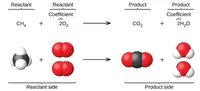
Reactant
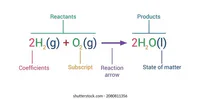
A substance that takes part in and undergoes change during a chemical reaction.
Product
A substance that is produced during a chemical reaction, written on the right side.
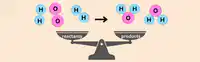
Conservation of Mass
A scientific law stating that matter is not created or destroyed in a chemical reaction.
Chemical Equation
Represents a chemical reaction using formulas and symbols to show reactants and products.
Coefficient
A number placed before a chemical formula to show the quantity and balance an equation.
4
Key Vocabulary
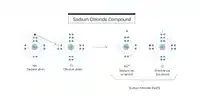
Ionic Compound
Forms when atoms are held together by the transferring of electrons, creating formula units.
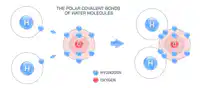
Covalent Compound
A compound formed when two or more atoms combine by sharing electrons to create molecules.
5
The Law of Conservation of Mass
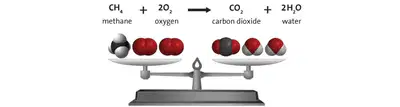
The law of conservation of mass states that matter is never created or destroyed.
The total mass of reactants must equal the total mass of the products.
In a reaction, atoms are simply rearranged to form brand new substances.
Burning wood combines with oxygen, changing into ash, CO2, and water vapor.
6
Multiple Choice
Which statement best describes the law of conservation of mass?
The total amount of mass stays the same.
The total amount of mass always decreases.
Matter is destroyed during a chemical reaction.
New matter is created during a chemical reaction.
7
Multiple Choice
In a chemical equation showing wood burning, what represents the substances that exist before the reaction occurs?
The reactants on the left side.
The products on the right side.
The water vapor produced.
The carbon dioxide produced.
8
Multiple Choice
When wood burns, it turns into ash, carbon dioxide, and water vapor. Which statement provides the best evidence that the law of conservation of mass has been followed?
The mass of the ash is equal to the original mass of the wood.
The total mass of the ash, carbon dioxide, and water vapor equals the original mass of the wood.
The mass of the wood is lost as heat and light energy.
The atoms in the wood are destroyed during the burning process.
9
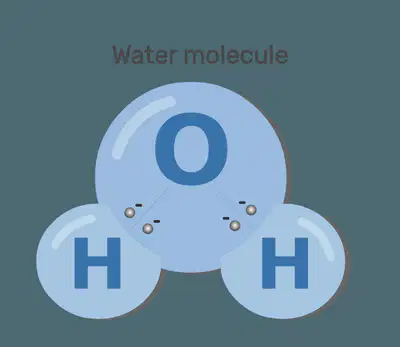
Covalent Compounds
These compounds are formed when two or more atoms share their electrons.
The smallest unit of a covalent compound is called a molecule.
Water, written as H2O, is a common example of a covalent compound.
Ionic Compounds
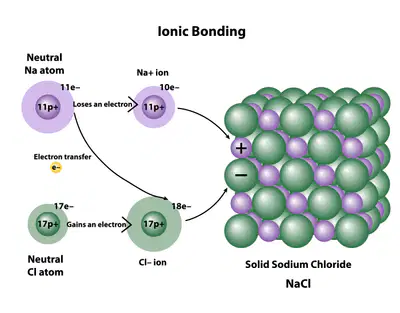
These compounds are formed when one atom transfers electrons to another atom.
Instead of molecules, these compounds form what is known as a formula unit.
A common example is table salt, which has the chemical formula NaCl.
10
Multiple Choice
What happens to electrons when a covalent compound is formed?
When two or more atoms share their electrons.
When one atom transfers electrons to another atom.
When atoms are dissolved in a liquid solution.
When atoms are broken apart into smaller pieces.
11
Multiple Choice
What is the main difference between how ionic and covalent compounds are formed?
Ionic compounds form molecules, while covalent compounds form formula units.
Ionic compounds involve transferring electrons, while covalent compounds involve sharing them.
Ionic compounds are always liquids, while covalent compounds are always solids.
Ionic compounds involve sharing electrons, while covalent compounds involve transferring them.
12
Multiple Choice
A scientist identifies that a certain compound's smallest unit is a molecule. What can be concluded about the atoms in this compound?
The atoms are transferring electrons.
The substance is a formula unit.
The atoms are sharing electrons.
The substance must be table salt.
13
Balancing Chemical Equations
A balanced equation has equal atoms on both sides.
Use coefficients in front of formulas to balance atoms.
Never change the small subscript numbers in a formula, because doing so changes the substance itself.
14
Multiple Choice
What is the main characteristic of a balanced chemical equation?
It has an equal number of each type of atom on both sides.
It has more molecules on the reactant side than the product side.
It uses coefficients and subscripts that add up to the same number.
It includes at least one solid, one liquid, and one gas.
15
Multiple Choice
How are chemical equations balanced to ensure the number of atoms is equal on both sides?
By changing the small subscript numbers within a formula.
By placing coefficients in front of chemical formulas.
By removing atoms from one side of the equation.
By adding new substances to the product side.
16
Multiple Choice
When balancing an equation, why is it incorrect to change the subscript in a formula (e.g., changing H2O to H2O2)?
Changing the subscript alters the chemical identity of the substance.
Changing the subscript only affects the number of molecules.
Subscripts can only be even numbers, never odd numbers.
Subscripts must be smaller than their corresponding coefficients.
17
Multiple Choice
Which of the following is a balanced chemical equation?
H₂ + O₂ → H₂O
2H₂ + O₂ → 2H₂O
H₂ + O₂ → H₂O
H₂ + O₂ → H₂O₃
18
Confirming Conservation of Mass
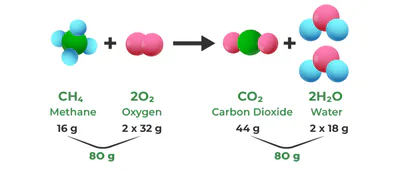
A balanced chemical equation shows that the total mass is conserved.
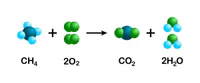
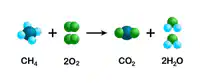
In the equation CH₄ + 2O₂ → CO₂ + 2H₂O, we can verify this.
The reactants side has a total mass of CH₄ (12 + 4) + 2O₂ (2 × 32) = 16 + 64 = 80 amu.
The products side also has a total mass of CO₂ (12 + 32) + 2H₂O (2 × 18) = 44 + 36 = 80 amu, conserving mass.
Mass is conserved because atoms are not created or destroyed during a chemical reaction.
19
Multiple Choice
What does a balanced chemical equation show about the mass of reactants and products?
The total mass of the reactants is equal to the total mass of the products.
The reactants always have more mass than the products.
The products always have more mass than the reactants.
The mass of reactants and products can change randomly.
20
Multiple Choice
How does the equation CH₄ + 2O₂ → CO₂ + 2H₂O demonstrate the conservation of mass?
The hydrogen atoms change into oxygen atoms
The total mass of reactants equals the total mass of products
It demonstrates that there are more molecules of reactants than products.
It shows that the reaction produces energy.
21
Multiple Choice
Why is the total mass of products equal to the total mass of reactants in the reaction CH₄ + 2O₂ → CO₂ + 2H₂O?
Because energy is released during the reaction
Because atoms are not created or destroyed
Because the number of molecules is the same
Because oxygen changes into hydrogen
22
Multiple Choice
A chemical reaction combines 4 grams of Hydrogen gas with 32 grams of Oxygen gas to form Water. What will be the total mass of water produced?
32 g
38 g
36 g
40 g
23
Misconception | Correction |
|---|---|
When wood burns, its matter and mass are destroyed. | Mass is conserved and changes into gases like carbon dioxide. |
You can change subscripts to balance a chemical equation. | Changing subscripts (e.g., H |
A chemical equation is just a list of the chemicals involved. | A balanced equation shows the exact ratio of reactants and products. |
24
Matter is conserved in reactions; it is rearranged, not created or destroyed.
Chemical equations show reactants yielding products and are balanced using coefficients.
Compounds are covalent (sharing electrons) or ionic (transferring electrons).
Balanced equations prove mass is conserved and have important real-world applications.
25
Poll
On a scale of 1-4, how confident are you about balancing chemical equations?
1
2
3
4
Middle School
Show answer
Auto Play
Slide 1 / 25
SLIDE
Similar Resources on Wayground

18 questions
Groundwater and Surface Water
Presentation
•
6th - 8th Grade
20 questions
Wind and Air Pressure
Presentation
•
6th - 8th Grade
18 questions
Balancing Chemical Equations
Presentation
•
6th - 8th Grade
17 questions
Engineering Design Process
Presentation
•
6th - 8th Grade
20 questions
Kinetic and Potenital
Presentation
•
7th - 8th Grade
20 questions
Earth, Moon, and Sun
Presentation
•
6th - 8th Grade
20 questions
Nitrogen Cycle
Presentation
•
6th - 8th Grade
18 questions
Solar System
Presentation
•
6th - 8th Grade
Popular Resources on Wayground
10 questions
How much do you know about our Portrait of an Eagle?

Quiz
•
10th Grade
10 questions
Fast Food Slogans
Quiz
•
6th - 8th Grade
21 questions
Continents and Oceans
Quiz
•
6th Grade
20 questions
Parts of Speech
Quiz
•
5th Grade
16 questions
Subject & Predicate
Quiz
•
5th Grade
25 questions
Multiplication Facts
Quiz
•
5th Grade
12 questions
Map Skills
Quiz
•
3rd Grade
22 questions
Continents and Oceans
Quiz
•
5th Grade
Discover more resources for Science
17 questions
7.6D Aqueous Solutions
Quiz
•
7th Grade
20 questions
Scientific Method and Variables
Quiz
•
8th Grade
20 questions
Scientific method and variables
Quiz
•
8th Grade
27 questions
Counting Atoms - Subscripts
Quiz
•
8th Grade
10 questions
6.6D - Relative Density Review
Quiz
•
6th Grade
20 questions
Claim, Evidence and Reasoning (CER)
Quiz
•
6th - 8th Grade
18 questions
Counting Atoms
Quiz
•
7th - 8th Grade
20 questions
Density
Quiz
•
6th Grade