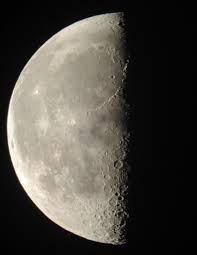
Moon Phases
Presentation
•
Science
•
6th - 8th Grade
•
Practice Problem
•
Easy
Standards-aligned
Dana Wallach
Used 408+ times
FREE Resource
4 Slides • 14 Questions
1
Moon Phases
Learning Target: Today, I am investigating the relationship between the Sun, Earth, and the Moon, so that I can understand that the movement of Earth and the Moon in relationship to the Sun causes phases of the Moon. I will know it when I can describe how the phases of the Moon occur, and identify the phases in a model.
2
3
Multiple Choice
Why does the Moon appear bigger than the planets and stars?
The lack of atmosphere on the Moon makes it look bigger.
The Moon is much bigger than the planets and stars.
The planets and stars are farther away.
The Moon's gravity makes it look bigger.
4
Multiple Choice
The moon produces its own light.
False, it reflects the Sun's light.
True, it produces moon light.
5
6
Multiple Choice
Which term refers to the "invisible" phase?
Full
Gibbous
New
Quarter
7
Multiple Choice
We use this term when we can see half the Moon’s sunlight side, or a quarter of the whole Moon.
Full
Gibbous
New
Quarter
8
Multiple Choice
We use this term when the Moon appears more than half lighted but less than full.
Full
Gibbous
New
Quarter
9
Multiple Choice
Which term means "maxing" - growing with light until a full Moon is reached?
Crescent
Gibbous
Waning
Waxing
10
Multiple Choice
Which term refers to the "fully illuminated" phase?
Crescent
Full
Gibbous
Quarter
11
Multiple Choice
Which term refers to a curved shape that has two narrow pointed ends?
Crescent
Full
Gibbous
Quarter
12
Multiple Choice
Which term means decreasing - visible surface area is getting smaller?
Crescent
Gibbous
Waning
Waxing
13
14
Multiple Choice
Select the moon phase shown in the picture.
Crescent
Quarter
Gibbous
Full
15
Multiple Choice
Select the moon phase shown in the picture.
New
Cresent
Quarter
Gibbous
16
Multiple Choice
Select the moon phase shown in the picture.
New
Cresent
Quarter
Gibbous
17
Multiple Choice
Select the moon phase shown in the picture.
First Quarter
Last Quarter
New Moon
Full Moon
18
Multiple Choice
During which two phases are the Sun, the Earth and the Moon all lined up.
Crescent and Full
Crescent and Gibbous
Full and New
New and Gibbous
Moon Phases
Learning Target: Today, I am investigating the relationship between the Sun, Earth, and the Moon, so that I can understand that the movement of Earth and the Moon in relationship to the Sun causes phases of the Moon. I will know it when I can describe how the phases of the Moon occur, and identify the phases in a model.

Show answer
Auto Play
Slide 1 / 18
SLIDE

Similar Resources on Wayground
15 questions
Muscular System Review
Presentation
•
6th - 8th Grade
14 questions
Homeostasis and Cellular Transport
Presentation
•
6th - 8th Grade
14 questions
Homologous Structures and Superposition
Presentation
•
6th - 8th Grade
16 questions
Catastrophic Events & Aquatic Biomes
Presentation
•
6th - 8th Grade
10 questions
Homeostasis
Presentation
•
6th - 8th Grade
16 questions
Identifying Variables, Control and Experimental Groups
Presentation
•
6th - 8th Grade
12 questions
Biotechnology - GMO - 1/5/2020
Presentation
•
6th - 7th Grade
12 questions
Living Things
Presentation
•
KG
Popular Resources on Wayground
10 questions
How much do you know about our Portrait of an Eagle?
Quiz
•
10th Grade
10 questions
Fast Food Slogans
Quiz
•
6th - 8th Grade
21 questions
Continents and Oceans
Quiz
•
6th Grade
20 questions
Parts of Speech
Quiz
•
5th Grade
16 questions
Subject & Predicate
Quiz
•
5th Grade
25 questions
Multiplication Facts
Quiz
•
5th Grade
12 questions
Map Skills
Quiz
•
3rd Grade
22 questions
Continents and Oceans
Quiz
•
5th Grade
Discover more resources for Science
17 questions
7.6D Aqueous Solutions
Quiz
•
7th Grade
20 questions
Scientific Method and Variables
Quiz
•
8th Grade
20 questions
Scientific method and variables
Quiz
•
8th Grade
27 questions
Counting Atoms - Subscripts
Quiz
•
8th Grade
10 questions
6.6D - Relative Density Review
Quiz
•
6th Grade
20 questions
Claim, Evidence and Reasoning (CER)
Quiz
•
6th - 8th Grade
18 questions
Counting Atoms
Quiz
•
7th - 8th Grade
20 questions
Density
Quiz
•
6th Grade