

AKS 11 Review

Presentation
•
Science
•
9th - 12th Grade
•
Medium
+1
Standards-aligned

Leslie Dunham
Used 5+ times
FREE Resource
14 Slides • 13 Questions
1
AKS 11 Review
Electromagnetic Spectrum and Visible Light

2
Comparing mechanical & EM Waves
Mechanical must have a medium, EM can travel through a vacuum
ALL electromagnetic waves are transferse waves
Both waves transfer energy and not matter

3
4
Multiple Choice

Light waves are categorized as
5
Multiple Choice
6
Multiple Choice
7
Multiple Choice
8
Electromagnetic spectrum
Energy is related to the frequency of the wave

9
Multiple Choice
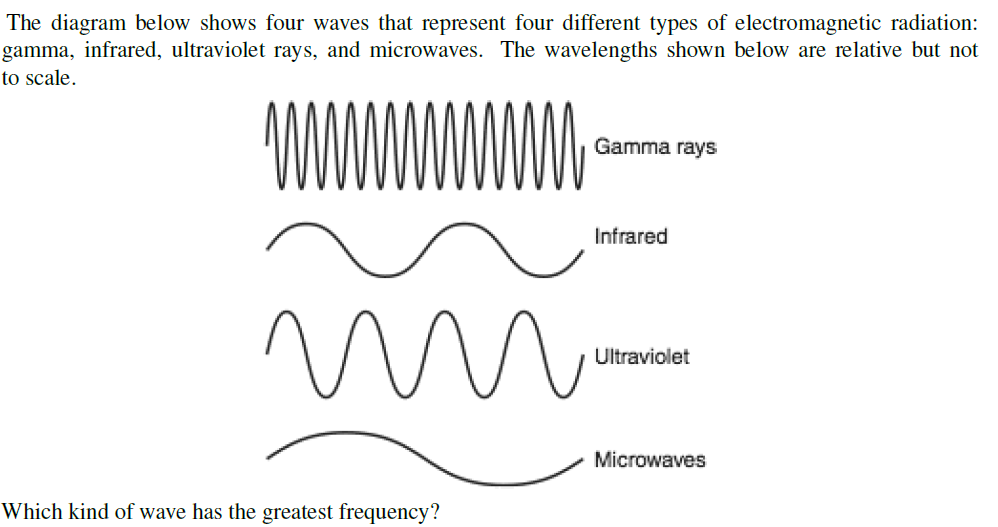
Which kind of wave has the greatest frequency?
10
Multiple Choice
11
Visible Light
The part of the spectrum we can see.
Color is determined by the wavelength of the wave.
Red light has a long wavelength, low frequency, and low energy. Violet light has a short wavelength, high frequency, and high energy.

12
What is white light?
Natural white light (from the sun) is not a single color but instead contains all colors of the visible spectrum
A prism can be used to disperse a single beam of white light into the rainbow
White can also be made by combining the primary colors of light

13
Color Mixing
The three primary colors of light are RED, BLUE, and GREEN
By mixing two primary colors you get the secondary colors - yellow, magenta, and cyan
All 3 primary colors gives white
All 3 secondary colors is black

14
Absorption and Reflection
Objects appear as different colors because of the wavelengths of light that are reflected or absorbed
We see the reflected wavelengths and that determine the color
White reflects all and black absorbs all wavelengths

15
Multiple Choice
16
Multiple Choice
17
Multiple Choice
18
Multiple Choice
19
Index of Refraction
Light slows down as it goes through more dense mediums
A material's index of refraction determines how much light slows (higher index of refraction = slower)

20
Index of Refraction
This equation can be used to determine the index of refraction (n) or the speed of light in a medium (v)
C is the maximum speed of light (3x10⁸ m/s)

21
22
23
Snell's Law
Uses the angle of light and its refracted angle to determine the index of refraction for a material
As light goes from one medium to another its speed changes and it bends

24
Light hits an emerald at an angle of 29o and refracts to 17o. What is the index of refraction?

25
Multiple Choice
26
Multiple Choice
27
Multiple Choice

Light travels from air (n = 1.00) into a "mystery" material. The incident ray of light hits the surface at angle of 43o and the refracted ray enters the mystery material at an angle of 27o. What is the index of refraction of the mystery material? n1sin(Θ1) = n2sin(Θ2)
AKS 11 Review
Electromagnetic Spectrum and Visible Light
Show answer
Auto Play
Slide 1 / 27
SLIDE


