
8.8A Components of the Universe, H-R Diagram Review
Presentation
•
Science
•
8th Grade
•
Medium
+1
Standards-aligned
Alonzo Martinez III
Used 177+ times
FREE Resource
6 Slides • 15 Questions
1
8.8A Components of the Universe, H-R Diagram Review
2
Components of the Universe, H-R Diagrams
We will describe components of the universe, including stars, nebulae, and galaxies, and use models such as the Hertzsprung-Russell Diagram for classification by viewing the Quizizz slides.
I will describe components of the universe, including stars, nebulae, and galaxies, and use models such as the Hertzsprung-Russell Diagram for classification by answering questions with 100% accuracy.
3
4
Multiple Choice
Two stars are identified on the Hertzsprung-Russell diagram below.
Based on this diagram, how do the characteristics of Star 1 and Star 2 compare?
Star 1 is cooler and less bright than Star 2
Star 1 is hotter and brighter than Star 2
Star 1 is cooler and brighter than Star 2
Star 1 is hotter and less bright than Star 2
5
6
Multiple Choice
Star brightness is defined in terms of apparent magnitude. Apparent magnitude is how bright the star appears from Earth.
How does the brightness of white dwarfs compare to the brightness of the Sun?
The Sun is less bright than white dwarfs.
White dwarfs are less bright than the Sun
White dwarfs and the Sun have the same brightness
White dwarfs are not seen from Earth, therefore you can not compare the brightness.
7
Multiple Choice
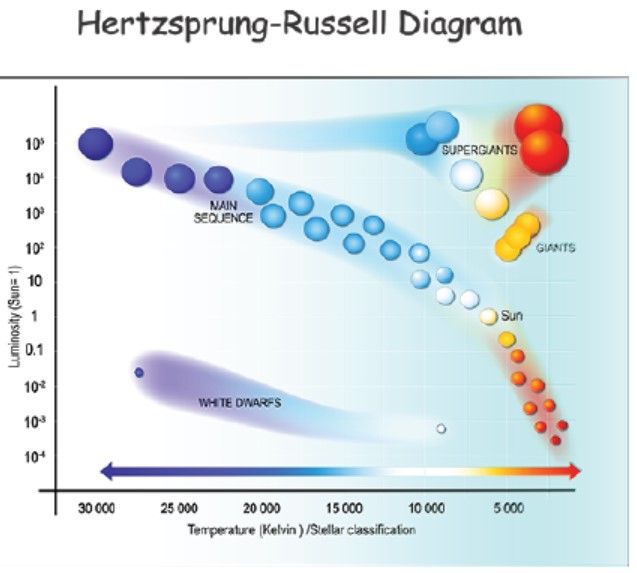
The Hertzsprung-Russell Diagram is used to classify stars in terms of luminosity and temperature. Brighter stars are shown at the top of the diagram, while fainter stars are shown in the lower part of the diagram. Stars on the left side of the diagram are hotter than stars on the right side of the diagram.
Which of the following statements best describes the main sequence stars?
The main sequence stars are brighter than the White Dwarfs. The very hot, extremely small stars are located in group D.
The main sequence stars are located in group B. The main sequence stars are much brighter than the Giants located in group C.
The main sequence stars are located in group D. Main sequence stars trend from extremely bright stars in the lower right corner to cool, faint stars in the upper left corner of the diagram. The Sun is an example of a main sequence star.
The main sequence stars are located in group A. These stars trend from cool, faint stars in the lower right corner to hot, extremely bright stars in the upper left corner of the diagram. The Sun is an example of a main sequence star.
8
Multiple Choice
Our Sun is one of the many stars that has been classified as average. Its luminosity and its temperature place it in the middle of the ___ area of the H-R diagram.
Main Sequence
White Dwarf
Red Giant
Super giant
9
Multiple Choice
According to the diagram, which of these types of stars has the greatest luminosity?
Hot white dwarf
Hot main sequence star
Cool super giant
Cool giant
10
Multiple Choice
Most of the stars in the universe fit onto one of the four areas on this Hertzsprung-Russell diagram.
Which area of the diagram represents the Supergiants?
Area M
Area X
Area P
Area Z
11
Multiple Choice
The Hertzsprung-Russell diagram shows how the sun is classified among the stars.
A star that is several thousand times brighter than the sun with a temperature lower than 4,000 K would be classified as __________.
a main-sequenced star in spectral class B
a supergiant in spectral class K
a main-sequence star in spectral class K or M
a white dwarf in spectral class B
12
Multiple Choice
Stars are classified on the Hertzsprung-Russell diagram according to their absolute magnitude and their surface temperatures at a given time in a star’s life cycle. What classification would a star have if it was very hot and very bright?
Main Sequence
White Dwarf
Supergiant
Giant
13
14
15
Multiple Choice
Most of the space in the universe is empty. Part of the reason for the emptiness of space is that the matter in the universe is gravitationally attracted to other pieces of matter. Most matter in the universe gets pulled into one of the many massive systems held together by the gravitational pull of black holes. These massive systems can be millions of light-years wide and contain millions of stars and planets.
What do scientists call these massive systems?
Solar Systems
Nebulae
Galaxies
Planetary Systems
16
Multiple Choice
Which of these correctly compares the masses of different objects in the universe?
A moon has less mass than a star and more mass than the planet it orbits.
A planet has less mass than a galaxy and more mass than the star it orbits.
A galaxy has less mass than a moon and more mass than a planet.
A star has less mass than a galaxy and more mass than a planet.
17
Multiple Choice
Four students are asked to describe a nebula and a star. Their responses are shown in the table below.
Which student described these two celestial bodies correctly?
Student 1
Student 2
Student 3
Student 4
18
Multiple Choice
are below.
Which student has the most accurate description of both nebulae and galaxies?
Student A
Student B
Student C
Student D
19
Multiple Choice
The universe has many different components. Which list places four components of the universe in the most likely order from smallest to largest?
Planets, stars, galaxies, nebulae
Nebulae, stars, planets, galaxies
Galaxies, stars, planets, nebulae
Planets, stars, nebulae, galaxies
20
Multiple Choice
Which statement best describes a galaxy?
A cloud of gas that is the birthplace of stars
A system of billions of stars, gas, and dust held together by gravity.
A ball of plasma that experiences nuclear fusion in its core.
A mass of dust and ice that orbits a star in an elliptical patteren
21
Multiple Choice
Which of these correctly identifies the different objects in the universe according to their size and composition?
A nebula is larger than a galaxy.
A solar system contains many stars.
A galaxy contains many solar systems.
A galaxy is bigger than a universe.
8.8A Components of the Universe, H-R Diagram Review
Show answer
Auto Play
Slide 1 / 21
SLIDE

Similar Resources on Wayground
17 questions
Genetics Review Part 2 (Practice)
Presentation
•
6th - 9th Grade
15 questions
Cell and cell organelle
Presentation
•
8th Grade
17 questions
Motors and Generators
Presentation
•
8th Grade
16 questions
Sci 8 - 2.1 Microscopes
Presentation
•
8th Grade
18 questions
Rocks and Rock Cycle
Presentation
•
8th Grade
18 questions
Cellular respiration vs photosynthesis
Presentation
•
8th Grade
16 questions
Speed/Time Graphs
Presentation
•
8th Grade
16 questions
Tides
Presentation
•
8th Grade
Popular Resources on Wayground
10 questions
Main Idea and Supporting Details
Quiz
•
3rd - 6th Grade
20 questions
Math Review
Quiz
•
3rd Grade
14 questions
25-26 SY 8th Grade EOY Benchmark
Quiz
•
8th Grade
15 questions
Fast food
Quiz
•
7th Grade
20 questions
Math Review
Quiz
•
6th Grade
20 questions
Context Clues
Quiz
•
6th Grade
21 questions
EOY Grade 6 Benchmark Assessment - Content Skills
Quiz
•
6th Grade
20 questions
Inferences
Quiz
•
4th Grade
Discover more resources for Science
21 questions
Test Name: SCI.PS - Unit 3 - Waves (Systemwide)
Quiz
•
8th Grade
34 questions
SUA 3 Review
Quiz
•
8th Grade
19 questions
Maintaining Biodiversity and Ecosystem Services
Quiz
•
6th - 8th Grade
5 questions
Solar System
Interactive video
•
6th - 8th Grade
10 questions
Exploring the Foundations of Genetics through Mendel's Experiments
Interactive video
•
6th - 10th Grade
62 questions
Super Science Trivia
Quiz
•
6th - 8th Grade
26 questions
Amplify Evolutionary History Vocabulary
Quiz
•
8th Grade
5 questions
SS Week 1.2: Cell Theory
Presentation
•
8th Grade