

Big Bang Theory

Presentation
•
Science
•
8th Grade
•
Easy
+2
Standards-aligned

Carol Lee
Used 314+ times
FREE Resource
12 Slides • 9 Questions
1
Origins of the Universe
The Big Bang Theory

2
Open Ended
3
The Universe
All existing matter and space considered as a whole; the cosmos. The universe is believed to be at least 10 billion light years in diameter and contains a vast number of galaxies; it has been expanding since its creation in the Big Bang about 13 billion years ago.

4
What's This Big Bang All About?
The Big Bang Theory is how astronomers explain the way the universe began. It is the idea that the universe began as just a single point, then expanded and stretched to grow as large as it is right now—and it is still stretching!

5
Before the Big Bang
Scientists believe that before the Big Bang space and time didn't exist and all that existed was energy
The Big Bang occurred when all of this energy was concentrated into a single point called 'singlularity'
Space began to expand quickly and the temperature was hot (an estimated 100 million trillion trillion degrees!)

6
A Tiny, Hot Beginning
When the universe began, it was just hot, tiny particles mixed with light and energy. It was nothing like what we see now
As everything expanded and took up more space, it cooled down.

7
A Tiny, Hot Beginning
The first stars created bigger atoms and groups of atoms. That led to more stars being born.
At the same time, galaxies were crashing and grouping together.
As new stars were being born and dying, then things like asteroids, comets, planets, and black holes formed!

8
9
Multiple Choice
10
Multiple Choice
11
Expanding Universe
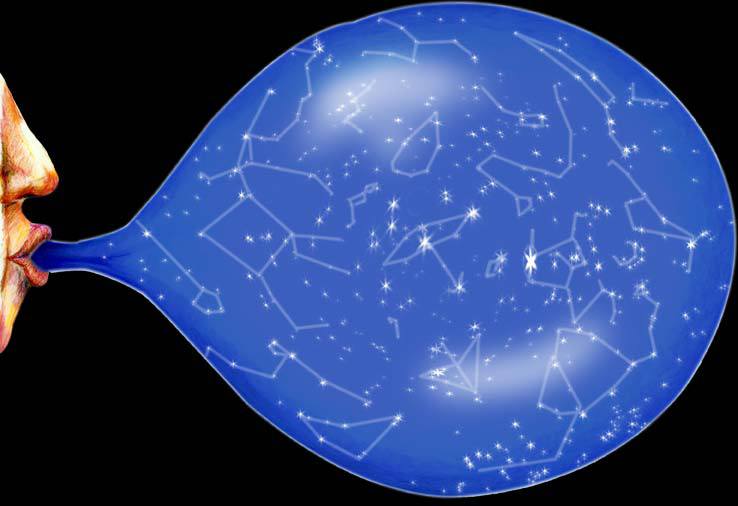
The universe is still expanding
If things were moving apart, it meant that long ago, everything had been close together
Everything we can see in our universe today—stars, planets, comets, asteroids—they weren't there at the beginning.

12

Evidence: Cosmic Background Radiation
13
Open Ended

If you were to point a satellite dish at into any point in space, what would you expect to hear?
14
If you were to point a satellite dish into empty space you would get static
The universe has an underlying static - Cosmic microwave background

15
16
Cosmic Microwave Background Radiation
Big Bang Theory suggests that the universe was a very hot place and that as it expands, the gas within it cools
As the universe began to cool, radiation began to fill the universe as a remnant of the heat left over - this is called 'Cosmic Microwave Background'
The cosmic microwave radiation is like an 'afterglow' of radiation

17
Multiple Choice
18
Multiple Choice
19
Multiple Choice
20
Multiple Choice
21
Open Ended
Origins of the Universe
The Big Bang Theory
Show answer
Auto Play
Slide 1 / 21
SLIDE


