Predator-Prey Graph: Lynx and Hare
Presentation
•
Science
•
6th - 7th Grade
•
Medium
+1
Standards-aligned
Amalia Herashchanka
Used 133+ times
FREE Resource
7 Slides • 9 Questions
1
Predator-Prey Graph
The Snowshoe Hare and the Canadian Lynx
2
Today you are going to see data that shows a predator-prey relationship.
On the next slide, watch a video of the Canadian lynx and the snowshoe hare.
3

Edpuzzle
You can open this webpage in a new tab.
4
Multiple Choice
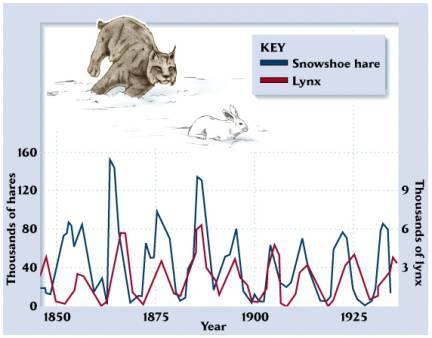
A local researcher gives you a graph about these two populations. Click on the picture of the graph. Which conclusion can you make based on what is pictured?
Canadian lynx and snowshoe hares have a linked ecological relationship.
Canadian lynx and snowshoe hares do not have a linked ecological relationship.
5
Multiple Choice
What term BEST describes the type of linked ecological relationship that these organisms have?
parasitic relationship
predator-prey relationship
cooperative relationship
commensalistic relationship
6
Multiple Choice
Click on the picture of the graph. What is this graph showing?
Lynx and hare populations over time
Lynx and hare captures over time
Lynx and hare offspring (babies) over time
Lynx and hare speed over time
7
Multiple Choice
Which pattern is found in the graph?
The populations do not show a similar pattern.
The populations cycle opposite of each other about every 10 years. When one increases, the other decreases.
The populations cycle with each other about every 10 years. When one increases, the other also increases.
8
Multiple Choice
Which population typically increases first? Hint: look at the key to determine the color of the line, then determine which line increases first.
The Canadian lynx population
The snowshoe hare population
9
Multiple Choice
Snowshoe hare populations typically increase first. Choose the statement that would BEST explain why.
The snowshoe hares increase when more Canadian lynx prey on them.
The snowshoe hares increase because more plants grow in the summer for them to eat.
The snowshoe hares increase because they cannot survive the harsh winters.
10
Multiple Choice
At the end of the graph, the Canadian lynx population starts to decline. What do you predict will happen to the snowshoe hare population following the decline of their predator?
The snowshoe hare population will most likely increase.
The snowshoe hare population will most likely decrease.
11
Where do they live?
There are many land ecosystems: desert, deciduous forest, tundra, savanna, grasslands, etc. The Canadian lynx and snowshoe hare live in a land ecosystem called the coniferous forest.
These ecosystems all have different climates. Scientists mainly look at temperature and precipitation for the climate of land biomes.
12
Open Ended
1. Describe the biotic and abiotic factors in the ecosystem in which the Canadian lynx and snowshoe hare live. 2. How would the snowshoe hare and Canadian lynx need to adapt to this environment?
13
Adaptations to Cold, Snowy Environments
Snowshoe hares have brown fur in the summers and white fur in the snowy winters in order to camouflage and evade the lynx.
Canadian lynx have long legs and giant paws to be able to hunt hare in the snow.
They have evolved together because snowshoe hare is 96% of the lynx's diet!
14
On the next slide, read about the endangerment of hares, and how humans are affecting this endangerment.
Hint: look at the headings for each paragraph.
15
16
Open Ended
ACCORDING TO THE ARTICLE, how do humans affect both the lynx and hare populations?
Predator-Prey Graph
The Snowshoe Hare and the Canadian Lynx
Show answer
Auto Play
Slide 1 / 16
SLIDE

Similar Resources on Wayground
11 questions
water cycle
Presentation
•
7th Grade
13 questions
Atmosphere Review
Presentation
•
5th - 7th Grade
11 questions
Mass vs Weight
Presentation
•
7th Grade
10 questions
Variables
Presentation
•
6th - 8th Grade
10 questions
Heredity & Punnett Squares
Presentation
•
7th Grade
12 questions
Major Tectonic Plates
Presentation
•
6th Grade
12 questions
Rock Cycle
Presentation
•
6th Grade
12 questions
Asexual Reproduction
Presentation
•
7th Grade
Popular Resources on Wayground
10 questions
5.P.1.3 Distance/Time Graphs
Quiz
•
5th Grade
10 questions
Fire Drill
Quiz
•
2nd - 5th Grade
20 questions
Equivalent Fractions
Quiz
•
3rd Grade
22 questions
School Wide Vocab Group 1 Master
Quiz
•
6th - 8th Grade
20 questions
Main Idea and Details
Quiz
•
5th Grade
20 questions
Context Clues
Quiz
•
6th Grade
20 questions
Inferences
Quiz
•
4th Grade
12 questions
What makes Nebraska's government unique?
Quiz
•
4th - 5th Grade
Discover more resources for Science
19 questions
Introduction to Properties of Waves
Presentation
•
6th - 8th Grade
16 questions
Interactions within Ecosystems
Presentation
•
6th - 8th Grade
10 questions
Exploring the Layers of the Earth
Interactive video
•
6th - 10th Grade
16 questions
Photosynthesis and Cellular Respiration Review
Quiz
•
7th Grade
20 questions
Abiotic & Biotic Factors
Quiz
•
7th Grade
15 questions
Punnett Squares
Quiz
•
6th Grade
10 questions
Exploring the Evolution of Cell Theory
Interactive video
•
7th Grade
17 questions
Human body systems
Quiz
•
7th Grade