Search Header Logo
How Light Interacts With Different Materials

How Light Interacts With Different Materials

Assessment

Presentation

Science

5th Grade

Practice Problem

Easy

NGSS
MS-PS4-2, 4-PS4-2, MS-ESS1-1

+1

Standards-aligned

Created by

John Gumban

Used 169+ times

FREE Resource

14 Slides • 10 Questions

1

How Light Interacts With Different Materials

Science Week 3

Slide image

2

Last Lesson

  • In the previous lesson, you have learned that conductors are materials that allow heat and electricity to pass through easily while insulators are materials that do not allow heat and electricity to pass through them. This time, you will learn how light interacts with different materials. 

3

Stained Glass

Have you seen an artwork on a stained glass? Stained glass are seen in churches, art museums, and even in some houses. The design on stained glasses are achieved through the use of glasses with various colors and hues, making them a sight to behold. 

Slide image

4

Visible Light

  • The light that is visible to the human eye is called visible light. It is the small part of the electromagnetic spectrum which affects our vision. Light is propagated in space as electromagnetic waves. This is known as electromagnetic wave theory of light. The primary source of visible light is the sun. The visible light allows us to see the color that is not absorbed by the objects. For example, you see most plants as green because the leaves absorb all colors of the visible light except for green. 

5

Multiple Choice

The light that is visible to the human eye.

1

Visible Light

2

Invisible Light

6

Multiple Choice

What is the primary source of light?

1

Moon

2

Sun

7

Optics

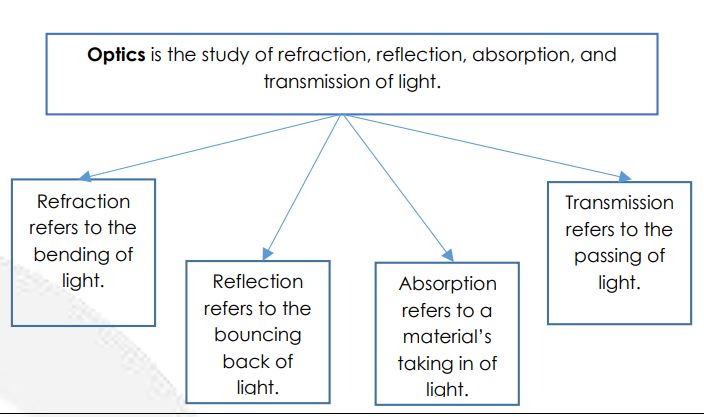
  • To understand light further, you have to learn how it interacts with different objects. This branch of Science is called optics. Optics is the study of refraction, reflection, absorption, and transmission of light. 

8

Multiple Choice

It is the the study of refraction, reflection, absorption, and transmission of light.

1

Optics

2

Vision

9

Refraction

It refers to the bending of light as it passes through different materials. For example, the pencil in the glass of water appears bent because of the different parts of the materials that interact with light. The part of the pencil that is not dipped in water interacts with the water. A medium is optically dense if it slows down the speed of light. This is why the pencil looks bent. 

Slide image

10

Reflection

It refers to the bouncing back of light when it hits an object. Some objects with flat surfaces, like mirrors, reflect light in a straight, predictable way. Some objects with uneven surfaces, like rocks, reflect light in a scattered way.

Slide image

11

Absorption

It refers to material’s taking in light but not reflecting it back. For example, when light strikes a black surface, it is absorbed by the surface and nothing is reflected.

Slide image

12

Multiple Choice

It is the bending of light as it passes through different materials.

1

Refraction

2

Reflection

3

Absorption

13

Multiple Choice

It refers to the bouncing back of light when it hits an object.

1

Refraction

2

Reflection

3

Absorption

14

Multiple Choice

It refers to material’s taking in light but not reflecting it back.

1

Refraction

2

Reflection

3

Absorption

15

Transmission

It refers to the passing of light through some materials. For example, when light passes through a glass window, it is transmitted to the other side, allowing the light to pass through the window. 

16

Transparent Materials

Transparent materials allow all lights to pass through them. Clear plastic and glass windows are examples of transparent objects. 

Slide image

17

Translucent Materials

Translucent materials allow some light to pass through them. Stained glasses and frosted windows are examples of translucent objects.

Slide image

18

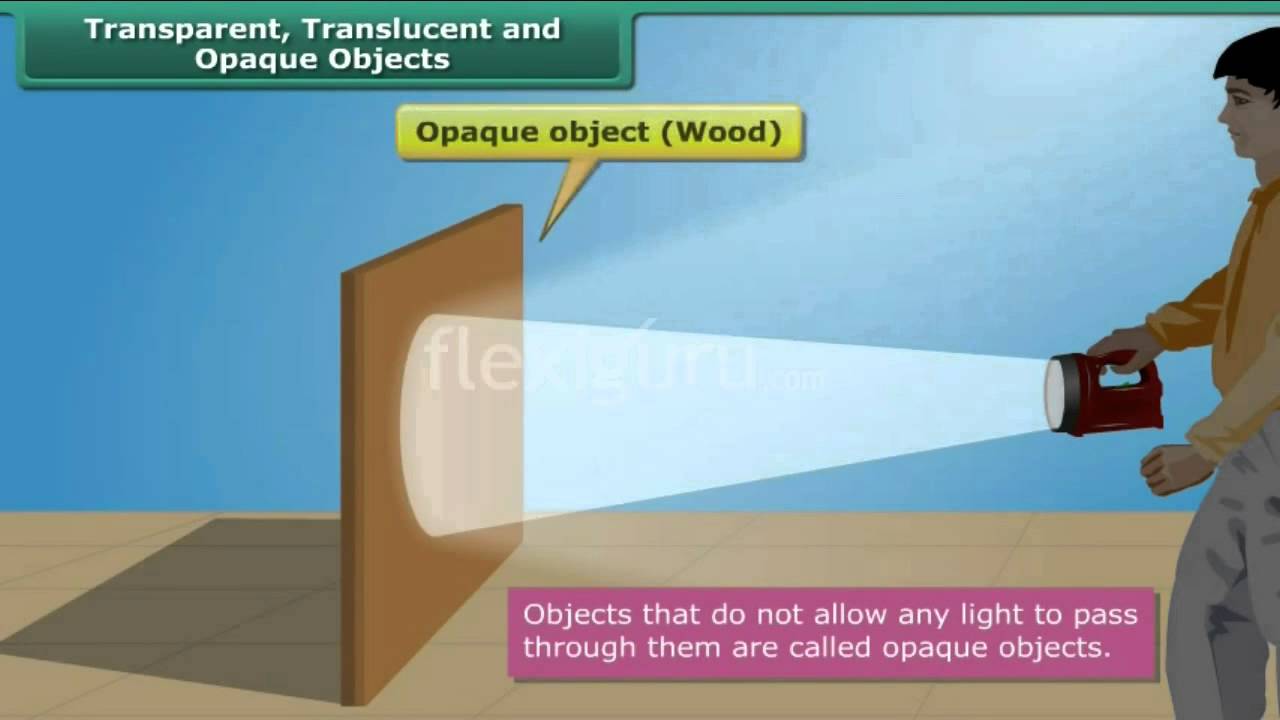
Opaque Materials

Opaque materials do not allow light to pass through them. Concrete walls, wooden doors, and mirrors are example of opaque objects
Slide image

19

Slide image

20

Multiple Choice

It refers to the passing of light through some materials.

1

Transmission

2

Transcription

21

Multiple Choice

It allow all lights to pass through them

1

Transparent

2

Translucent

3

Opque

22

Multiple Choice

Do not allow light to pass through them

1

Transparent

2

Translucent

3

Opaque

23

Multiple Choice

It allow some lights to pass through them

1

Transparent

2

Translucent

3

Opaque

24

Slide image

How Light Interacts With Different Materials

Science Week 3

Slide image

Show answer

Auto Play

Slide 1 / 24

SLIDE