

Q3 W8 BIODIVERSITY

Presentation
•
Science, Biology
•
10th Grade
•
Practice Problem
•
Medium

Michel Ann Gellada
Used 9+ times
FREE Resource
16 Slides • 10 Questions
1
Q3 W8 BIODIVERSITY

2
Most Essential Learning Competencies:
Lesson 1 - Explain how species diversity increases the probability of adaptation and survival of organisms in changing environments. Lesson 2 - Explain the relationship between population growth and carrying capacity.
3
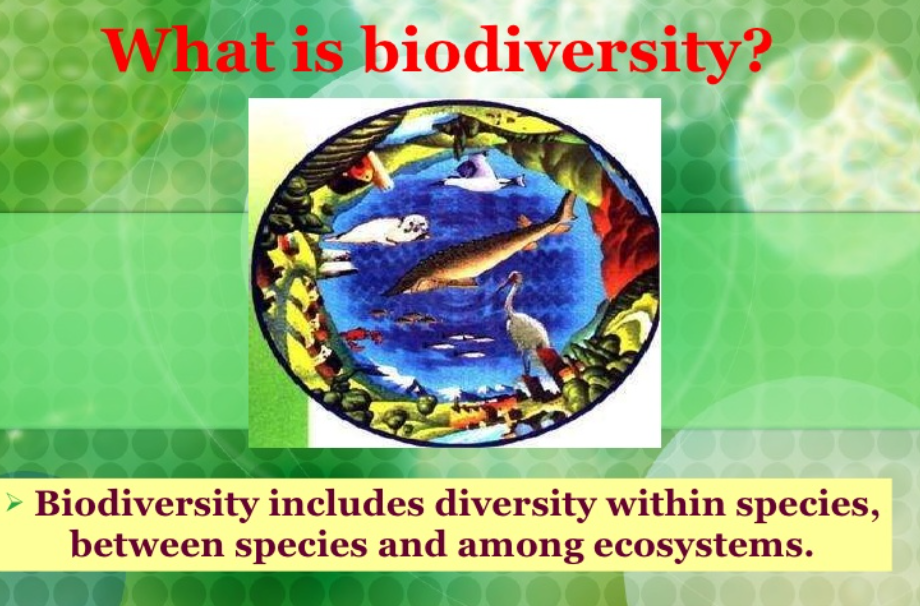
WHAT IS BIODIVERSITY?
Biodiversity refers to the variety of living species on Earth which includes the smallest bacteria to the largest land animal which is the elephant.
4
5
WHAT IS ECOSYSTEM?
Ecosystem is composed of all living and non living organisms interacting with each other. Relationship is important in an ecosystem, this maintains the balance and stability of a community. To uphold the balance of an ecosystem, the members of species of its biodiversity must have a healthy relationship among other organisms as well as the environment.
6
Several factors however can disturb the balance of an ecosystem which will result to instability. These factors include pandemic, natural disasters, human-made damages, and competition for food and other basic necessities. These occurences will result to biodiversity instability.
7

8

9
To be able to cope with the ever-changing state of the ecosystem, species learn to work together for their survival. In this situation, the more variety of species an ecosystem have, the higher the chance of survival. This variety of species is called biodiversity stability.
10
The stability of an ecosystem can be described as the ability to withstand or adjust to changes that may occur in the environment. These changes may be a result of natural or human activities. As an effect, biodiversity may be reduced and result in the instability of the ecosystem.
11
Multiple Choice
What describes how varied living things are in a specific area?
stability
biodiversity
equilibrium
12
Multiple Choice
Which of the following ecosystem is the most biodiverse?
a desert
a stream
a rice field
tropical rain forest
13
Multiple Choice
Which of the following best describes the relationship between biodiversity and stability of ecosystem?
Increased biodiversity increases the stability of an ecosystem.
As biodiversity increases, stability of the ecosystem decreases.
A less diverse ecosystem keeps more resources in the ecosytem.
An ecosystem with low biodiversity is better able to recover from natural disasters.
14
Multiple Choice
Some species go extinct at an alarming rate. Why might this be a concerning issue?
It can affect the water cycle.
There would be more food for other species.
Species are interdependent, others would be affected.
15
Multiple Choice
How should biodiversity be protected in rain forests?
Deforestation should be strictly prohibited.
Environmental laws should be followed strictly.
Public awareness should be created regarding biodiversity conservation and its importance
All of the above.
16

17
Biodiversity plays an important role in maintaining a healthy and productive ecosystem. The variety of species in a community contributes to its stability. The more species in a community however does not guarantee a healthy relationship between all the organisms. Problems arise when the population of organisms becomes too many. To maintain the balance of the ecosystem and to make sure that all inhabitants receive their needs such as food and other resources, the environment must be occupied by a limited population.
18
The maximum number of species an environment can handle is known as carrying capacity. Carrying capacity describes the connection between resources available and population growth. There are factors that can affect the quality of life of species in an area if the population goes beyond the environment’s carrying capacity. These include shortage of food, space for shelter, and ability to find a suitable mate. If these needs are not met, the species population will decline until the environment’s resources bounce back.
19
Before a population reaches its carrying capacity, it experiences a period of rapid growth. This period of growth is called exponential population growth when resources are unlimited. When resources are limited, populations exhibit logistic growth. During this period, population expansion decreases as resources become scarce.
20
Limiting factors can be density-independent or density-dependent. Density independent does not depend on the size of the population. These are factors such as natural disasters, severe weather, pollution and activities of humans.
21
When the population gets large enough, the limited food may no longer be enough, leading to competition for resources. In this case, competition for food is a density-dependent limiting factor as it depends on population density. Competition for resources, predation, disease, and parasites, and emigration are other density-dependent factors.
22
Multiple Choice
Which refers to the largest population an area can support with its resources?
carrying capacity
immigration
population density
23
Multiple Choice
An increase in population of house lizard causes a decrease in population of mosquito. What limits the population of mosquito?
diseases and parasites
predation
competition for resources
emigration
24
Multiple Choice

What is the carrying capacity of the graph?
800
1000
1200
25
Multiple Choice

What happens if a population grows past its carrying capacity?
The population keeps growing.
The population starts to die off.
The carrying capacity just increases
26
Multiple Choice
A new strain of virus, Corona Virus, has caused deaths to almost half a million of population in different countries. What factor limits the population of the world?
Competition - Density-Dependent
Resources - Density-Independent
Disease and Parasites - Density -dependent
Q3 W8 BIODIVERSITY
Show answer
Auto Play
Slide 1 / 26
SLIDE
Similar Resources on Wayground

20 questions
Plant Nutrition
Presentation
•
10th Grade
18 questions
Plants
Presentation
•
6th - 8th Grade
21 questions
Cell Transport - Diffusion
Presentation
•
9th - 10th Grade
23 questions
Cell Cycle
Presentation
•
10th Grade
20 questions
Basic Chemistry
Presentation
•
9th Grade
20 questions
CR: INTRO-GLYCOLYSIS
Presentation
•
9th - 10th Grade
21 questions
Plant & Flower Anatomy
Presentation
•
9th Grade
Popular Resources on Wayground
6 questions
PRIDE Always and Everywhere
Presentation
•
12th Grade
20 questions
Lab Safety Quiz

Quiz
•
6th Grade
26 questions
KOR Review Kahoot Questions
Quiz
•
8th Grade
21 questions
Continents and Oceans
Quiz
•
6th Grade
12 questions
Unit Zero lesson 2 cafeteria
Presentation
•
9th - 12th Grade
20 questions
Parts of Speech
Quiz
•
5th Grade
10 questions
Riddles Riddles fun Riddles
Quiz
•
6th - 12th Grade
16 questions
Subject & Predicate
Quiz
•
5th Grade
Discover more resources for Science
10 questions
Exploring Chemical and Physical Changes

Interactive video
•
6th - 10th Grade
10 questions
Exploring the States of Matter
Interactive video
•
6th - 10th Grade
30 questions
Atomic Structure and Periodic Table Review
Quiz
•
10th Grade
9 questions
Exploring the Steps of the Scientific Method
Interactive video
•
6th - 10th Grade
16 questions
Identify Key Characteristics of Living Organisms
Quiz
•
9th - 12th Grade
10 questions
Exploring the Scientific Method
Interactive video
•
6th - 10th Grade
10 questions
Exploring the Concept of Energy
Interactive video
•
6th - 10th Grade
19 questions
Explore Macromolecules in Living Organisms
Quiz
•
9th - 12th Grade