Big Idea 6: Earth Structures - Plate Tectonics (CS1)
Presentation
•
Science
•
6th Grade
•
Medium
Carly MacMillan
Used 4+ times
FREE Resource
5 Slides • 39 Questions
1
Big Idea 6: Earth Structures
The Theory of Plate Tectonics (CS1)
2
Big Idea 6: Earth Structures
Over geologic time, internal and external sources of energy have continuously altered the features of Earth by means of both constructive and destructive forces. All life, including human civilization, is dependent on Earth's internal and external energy and material resources.
3
Explore the scientific theory of plate tectonics by describing how the movement of Earth's crustal plates causes both slow and rapid changes in Earth's surface, including volcanic eruptions, earthquakes, and mountain building. (SC.7.E.6.5 - DoK 2)
The Earth's crust is broken into pieces that are called plates. These plates sit on the solid, but flowing rock of the mantle, which causes them to shift. There are two types of crust/plates, continental (makes up continents) and oceanic crust (makes up ocean floor).
Mantle rock flows because heat from the core transfers to the bottom layer of the mantle, which makes the rock less dense so it flows toward the crust. When away from the hot core, the mantle rock cools and sinks back down toward the core, creating circular convection currents within mantle rock.
The convection currents in mantle rock are what causes plate tectonics, or the shifting and interactions of tectonic plates.
There are three types of interactions between the boundaries of two plates. The plates may move toward each other (convergent boundary), move away from each other (divergent boundary), or slide parallel past one another (tranform boundary).
4
Explore the scientific theory of plate tectonics by describing how the movement of Earth's crustal plates causes both slow and rapid changes in Earth's surface, including volcanic eruptions, earthquakes, and mountain building. (SC.7.E.6.5 - DoK 2)
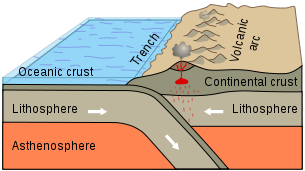
At a convergent boundary, the plates can push against each other, forcing the earth upwards, creating a mountain range or one plate can subduct or slide underneath the other creating deep ocean trenches or volcanic mountain ranges.
At a divergent boundary, two plate move apart, creating a mid ocean ridge or a rift valley.
At a transform boundary, plates slide past each other, their friction causing breaks, or faults, in the rock. The moving rock can sometimes get stuck, gathering energy and resulting in an earthquake.
5
6
Multiple Choice
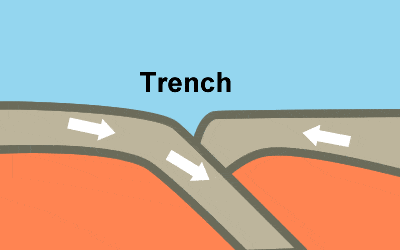
The diagram shows the boundary of two tectonic plates and a feature that forms on Earth's surface at that boundary. At which of the following plate boundaries does the feature shown in the diagram form?
a continental plate and an oceanic plate sliding past each other
a continental plate subducting beneath an oceanic plate
two oceanic plates moving away from each other
two oceanic plates moving toward each other
7
Multiple Choice
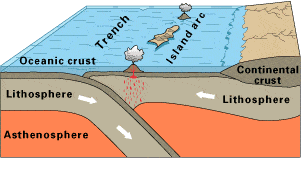
The interaction of Earth's plates at plate boundaries causes changes to Earth's surface. The diagram shows a plate boundary and features of Earth's surface.
Which of the following features formed as a result of the plate interactions shown in the diagram?
folded mountains
mid-ocean ridge
rift valley
volcanic islands
8
Multiple Choice
A scientist finds a fossil of a fern in a hot, dry desert. The fern is the ancestor of a modern fern that lives in warm, moist climates. Which of the following is the best conclusion for the scientist to draw?
The desert was underwater in the distant past.
Ancient ferns were able to live in very dry climates.
The climate of the desert has stayed the same over time.
The desert had a warm, moist climate in the distant past.
9
Multiple Choice
Interactions between layers of Earth cause convection currents to move crustal plates. The diagram shows four layers of Earth. In which layer of Earth are the convection currents that directly result in tectonic plate motion found?
1
2
3
4
10
Multiple Choice
Ravi learns that convection currents within the mantle cause tectonic activity on Earth’s surface. What happens in a convection current?
heated material sinks and cooler material rises
heated material rises and cooler material sinks
rock material melts and moves toward the Earth’s core
rock material hardens and becomes part of Earth’s mantle
11
Multiple Choice
The movement of tectonic plates can produce landforms on Earth’s surface. Along what type of plate boundary might a mountain range form?
transform only
divergent only
both convergent and divergent
both transform and divergent
12
Multiple Choice
Earth’s tectonic plates move very slowly. Which of the following causes the movement of Earth’s tectonic plates?
magnetic pole reversal
large faults in mountain ranges
energy released from volcanic activity
convection of Earth’s upper mantle
13
Multiple Choice
Earth’s lithospheric plates meet at locations called plate boundaries. What happens at a transform boundary?
the plates move away from each other
the plates do not move
the plates move toward each other
the plates slide past each other
14
Multiple Choice
The table shows a listing of states that have earthquakes, the number of earthquakes greater than 3.5 on the Richter scale, and the percent of the total number of earthquakes this state had compared to other states between 1974 and 2003. Based upon this data, what conclusions can be drawn as to the region of the United States that has the most divergent plate boundaries that cause earthquakes?
The east coast has the most divergent plate boundaries, because it had the fewest number of earthquakes.
The midwest has the greatest amount of divergent plate boundaries, because it had more earthquakes than the east coast.
The west coast has more divergent boundaries than the rest of the country, because it had the most number of earthquakes.
The east coast has the most divergent plate boundaries, because Connecticut and Florida had earthquakes greater than 3.5 on the Richter scale.
15
Multiple Choice
Why are there no large mountains in Florida?
Florida is close to sea level.
Florida is close to the ocean.
Florida is far from the Prime Meridian.
Florida is far from major tectonic plate boundaries.
16
Multiple Choice
The diagram shows the movement of two of Earth’s plates. The plates are pulling apart. What can MOST likely be found just beneath these plates?
Earth’s core
hot, melted rock
lava and ash
another set of plates
17
Multiple Choice
The diagram shows a cross-section of the lithosphere. Point C represents a boundary between two tectonic plates. The plates shifted in opposite directions. What occurred at Point A as a result of this movement?
a release of energy that caused an earthquake
the formation of a tsunami, or underwater seismic wave
the formation of a hot spot
the sinking of one plate under another
18
Multiple Choice
Tectonic activity can recycle old crust and form new crust in different places. Where on the ocean basin would you expect to find new oceanic crust?
along a trench because two plates slide past one another
along an abyssal plain because two plates collide
long a subduction zone because one plate sinks beneath another
along a mid-ocean ridge because two plates pull apart
19
Multiple Choice
Imagine a metamorphic rock that has been subjected to intense heat and pressure. Over time, it gets pulled underground with a tectonic plate that is sinking beneath another plate along a convergent boundary. The rock melts as it goes deeper; then the molten rock rises up and seeps out of a crack in the ocean floor and hardens. What type of rock is it now?
composite
igneous
metamorphic
sedimentary
20
Multiple Choice
Earth’s mantle plays an important role in plate tectonics. Why is the mantle so important to this process?
Earthquakes occur constantly in the mantle, which causes the plates to move.
The mantle is made up entirely of liquid rock, on which Earth’s crustal plates can float.
Heavy metals in the mantle set up strong magnetic fields that attract and repel Earth’s plates.
Temperature differences in the mantle set up convection currents that help to drive the movement of the plates.
21
Multiple Choice
An earthquake occurs when rock in Earth's crust breaks or slips, quickly releasing pressure. In which location is an earthquake least likely to occur?
in the middle of a plate
at a boundary where plates pull apart
at a boundary where plates push together
at a boundary where plates slide past each other
22
Multiple Choice
The Marianas Trench, where the Pacific Plate descends under the leading edge of the Eurasian Plate, is the deepest sea floor in the world. These ocean trenches form when two oceanic plates collide
and the older, less dense of the two plates rides over the edge of the older plate.
when convection currents in the mantle force the older plate downward.
and the younger, denser of the two plates, rides over the edge of the older plate.
and the plates are approximately the same age and density.
23
Multiple Choice
Where would sea floor spreading most likely occur?
At convergent boundaries (oceanic vs. oceanic)
At convergent boundaries (oceanic vs. continental)
At divergent plate boundaries (oceanic vs. oceanic)
At transform plate boundaries
24
Multiple Choice
25
Multiple Choice
26
Multiple Choice
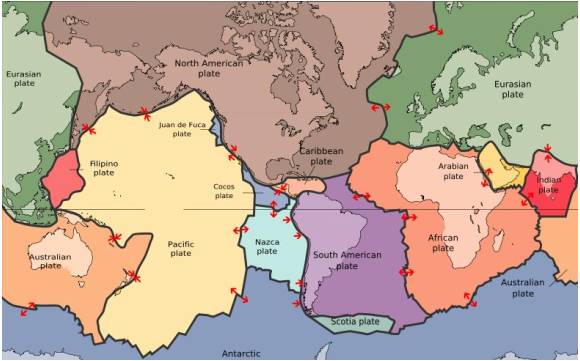
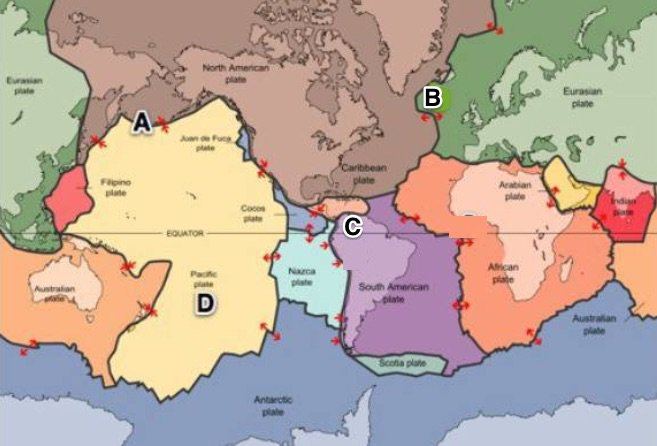
The map in the picture shows tectonic plate boundaries. This map would be useful in predicting the location of future
droughts
hurricanes
earthquakes
tornadoes
27
Multiple Choice
Observe this diagram of a plate boundary. One statement BEST describes what is happening. It is that
the oceanic crust is melting.
the denser ceanic crust is subducting under the less dense oceanic crust
volcanic islands are forming.
the tectonic plates are moving away from each other.
28
Multiple Choice
29
Multiple Choice
What occurs when two plates come together and the denser one is forced under back into the mantle?
reduction
conduction
subduction
convection
30
Multiple Choice
A divergent boundary occurs when plates ....
Pull apart
Come together
Slide past each other
subducting
31
Multiple Choice
The type of plate boundary where two plates come together is a .....
Convergent Boundary
Divergent Boundary
Transform Boundary
Plate Boundary
32
Multiple Choice
Which of the following causes Earth's tectonic plates to move?
Energy from the Sun
Magnetic Pole Reversal
Convection currents in the mantle
Faults in Mountain Ranges
33
Multiple Choice
The San Andréa fault in California is one example of a...
Divergent boundary
Convergent boundary
Transform boundary
All of the above
34
Multiple Choice
The mechanism that moves continents is based on heat energy moving by
Radiation in the core
Conduction in the lithosphere
Convection in the Asthenosphere
None of these options is true
35
Multiple Choice
What type of features are associated with a divergent boundary?
Rift valleys
Volcanic mountains
Fold mountains
Fault block mountains
36
Multiple Choice
The Himalayan mountains have some of the highest peaks like Mt. Everest, on which type of convergent boundary are they located?
Oceanic/Continental
Oceanic/Oceanic
Continental/Continental
None of the above
37
Multiple Choice
Where are most divergent boundaries located?
Along the middle of most ocean floors
Along the margins of most continents
Across the middle of many continents
All the above options are correct
38
Multiple Choice
Evaluating the relationship between scientific laws, theories, and hypothesis, one can say
Scientific hypothesis can became laws
Scientific theories can became laws
Scientific laws can be changed
Scientific hypothesis can became theories
39
Multiple Choice
The rejection of Mr. Wegener's hypothesis teaches us that
Indirect evidence is not sufficient to prove a hypothesis
Direct evidence is hard to find
Hypotheses are hard to prove
Scientists of the early 1900s were not smart enough
40
Multiple Choice
Peer scientists reviewing Wegener’s hypothesis of continental drift rejected his notion because
His evidence was too few to make a valid conclusion
He did not explain how continents move and what moves them
His evidence was not clear in showing how continents were joined
He lied by including false evidence
41
Multiple Choice
Wegener suggested that coal beds discovered in Antarctica indicated that this continent was
once under water
always frozen
once near the equator
part of Africa
42
Multiple Choice
Evidence used by Wegener to supported his idea of continental drift included
Ocean rocks and sediments
Ocean floor topography
Magnetic isochron patterns
Climatic data
43
Multiple Choice
A German scientist Alfred Wegener was the first to hypothesize that ...........
Continents were once joined
The sea floor is spreading
Continents are moving
The Earth's magnetic pole flips
44
Multiple Choice
Pangaea was an ancient supercontinent made up of...
America, Greenland, and Europe.
Antarctica, India, and America.
all of Earth’s continents.
South Africa, India, Australia, and South America.
Big Idea 6: Earth Structures
The Theory of Plate Tectonics (CS1)
Show answer
Auto Play
Slide 1 / 44
SLIDE

Similar Resources on Wayground
40 questions
Chapter 7 Science: Plate Tectonics Vocabulary Quiz Review
Presentation
•
6th Grade
35 questions
Weathering and Soil
Presentation
•
6th Grade
38 questions
Microscope Lesson
Presentation
•
6th Grade
39 questions
PURE SUBSTANCES AND MIXTURES
Presentation
•
7th Grade
39 questions
Waves 6.P.1.1
Presentation
•
6th Grade
38 questions
Weather Forecasting
Presentation
•
6th Grade
39 questions
Body Systems
Presentation
•
6th Grade
37 questions
Genetic Engineering
Presentation
•
6th - 7th Grade
Popular Resources on Wayground
10 questions
5.P.1.3 Distance/Time Graphs
Quiz
•
5th Grade
10 questions
Fire Drill
Quiz
•
2nd - 5th Grade
20 questions
Equivalent Fractions
Quiz
•
3rd Grade
22 questions
School Wide Vocab Group 1 Master
Quiz
•
6th - 8th Grade
20 questions
Main Idea and Details
Quiz
•
5th Grade
20 questions
Context Clues
Quiz
•
6th Grade
20 questions
Inferences
Quiz
•
4th Grade
12 questions
What makes Nebraska's government unique?
Quiz
•
4th - 5th Grade
Discover more resources for Science
19 questions
Introduction to Properties of Waves
Presentation
•
6th - 8th Grade
16 questions
Interactions within Ecosystems
Presentation
•
6th - 8th Grade
10 questions
Exploring the Layers of the Earth
Interactive video
•
6th - 10th Grade
15 questions
Punnett Squares
Quiz
•
6th Grade
20 questions
Energy Transformations
Quiz
•
6th - 8th Grade
20 questions
Cell Organelles and Functions
Quiz
•
6th - 8th Grade
10 questions
Ecosystem levels of organization
Quiz
•
6th Grade
20 questions
Levels of Organization
Quiz
•
6th Grade