


Ecology
Presentation
•
Science
•
10th Grade
•
Practice Problem
•
Medium
+1
Standards-aligned
Melissa Guinta
Used 27+ times
FREE Resource
18 Slides • 5 Questions
1
Ecology
7.6-7.10
2
3
Succession
Primary - Bare rock: starts with lichens (volcano, glacier)
Secondary - Soil present: starts with small annual plants (fires, clear cutting, climate change, introduced species)
Pioneer Species
4
Primary or Secondary Succession will happen here??
5
Multiple Choice
An ecosystem has experienced a flood. Which type of plants would you expect to see growing first after the flood?
Shrubs
Lichens
Small Annual Plants
6
Trophic Levels
Food Chain - plants bring insects, then small mammals, which bring?
7
Label Consumers vs Producers
8
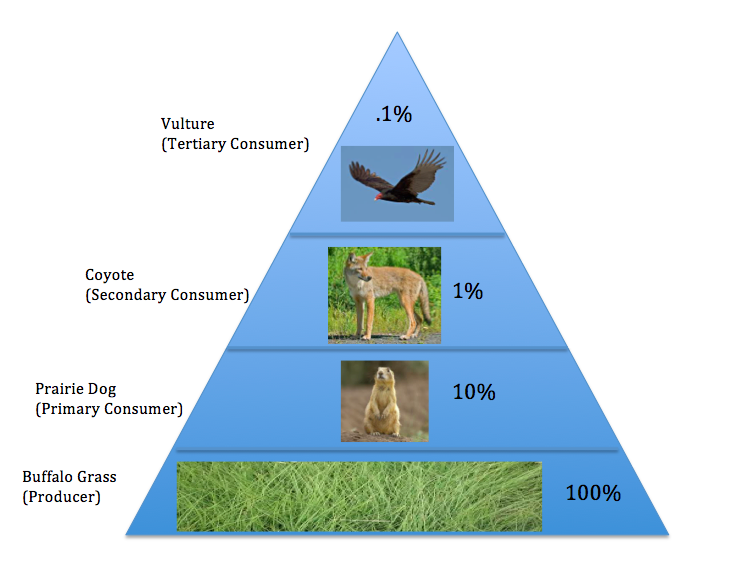
Energy Pyramid: Only 10% passed on, rest used or lost as heat
9
A grass starts with 30,000 kJ of energy. How much energy would a cheetah acquire after it ate a zebra that consumed the grass?
30 kJ
300 kJ
3000 kJ
10
Multiple Choice
What is the difference between food chains and food webs?
Food webs show flow of energy from producers to consumers, food chains show the flow of energy from consumers to producers.
Food chains show a single path of energy, and food webs show overlapping pathways of energy
11
Biodiversity - More species diversity means more health of an Ecosystem
Habitat Loss/Fragmentation
Poaching
Introducing New Species
Pollution
12
Limiting Factors Determine Carrying Capacity
Restrict Population Growth
13
Density Dependent Limiting Factors
Disease
Parasites
Competition
Predation
14
Density Independent
Natural Disasters, Climate Change, Humans
15
16
Population Density - number of individuals in a population per unit area
Growth = from Birth Rate + Immigration
Decrease = from Death + Emigration
(BR+I) - (DR+E) = Population Growth
Positive number = growth; Negative number = shrinking
17
Exponential Growth
Population grows at the same rate
18
Open Ended
In a population of deer, the birth rate is 5, the death rate is 4, immigration is 8, and emigration is 6. Calculate the population growth by filling in the formula below.
(BR+I) - (DR+E) = Population Growth
19
Multiple Choice
A trout population grew from 4 in 1992 to 16 in 1993 and then to 64 in 1994. If it continued to grow exponentially, approximately how many trout were there in 1995?
100
128
256
20
Greenhouse Gases
Carbon Dioxide (burning fossil fuels)
Methane (livestock, landfills
Nitrous Oxide (sewage treatment, agriculture)
21
Ballast Water - in ships
carries invasive species into great lakes
causing a decrease in native species the Walleye
22
23
Multiple Choice
White perch is a fish that is native to Atlantic coastal regions and is invasive to the Great Lakes. It feeds on native species. What was most likely its mode of introduction?
trapped in a cargo crate carrying nonperishable items
produce brought from the eastern states
trapped in a ship's ballast or a water tank
Ecology
7.6-7.10

Show answer
Auto Play
Slide 1 / 23
SLIDE

Similar Resources on Wayground
18 questions
Law of Conservation of Mass
Presentation
•
9th Grade
20 questions
1.1.2 Cell Transport
Presentation
•
10th Grade
15 questions
Scientific Investigation
Presentation
•
9th - 10th Grade
18 questions
Discovery of the cell and the Cell Theory
Presentation
•
10th Grade
18 questions
Law of Conservation of Linear Momentum and Impulse
Presentation
•
10th Grade
19 questions
Passive Transport: Diffusion
Presentation
•
9th - 10th Grade
19 questions
Open Cloze
Presentation
•
10th Grade
20 questions
adaptations
Presentation
•
10th Grade
Popular Resources on Wayground
10 questions
5.P.1.3 Distance/Time Graphs
Quiz
•
5th Grade
10 questions
Fire Drill
Quiz
•
2nd - 5th Grade
20 questions
Equivalent Fractions
Quiz
•
3rd Grade
22 questions
School Wide Vocab Group 1 Master
Quiz
•
6th - 8th Grade
20 questions
Main Idea and Details
Quiz
•
5th Grade
20 questions
Context Clues
Quiz
•
6th Grade
20 questions
Inferences
Quiz
•
4th Grade
12 questions
What makes Nebraska's government unique?
Quiz
•
4th - 5th Grade
Discover more resources for Science
10 questions
Exploring the Layers of the Earth
Interactive video
•
6th - 10th Grade
16 questions
Balancing Chemical Equations and Types of Reactions
Quiz
•
9th - 10th Grade
10 questions
Exploring Ecological Levels: Organism to Ecosystem
Interactive video
•
6th - 10th Grade
10 questions
Exploring Light and Waves Concepts
Interactive video
•
6th - 10th Grade
10 questions
Exploring Weathering, Erosion, and Deposition Processes
Interactive video
•
6th - 10th Grade
10 questions
Exploring Chemical and Physical Changes
Interactive video
•
6th - 10th Grade
10 questions
Exploring Plant Structures and Adaptations
Interactive video
•
6th - 10th Grade
5 questions
Solubility curves
Presentation
•
10th Grade