Search Header Logo
Topic 3 Review

Topic 3 Review

Assessment

Presentation

Biology

11th - 12th Grade

Medium

Created by

Jeffrey Nye

Used 2+ times

FREE Resource

64 Slides • 47 Questions

1

IB Bio Topic 3 Genetics Review

Covers Topics 3.1 - 3.4 and AHL 10.1

Slide image

2

Topic 3.1

Genes

3

Slide image

4

Slide image

5

Slide image

6

Multiple Select

3.1 - Which statements are characteristics of alleles?

I. Alleles differ significantly in number of base pairs.

II. Alleles are specific forms of a gene.

III. New alleles are formed by mutation

1

I

2

II

3

III

7

Multiple Choice

Question image

3.1 - The specific region of a gene on a chromosome, written in the format of 3p22.1, is called the

1

centromere

2

p-arm

3

chromosome number

4

gene locus

8

Slide image

9

Slide image

10

Multiple Choice

3.1 - For a mutation to be passed on to one's offspring, the mutation must affect the DNA of a

1

somatic cell

2

gamete

3

somatic cell OR gamete

4

somatic cell AND gamete

11

Multiple Choice

Question image

3.1 - A substitution mutation that has no effect

on amino acids sequence

1

Insertion Mutation

2

Translocation

3

Silent Mutation

4

Deletion Mutation

12

Multiple Choice

3.1 - Genetic mutations can be...

1

beneficial, harmful, or neutral

2

beneficial only

3

harmful only

4

neutral only

13

Slide image

14

Slide image

15

Multiple Choice

3.1 - What is the cause of sickle-cell anemia?

1

A change to the base sequence of a hemoglobin gene

2

Mosquitos acting as the vector for malaria

3

Iron deficiency due to the malaria parasite

4

Production of more white blood cells than red blood cells by bone marrow

16

Multiple Choice

3.1 - Which of the following is the cause of sickle-cell anemia?

1

Tryptophan is replaced by leucine

2

Leucine is replaced by valine

3

Glutamic acid is replaced by valine

4

Lysine is replaced by glutamic acid

17

Slide image

18

Slide image

19

Slide image

20

Multiple Choice

Which of the following shows the correct order from most complex to least complex?

1

Genome --> Gene --> Chromosome

2

Chromosome --> Gene --> Genome

3

Genome --> Chromosome --> Gene

4

Chromosome --> Genome --> Gene

21

Topic 3.2

Chromosomes

22

Slide image

23

Slide image

24

Slide image

25

Open Ended

3.2 - Distinguish between the structure of the chromosomes of prokaryotes

and eukaryotes.

26

Slide image

27

Slide image

28

Slide image

29

Multiple Choice

3.2 - If a somatic (body) cell in a butterfly contains 24 chromosomes, a butterfly egg would contain

1

3

2

6

3

12

4

24

30

Multiple Choice

3.2 - If the Diploid number of Carrots is 18, the haploid number is

1

18

2

9

3

27

4

36

31

Slide image

32

Multiple Choice

3.2 -What is the same in all parts of homologous chromosomes?

1

Base pair sequence

2

Alleles

3

Sequence of genes

4

Deletions

33

Slide image

34

Slide image

35

Slide image

36

Multiple Choice

Question image

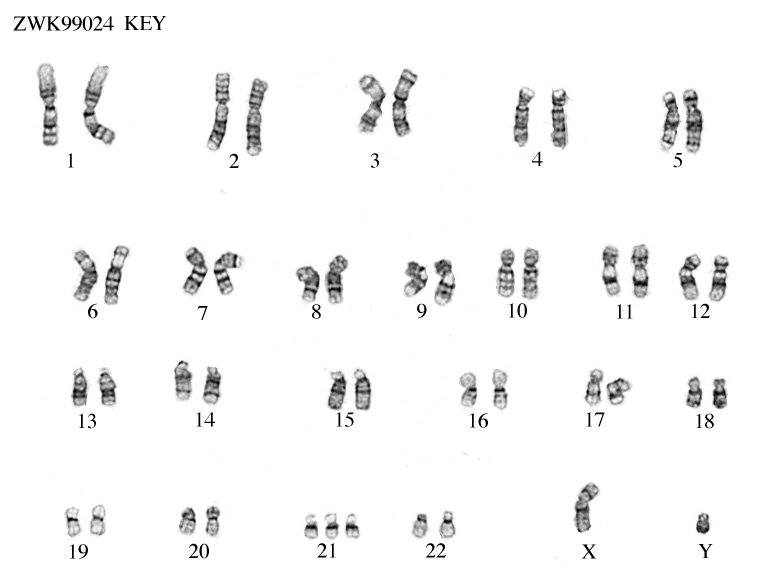
3.2 - What is the mutation in this persons chromosomes?

1

There is only one X

2

7 is shaped like a hockey stick

3

There's an extra 21

4

1 is too curved

37

Multiple Choice

Question image

3.2 - What is the haploid number for this Karyotype?

1

26

2

27

3

52

4

54

38

Slide image

39

Topic 3.3

Meiosis

40

Slide image

41

Slide image

42

Slide image

43

Slide image

44

Slide image

45

Slide image

46

Slide image

47

Multiple Choice

3.3 - Unlike mitosis, meiosis in male mammals results in the formation of

1

one haploid gamete

2

three diploid gametes

3

four diploid gametes

4

four haploid gametes

48

Multiple Choice

Question image

3.3 - Identify the phase.

1

Telophase I

2

Telophase II

3

Metaphase I

4

Metaphase II

49

Multiple Choice

3.3 - After meiosis II the daughter cells will contain ____ chromosomes if the original cell contained 78.

1

78

2

39

3

23

4

46

50

Multiple Choice

Question image

3.3 - Identify the process.

1

Mitosis

2

Meiosis I

3

Meiosis II

4

Interphase

51

Multiple Choice

Question image

3.3 - Identify the phase:

1

Metaphase I

2

Metaphase II

3

Anaphase I

4

Anaphase II

52

Slide image

53

Slide image

54

Slide image

55

Slide image

56

Slide image

57

Multiple Choice

3.3 - Which source of genetic variation is NOT a result of sexual reproduction?

1

Crossing over

2

Independent assortment (due to random orientation

3

Gene mutation

4

Random fertilization

58

Multiple Choice

3.3 - The process of "crossing over" occurs in what phase of meiosis?

1

anaphase 1

2

prophase 1

3

prophase 2

4

telophase 2

59

Multiple Choice

Question image

3.3 - The diagram shows the process of crossing over. Which claim about crossing over in chromosomes is best supported by the diagram?

1

Crossing over increases genetic diversity through deletion.

2

Crossing over decreases genetic diversity through mutation.

3

Crossing over increases genetic diversity by creating new combinations of genes.

4

Crossing over decreases genetic diversity by inserting nucleotides into gene sequences.

60

Multiple Choice

3.3 - This law describes how each homologous pair separates independently of any other pairs during Anaphase I of meiosis

1

Law of Segregation

2

Law of Independent Assortment

3

Law of Gravity

4

Law of Mathematical Order

61

Multiple Select

What contributes to genetic variation?

1

crossing over

2

law of independent assortment

3

law of segregation

4

gene linkage

62

Slide image

63

Slide image

64

Slide image

65

Slide image

66

Slide image

67

Multiple Choice

3.3 - Which of the following is false?

1

Results from chorionic villus sampling come faster than from amniocentesis

2

Chorionic villus sampling is typically performed later in the pregnancy than amniocentesis

3

Ultrasound imaging has no known risk

4

The complication rate for chorionic villus sampling is about 2% and for amniocentesis is 1%.

68

Multiple Choice

3.3 - Amniocentesis and chorionic villus sampling allow for ___________ and ____________ of the fetus so that it can be tested for abnormalities.

1

imaging...biochemical

2

imaging...karyotyping

3

karyotyping...biochemical testing

69

Multiple Choice

3.3 -Testing the amniotic fluid for birth defects.

1

Chorionic Villi Sampling

2

Ultrasound

3

Amniocentesis

4

Embryo Test

70

Multiple Choice

3.3 - What would you call the failure of one or more pairs of homologous chromosomes or sister chromatids to separate normally during meiosis?

1

nondisjunction

2

anaphase I

3

nondiploidy

4

karyotype

71

Multiple Choice

3.3 - When chromosomes fail to separate correctly during anaphase of meiosis, what can occur?

1

extra chromosomes are found in the sex cell

2

chromosomes of the sex cell are doubled

3

chromosomes of the sex cell are halved

4

meiosis never completes

72

Multiple Choice

3.3 - Nondisjunction can result in

1

trisomy conditions

2

monosomy conditions

3

additional sex chromosomes

4

all of these

73

Slide image

74

Slide image

75

Slide image

76

Slide image

77

Slide image

78

Slide image

79

Slide image

80

Multiple Choice

Question image

3.4 - A heterozygous long-tusked elephant is crossed with a homozygous recessive short-tusked elephant. What is the probability of the offspring having short tusks?

1

0%

2

25%

3

50%

4

75%

81

Multiple Choice

3.4 - What maximum number of different genotypes and phenotypes are possible among the children of a mother with blood group A and a father with blood group B?

1

Genotypes: 2 Phenotypes:2

2

Genotypes: 2 Phenotypes:4

3

Genotypes: 4 Phenotypes:4

4

Genotypes: 4 Phenotypes:2

82

Multiple Choice

Mrs. Canal is type A and Mr. Canal is type O. They have three children named Greg, Rosalind and Biff. Greg is type 0, Rosalind is type A and Biff is type AB...

What is Mr. Canal's Genotype?

1

IᴬIᴬ

2

IᴮIᴮ

3

IᴬIᴮ

4

ii

83

Multiple Choice

Question image

Punnett Square: Type AB father and type O mother. What are the percentages of each offspring?

1

Type A: 50%, Type B 0%, Type AB 50%, Type 0 0%

2

Type A: 50%, Type B 50%, Type AB 0%, Type 0 0%

3

Type A: 25%, Type B 25%, Type AB 25%, Type 0 25%

4

Type A: 0%, Type B 0%, Type AB 50%, Type 0 50%

84

Slide image

85

Slide image

86

Slide image

87

Slide image

88

Multiple Choice

Question image

3.4 - Which individuals are color blind in this Punnett grid?

1

XB Y

2

XB XB

3

Xb Y

4

XB Xb

89

Multiple Choice

What are the genotypes of these flies:


white eyed, male ?

1

X R X r

2

X R X R

3

Xr X r

4

X r Y

5

XR Y

90

Multiple Choice

Muscular dystrophy is a sex-linked recessive disorder. A man with muscular dystrophy marries a woman who doesn’t have this disease. Half of their daughters and half of their sons develop this disease. What is the genotype of the mother?

1

XNXN

2

XNXn

3

Xn

4

XN

91

Multiple Choice

Colorblindness is a sex-linked recessive trait. A colorblind woman marries a male with normal color vision. What is the percent chance of them having a color blind son?

1

0%

2

25%

3

50%

4

75%

92

Multiple Choice

Question image
When we say that a woman is a carrier for a genetic disease or disorder it means that
1
she has 1 gene, but not the disorder
2
she has 2 genes for the disorder
3
she can pass the gene only to male children
4
she can pass the gene only to female children

93

Multiple Choice

The sex of a child is determined by
1
whether the father's sperm contains an x or y chromosome
2
whether the mother's egg contains an x or y chromosome
3
the age of the parents

94

Multiple Choice

What are the genotypes of these flies:


red eyed female (heterozygous) ?

1

X R X r

2

X R X R

3

Xr X r

4

X r Y

5

X R Y

95

Multiple Choice

What are the genotypes of these flies:


white eyed, female ?

1

X R X r

2

X R X R

3

Xr X r

4

X r Y

5

X R Y

96

Slide image

97

Slide image

98

Slide image

99

Slide image

100

Slide image

101

Slide image

102

Slide image

103

Slide image

104

Slide image

105

Multiple Choice

Question image

Give the genotype for person II-1, for this autosomal trait.

1

GG

2

Gg

3

gg

4

we cannot be 100% sure of the genotype

106

Multiple Choice

Question image
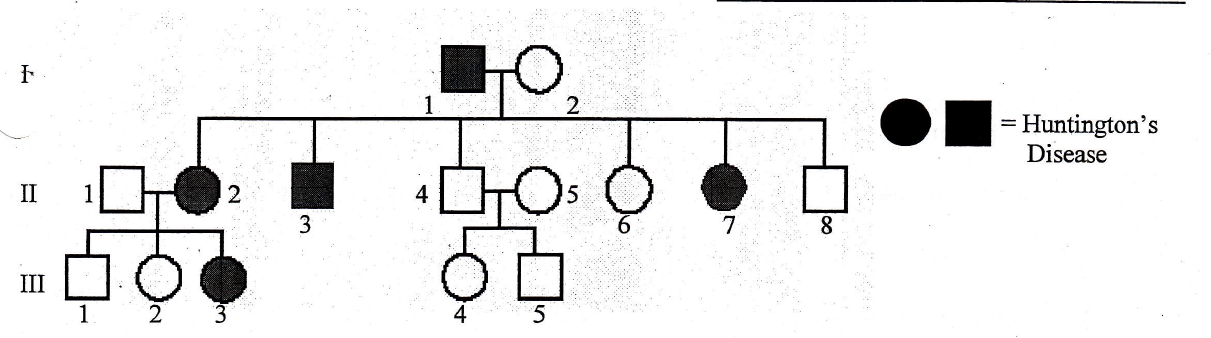
There are no carriers for Huntington's Disease - you either have it or you don't. Is Huntington's disease caused by a dominant or recessive trait?
1
Dominant
2
Recessive
3
Co-dominant
4
Incompletely dominant

107

Multiple Choice

Question image
What evidence is given in the pedigree chart below to establish that the condition is caused by a dominant allele?
1
Two unaffected parents have unaffected children
2
Two affected parents have affected children
3
An affected parent and an unaffected parent have affected children
4
Two affected parents have an unaffected child

108

Multiple Choice

Question image
What type of inheritance is shown in this pedigree chart?
1
X-linked dominant
2
Y-linked dominant
3
X-linked recessive
4
Y-linked recessive

109

Multiple Choice

Question image

How many females are carriers in this family?

1

1

2

2

3

3

4

4

110

Slide image

111

Slide image

IB Bio Topic 3 Genetics Review

Covers Topics 3.1 - 3.4 and AHL 10.1

Slide image

Show answer

Auto Play

Slide 1 / 111

SLIDE