Trophic Levels EOC Review
Presentation
•
Biology, Science
•
8th - 11th Grade
•
Practice Problem
•
Medium
Standards-aligned
rodrigo tavara
Used 204+ times
FREE Resource
7 Slides • 12 Questions
1
Trophic Levels
BIO EOC Review
2
SC.912.L.17.9
(Also assesses SC.912.E.7.1.)
Use a food web to identify and distinguish producers, consumers, and decomposers.
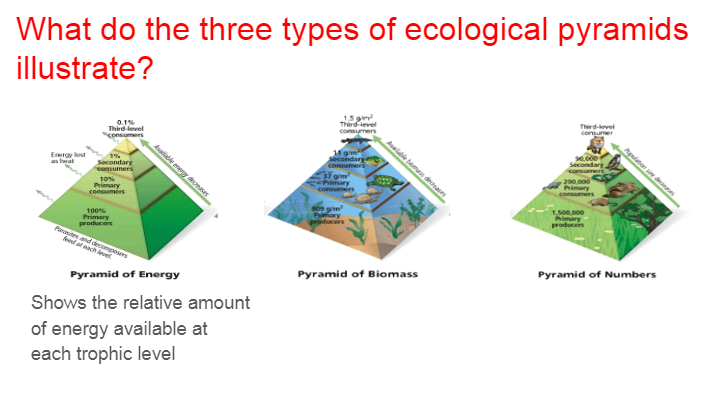
Explain the pathway of energy transfer through trophic levels and the reduction of available energy at successive trophic levels.
3
Multiple Choice
What is the sun's role in the energy pyramid?
to produce chemical energy for the ecosystem.
to provide radiant energy for producers to convert to chemical energy.
to start the energy flow of the ecosystem.
to provide mechanical energy for producers to convert to chemical energy.
4
Multiple Choice
The diagram is intended to show relationships in an ecosystem. What do the arrows represent?
The direction of population migration
Differences in dietary habits
Progressively smaller organisms
The direction of the energy flow
5
6
Multiple Choice
In this energy pyramid, what is the proper name for ANY ORGANISM ABOVE THE PRODUCER LEVEL?
decomposers
consumers
producers
omnivores
7
8
Multiple Choice
The diagram represents different levels of a marine food pyramid. Between which two levels is the greatest amount of energy transferred?
3 and 4
all equal amounts of energy being transferred
2 and 3
1 and 2
9
Multiple Choice
Which organism in figure 1 contains the most available energy?
plants
hawks and owls
spiders
foxes
10
Multiple Choice
What makes an energy pyramid different than a food web or chain?
It shows energy flowing from the top of the chain and downward.
The tropic levels are the opposite
It shows the amount of energy in each trophic level
It shows specific predator/prey relationships
11
12
13
Multiple Choice
A pyramid shape is used to show the amount of available energy at each trophic level because...
energy decreases as you go up the food chain, just like the pyramid shape gets smaller as you go up.
energy increases up the food chain just like the pyramid shape gets smaller as you go up.
energy amounts are the same at each trophic level
14
Multiple Choice
Why are producers found at the base of the pyramid?
They create all of the energy and therefore have the most energy of all of the trophic levels
There are more plants than animals.
They begin the flow of energy in an ecosystem.
All of these answers are correct.
15
16
Multiple Choice
True or False. In this energy pyramid, the consumers on each level only get about 10 percent of energy that the trophic level before it has stored.
True
False
17
Multiple Choice
If only 10% of an organism's energy is available for the next trophic level, what happens with the other 90% of the energy?
It is destroyed after it is used up.
It is used for life processes or lost as body heat.
It remains for the next trophic level IF the predator consumes ALL of the organism.
It is lost completely as body heat.
18
Multiple Choice
The diagram represents a model of a food pyramid. Which statement best describes what happens in this food pyramid?
More organisms die at higher levels than at lower levels, resulting in less mass at higher levels.
When organisms die at higher levels, their remains sink to lower levels, increasing the mass of lower levels.
Energy is lost to the environment at each level, so less mass can be supported at each higher level.
Organisms decay at each level, and thus less mass can be supported at higher levels
19
Multiple Choice
In the energy pyramid below, which organism has the least amount of energy available?
primary carnivore
top carnivore
producers
herbivores
Trophic Levels
BIO EOC Review
Show answer
Auto Play
Slide 1 / 19
SLIDE

Similar Resources on Wayground
12 questions
Rocks and The Rock Cycle
Lesson
•
9th - 12th Grade
15 questions
Do Now: Present tense regulars
Lesson
•
8th - 11th Grade
17 questions
Genetics Review Part 2 (Practice)
Lesson
•
6th - 9th Grade
15 questions
PROTEIN SYNTHESIS
Lesson
•
7th - 11th Grade
15 questions
Plant Vascular System
Lesson
•
9th - 11th Grade
17 questions
Waves
Lesson
•
9th - 11th Grade
13 questions
Independent vs Dependent Variables
Lesson
•
7th - 12th Grade
12 questions
Genotypes: Dominant and Recessive Alleles
Lesson
•
7th - 10th Grade
Popular Resources on Wayground
10 questions
5.P.1.3 Distance/Time Graphs
Quiz
•
5th Grade
10 questions
Fire Drill
Quiz
•
2nd - 5th Grade
20 questions
Equivalent Fractions
Quiz
•
3rd Grade
15 questions
Hargrett House Quiz: Community & Service
Quiz
•
5th Grade
20 questions
Main Idea and Details
Quiz
•
5th Grade
20 questions
Context Clues
Quiz
•
6th Grade
20 questions
Inferences
Quiz
•
4th Grade
15 questions
Equivalent Fractions
Quiz
•
4th Grade
Discover more resources for Biology
14 questions
Ecological Succession: Primary and Secondary
Quiz
•
9th Grade
20 questions
Cladogram Practice
Quiz
•
10th Grade
20 questions
Evolution and Natural Selection
Quiz
•
9th Grade
21 questions
Cell Cycle and mitosis
Quiz
•
9th - 10th Grade
45 questions
Unit 9 Review: Biosphere
Quiz
•
9th Grade
20 questions
Food Chains and Food Webs
Quiz
•
7th - 12th Grade
20 questions
Natural Selection
Quiz
•
8th Grade
20 questions
Sex-Linked Traits
Quiz
•
9th - 12th Grade