

PLANTS YEAR 5 ~ ADAPTATION TO CLIMATE AND SEASONAL CHANGES 1

Presentation
•
Science
•
5th Grade
•
Practice Problem
•
Medium
+1
Standards-aligned

ROSSINAH KASSIM
Used 97+ times
FREE Resource
18 Slides • 20 Questions
1
PLANTS YEAR 5 ~ ADAPTATION TO CLIMATE AND SEASONAL CHANGES 1

2
Multiple Select
3
Multiple Select
4
PLANTS ADAPTATION
Adapting To Climate and Seasonal Changes

5
6
HOT WEATHER/DROUGHT SEASON/HOT CLIMATE
Plants also have special characteristics to adapt to climate and seasonal changes.
Weather that is too hot causes plants to lose a lot of water.

7
1. HAVING LONG ROOTS
The roots of cactus that grow long into the soil enable it to absorb water deep in the soil in a dry area.
Example : Cactus plants

8
2. TRUNK/STEM STORES WATER
The trunk/stem of cactus and banana can store water and enable it to survive even in the drought season or in extremely hot weather.
Examples : cactus, banana plant and aloe vera

9
3. FOLD ITS LEAVES
The turmeric plant will fold its leaves during hot weather to reduce the loss of water.
Examples : turmeric plant, yam plant, banana plant and maize plant

10
SHED ITS LEAVES
Some plants will shed its leaves during drought season or hot weather to prevent loss of excessive water
Examples : rubber tree, acacia tree and maple tree

11
NEEDLE-SHAPED LEAVES
Some trees have tiny needle-shaped leaves to reduce loss of water during hot day or drought season.
Examples : casaurina tree, cactus

12

13
Multiple Choice

Why does rubber tree shed it leaves during hot and dry season?
14
Multiple Choice

Which specific characteristic of this plant to adapt itself during hot and dry season?
15
Multiple Select
16
Multiple Choice

From the diagram, what is the specific characteristic of banana plant to adapt itself to the hot climate and dry season?
17
Multiple Select
18
Multiple Choice

How does bougainvillea tree adapt itself to hot climate and dry season?
19
Multiple Select
20
Multiple Choice
Which specific characteristic of this plant to adapt itself during hot and dry season?
21
Multiple Select
22
Multiple Choice
From the diagram, what is the specific characteristic of banana plant to adapt itself to the hot climate and dry season?
23
Multiple Choice
How does the bougainvillea tree adapt itself to the hot climate and dry season?
24

25
PINNATE LEAVES/DIVIDED LEAVES
Coconut tree has pinnate leaves to reduce wind resistance and prevent it from collapsing when blown by strong wind.

26
FLEXIBLE STEM
Wind-resistant plants have flexible stems, which allow them to bend and sway without breaking.
For instance, palms and crepe myrtles are good wind-resistant plants

27
NEEDLE-LIKE LEAVES
Plants that are adapted to windy conditions usually have small, narrow leaves as well.
Such as needle-leaved conifers, spruce, fir and pine

28
ROOTS SYSTEM
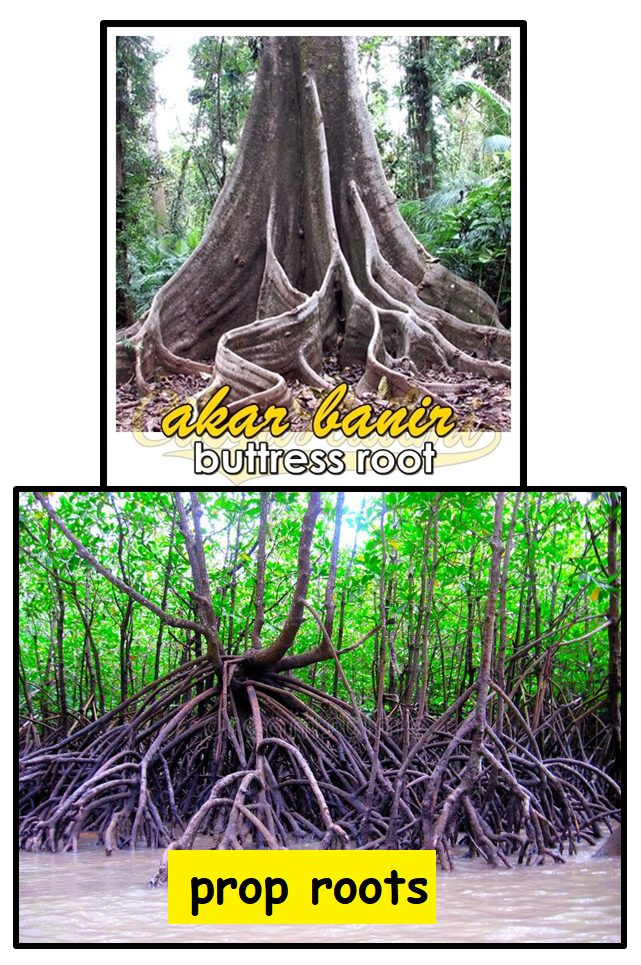
The root system of the plant provides physical support by anchoring the plant body to the soil. Many plants can stand erect for hundreds of years because their roots grow deep into the soil and hold the plants strongly in place.
Mangroves have prop roots descending from the trunk and branches, providing a stable support system.
Buttress roots are large and can prevent the tree from falling over due to strong winds.
29
Multiple Select
30
Multiple Select

State the specific characteristics of plant based on the given situation to adapt themselves to climate and seasonal changes.
Bamboo trees can survive in areas with strong winds.
31
Multiple Choice
32
Multiple Select
State the specific characteristics of plant based on the given situation to adapt themselves to climate and seasonal changes.
Bamboo trees can survive in areas with strong winds.
33

34
COLD WEATHER
1. NEEDLE-LIKED LEAVES
Conifers, pines, and firs tend to grow in areas where snow falls, The needle-liked leaves have adapted to reduce damage from the accumulation of snow. Because the needle-liked leaves are narrow, it's difficult for snow to remain on the leaves, and it falls to the ground.
Examples: conifer leaves, pine leaves, fir leaves, spruce leaves

35
2. THICK BARK
The tree’s bark acts as its first line of defense against the cold.
Thick bark covering the trunks of trees prevents the absorbed water from freezing in an extremely cold climate.

36
Multiple Select

State the specific characteristics of plant-based on the given situation to adapt themselves to climate and seasonal changes.
Pine trees can survive in cold weather.
37
Multiple Select

How do pine trees adapt themselves to climate and seasonal changes?
38
Multiple Select

Why does maple tree have thick bark?
PLANTS YEAR 5 ~ ADAPTATION TO CLIMATE AND SEASONAL CHANGES 1
Show answer
Auto Play
Slide 1 / 38
SLIDE


