Search Header Logo
Final Exam Review: AKS 7, 8, 9

Final Exam Review: AKS 7, 8, 9

Assessment

Presentation

•

Physics

•

9th - 12th Grade

•

Medium

•
NGSS
MS-PS2-3, HS-PS1-1, MS-ETS1-1

+4

Standards-aligned

Created by

Leslie Dunham

Used 4+ times

FREE Resource

17 Slides • 12 Questions

1

Final Exam Review: AKS 7, 8, 9

AKS 7: Electrostatics

AKS 8: Circuits

AKS 9: Magnets/Electromagnets
Slide image

2

Charged objects can apply forces to each other

  • Opposite charges ATTRACT

  • Like charges REPEL

Slide image

3

Objects can become charged by moving ELECTRONS between them

  • Friction - RUBBING

  • Conduction - CONTACT

  • Induction - "Indirect", no contact

Slide image

4

Charging by FRICTION

  • Before: 2 Neutral objects

  • Electrons move from one object to another

  • After: 1 positive object and 1 negative object

Slide image

5

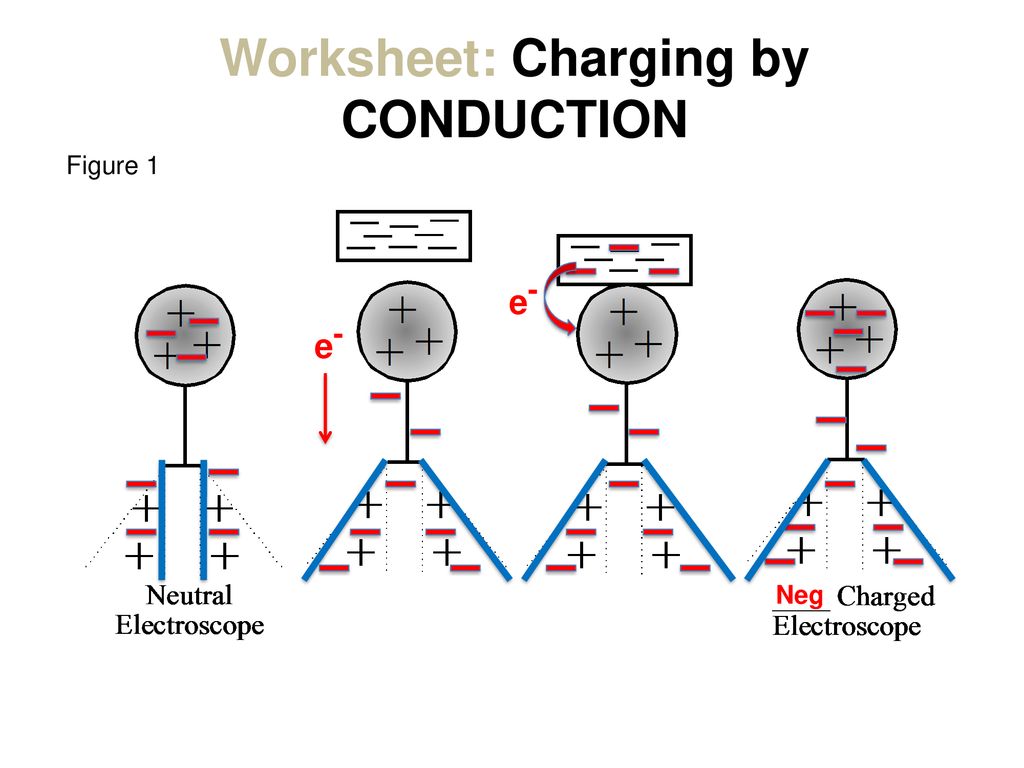
Charging by CONDUCTION

  • Before: 1 charged object and one neutral

  • Electrons move between the objects until both have the same charge

  • After: 2 objects with the same charge

Slide image

6

Electroscope - Conduction

  • Electrons move between objects

  • Leaves stay apart because the electroscope is charged
Slide image

7

Charging by INDUCTION

  • Before: 1 charged and 1 neutral

  • POLARIZATION - charges separate/reorganize

  • After: If grounded, 1 positive and 1 negative

Slide image

8

Electroscope - Induction

  • Polarization causes the leaves to repel

Slide image

9

Multiple Choice

During a physics lab, a plastic strip was rubbed with cotton and became positively charged. The correct explanation for why the plastic strip becomes positively charged is that ...
1
the plastic strip acquired extra protons from the cotton.
2
the plastic strip acquired extra protons from the charging process 
3
protons were created as the result of the charging process
4
the plastic strip lost electrons to the cotton during the charging process 

10

Multiple Choice

Question image

What is the term for the separation of charges that is seen between the negative balloon and the wall?

1

Friction

2

Conduction

3

Polarization

4

Electromagnetism

11

Multiple Choice

A positively charged rod is held near the knob of a neutral electroscope. What best describes what will happen to the leaves?
1
the leaves will spread apart and be positive
2
the leaves will spread apart and be negative
3
the leaves will stay closed and be positive
4
the leaves will stay closed and be negative

12

Circuits

  • Every circuit requires a VOLTAGE source (ex. battery) and a complete path for electrons to flow

Slide image

13

Series vs. Parallel Circuits

  • Series - one single path for electrons; if one element stops work, none work

  • Parallel - multiple paths for electrons; if one element stops working, the others still work

Slide image

14

Circuit Symbols

Slide image

15

Using symbols to draw circuits

Slide image

16

Multiple Choice

When only one lightbulb blows out, an entire string of decorative lights goes out. The lights in this string must be connected in

1

series with multiple current pathways

2

series with one current pathway

3

parallel with multiple current pathways

4

parallel with one current pathway

17

Multiple Choice

Question image

Pick the correct sentence.

1

This circuit will work because it is a closed circuit.

2

Energy will freely flow in this circuit.

3

This circuit will not work because there is no voltage source.

4

This circuit will not work because there is no switch.

18

Multiple Choice

Question image

Which of the following schematic diagrams represents this circuit?

1
2
3

19

Multiple Choice

Question image

Which schematic circuit matches this circuit picture?

1
2
3

20

Multiple Choice

Which schematic diagram shows ,

3 bulbs connected in 1 path, controlled by 1 switch and uses a battery as a source of energy.

1
2
3

21

Magnetism

  • All magnetism comes from moving electrons

  • In magnetic materials like Iron, Nickle, and Cobalt, the atoms align to form MAGNETIC DOMAINS

  • When many DOMAINS are aligned, the object has a magnetic field

Slide image

22

Current creates a magnetic field

  • Since current is moving electrons and moving electrons have a magnetic field, current creates a magnetic field

Slide image

23

24

Electromagnets - using electricity to create temporary magnets

  • Increase voltage/current

  • More loops in coil

  • Iron Core

Slide image

25

Using magnets to create electric current

  • Increase loops in coil

  • Move magnet faster

Slide image

26

Multiple Choice

 If a magnet is pushed into a coil, voltage is induced across the coil. If the same magnet is pushed
into a coil with twice the number of loops,
1
a. one-half as much voltage is induced.
2
b. the same voltage is induced.
3
c. twice as much voltage is induced.
4
d. four times as much voltage is induced.

27

Multiple Choice

What would increase the strength of an electromagnet?
1
Increasing the amount of current flowing through the wire.
2
Inserting a wooden core inside the coil
3
Changing the direction of the current
4
Decreasing the number of coils of wire

28

Multiple Choice

Question image
This is a picture of a simple electromagnet. How can the electromagnet be made stronger?
1
Add more coils of wire to the nail.
2
Use a smaller battery.
3
Reverse the poles of the magnet.
4
Remove all the coils and the nail.

29

Multiple Choice

Question image
You know this substance is magnetized because
1
all the domains have right angles
2
the arrows are drawn in red
3
the domains are aligned
4
the domains are random

Final Exam Review: AKS 7, 8, 9

AKS 7: Electrostatics

AKS 8: Circuits

AKS 9: Magnets/Electromagnets

Slide image

Show answer

Auto Play

Slide 1 / 29

SLIDE