Search Header Logo
Modernity in the United States

Modernity in the United States

Assessment

Presentation

History

10th Grade

Medium

Created by

Meimuna Ahmed

Used 3+ times

FREE Resource

4 Slides • 22 Questions

1

Modernity in the United States

Revision Lesson

Slide image

2

The Economic Boom

  • Was the Major Growth in the Economy in the 1920s

  • After World War I was over everyone started spending tremendously.

  • Women were allowed to get jobs now, credit was invented, people could buy big ticket items on borrowed money.

Slide image

3

The Great Depression

  • But then the Great Depression happened - 1929 –1933

  • The economic boom of the 1920s and then the stock market crash of 1929 was the prelude to the Great Depression

Slide image

4

FDR'S New Deal

  • To try and solve the Great Depression, then President Franklin D. Roosevelt came up with the "New Deal" program.

  • Roosevelt aimed to restore America. He tried to stabilize the economy and provide jobs and relief to those who were suffering.

  • He created a series of New Deal projects and programs, such as the CCC, the WPA, the TVA, the SEC and others

Slide image

5

Multiple Choice

Why did the United States economy boom after WWI?

1

Because a lot of European nations had borrowed money from the US during the war so when the war ended their repayments helped our economy

2

Because the US got a lot of money for winning the war

3

Because the war didn't cost much to begin with

4

Because the US ended poverty completely

6

Multiple Choice

In what way did mass production change the economy?

1

It didn't, the economy was the same.

2

The US became a command economy

3

It made industries grow, gave people jobs, and allowed people to buy consumer goods

4

It slowed down the way things were made

7

Multiple Choice

What grew as a result of Consumer Credit?

1

Incomes

2

Consumer Debt

3

Government Debt

4

Happiness

8

Multiple Choice

In 1927, 1928, and 1929 it was easy to get rich.

1

true

2

false

9

Multiple Choice

When did the stock market crash?

1

1937

2

1929

3

1925

10

Multiple Choice

Some say the Stock Market Crash of 1929 marked the start of the Great Depression!

1

true

2

false

11

Multiple Choice

What is the stock market crash also known as?

1

Dark Tuesday

2

Big Recession

3

Black Tuesday

12

Multiple Choice

What was an effect of the stock market crash?

1

The Enormous Melancholy

2

The Great Depression

3

The Big Sadness

4

The Large Recession

13

Multiple Choice

Stock prices dropped in the fall of 1929 because

1

the stock market was stable.

2

no one was selling their stock.

3

too many people were selling their stock.

14

Multiple Choice

The Great Depression

1

the only time we had an economic depression.

2

was short and didn't affect many people.

3

was deeper and longer than any depression before it.

15

Multiple Choice

President Hoover believed that direct economic relief was not an answer to the Great Depression because

1

it would hurt the American spirit.

2

government should keep a balanced budget.

3

relief should come from state and local governments.

4

All of the above

16

Multiple Choice

Which of these statements is true of the 1932 presidential election?

1

Franklin Roosevelt won in a landslide.

2

Hoover lost by a narrow margin.

3

Huey Long ran a strong campaign.

17

Multiple Choice

A major difference between the philosophies of President Herbert Hoover and President Franklin D. Roosevelt in responding to the Great Depression is that Roosevelt

1

wanted to rely on private charities to provide assistance

2

stressed the need for individual rugged individualism

3

supported direct relief to people who were unemployed.

4

thought the government should not be involved in economic reform

18

Multiple Choice

The election of Franklin D. Roosevelt to the Presidency in 1932 reflected the desire of many Americans to
1
have government take an active role in solving economic problems
2
return to a policy of laissez-faire capitalism
3
continue the domestic policies of the Hoover administration

19

Multiple Choice

FDR addressed the American public in weekly broadcasts known as:
1
FDR Hour
2
Hangin' With Franklin
3
Fireside Chats
4
Around the Fire

20

Multiple Choice

A ___________________ is a time when industries do not grow and many people are out of work.

1

unemployment

2

stock market

3

depression

21

Multiple Choice

Which of the following was a major cause of the Great Depression?

1

overproduction and underconsumption

2

a decrease in the supply of consumer goods

3

an increase in demand for imported products

22

Multiple Choice

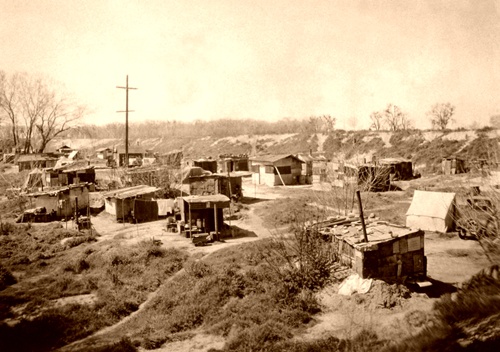
Question image

What was the main reason for the emergence of “Hoovervilles” like the one shown in the photograph?

1

Many Americans had lost jobs during the Great Depression.

2

World War I had created a shortage of building materials.

3

Housing projects could not keep up with the demand for homes needed by the poor.

23

Multiple Choice

What was a guiding principle of the New Deal economic policies?

1

Pro-business tax breaks would solve the problems associated with urban poverty.

2

Rugged individualism must be allowed to solve social inequality.

3

Government must assume more responsibility for helping the poor.

24

Multiple Choice

A major result of the New Deal was that it

1

eliminated poverty in the US

2

extended the merit system in the civil service

3

greatly increased the size and power of the Federal Government

25

Multiple Choice

What are the 3 R's of the New Deal?

1

Relief, Rebuild, and Reform

2

Recover, Rebuild, and Reform

3

Relief, Recovery, and Reform

26

Open Ended

Short Answer Task:


Was Franklin D. Roosevelt's New Deal Programs a success or failure?

Modernity in the United States

Revision Lesson

Slide image

Show answer

Auto Play

Slide 1 / 26

SLIDE