Search Header Logo
Electrostatics

Electrostatics

Assessment

Presentation

Physics

9th - 11th Grade

Medium

NGSS
HS-PS2-4, HS-PS3-5, MS-PS2-3

+5

Standards-aligned

Created by

Debra Williams

Used 33+ times

FREE Resource

39 Slides • 32 Questions

1

Electrostatics
Slide image

2

Slide image

3

Slide image

4

Multiple Choice

Electric charges exert which kind of force?

1

a field force

2

a contact force

3

a gravitational force

4

a frictional force

5

Slide image

6

Slide image

7

Slide image

8

Slide image

9

Multiple Choice

Why does the balloon stick to the wall?

1

There is tape on it

2

The gravitational pull of the wall

3

The electrons in the wall move away making the wall positive

4

The friction of the walls surface

10

Slide image

11

Slide image

12

Slide image

13

Multiple Choice

A negatively charged object and a neutral object can be repelled.

1

True

2

False

14

Slide image

15

Slide image

16

Slide image

17

Slide image

18

Slide image

19

Slide image

20

Slide image

21

Slide image

22

Multiple Choice

What direction do the field lines point for a positive charge?

1

Away from the charge

2

Toward the charge

3

Perpendicular to the charge

23

Multiple Choice

What does it mean when the electric field lines are close together?
1
the field is positive
2
the field is negative
3
The field is strong
4
the field is weak

24

Multiple Choice

Question image

Which type of charges do these balloons have?

1

like charges

2

opposite charges

25

Multiple Choice

Question image

The accumulation of excess electric charge on an object is called

1

Static electricity

2

Electric discharge

3

Resistance

4

Circuit

26

Multiple Choice

Two like charges

1

neutralize each other.

2

repel each other.

3

must be neutrons.

4

attract each other.

27

Multiple Choice

Question image
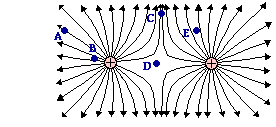
Which of the following labeled points is in the region with the strongest force of electric charge
1
A
2
B
3
C
4
D

28

Multiple Choice

What direction are the electric field lines around an electron?
1
towards the charge
2
away from the charge

29

Multiple Choice

An atom loses an electron.  What type of charge does it have now?
1
positive
2
negative

30

Slide image

31

Slide image

32

Slide image

33

Slide image

34

Slide image

35

Slide image

36

Multiple Choice

Which net charge could be found on an object?

1

4.8 x 10⁻¹⁹ C

2

1.8 x 10⁻¹⁹ C

3

3.0 x 10⁻¹⁹ C

4

2.8 x 10⁻¹⁹ C

37

Multiple Choice

A metal sphere having an excess of +5 elementary charges has a net electric charge of
1
8.0 x 10⁻¹⁹ C
2
8.0 x 10¹⁹ C
3
1.6 x 10⁻¹⁹ C
4
5.0 x 10⁻¹⁹ C

38

Slide image

39

Multiple Choice

What variable do Coulombs represent?
1
Electrostatic Charge
2
Force
3
Distance
4
Mass

40

Multiple Choice

When distance increases, electrostatic force ____________; we call this relationship ____________ proportional

1

decreases;directly

2

decreases;inversely

3

increases;inversely

4

increases;directly

41

Slide image

42

Slide image

43

Multiple Choice

The Electric Force is strongest when charges are...

1

close together

2

far apart

3

the electric force is constant everywhere

44

Multiple Choice

Recap:

Coulomb’s law states that the force between two charged objects will __________ when the magnitude of the object’s charge increases.

Coulomb’s law also states that the force between two charged objects will __________ when the distance between objects increases.

1

increase; increase

2

increase; decrease

3

decrease; increase

4

decrease; decrease

45

Multiple Choice

Electrostatic force F is directly proportional to:
1
r^2 (distance squared)
2
q1
3
q2
4
both q1 and q2

46

Multiple Choice

When distance increases, electrostatic force ____________; we call this relationship ____________ proportional
1
decreases;directly
2
decreases;inversely
3
increases;inversely
4
increases;directly

47

Multiple Choice

If the distance doubles, what happens to the force?
1
Reduced by half
2
Reduced by 1/4
3
Stays the same
4
Quadruples

48

Multiple Choice

Which is the value of the constant in Coulomb's equation?

1

k = 9·10-9

2

k = 9.8

3

k = 6.67·10-11

4

k = 9 ·109

49

Multiple Choice

Which is the value of the constant in Coulomb's equation?

1

k = 9·10-9

2

k = 9.8

3

k = 6.67·10-11

4

k = 9 ·109

50

Slide image

51

Multiple Choice

Two similar metal spheres, A and B, have charges of +2.0 x 10⁻⁶ coulomb and +1.0 x 10⁻⁶ coulomb, respectively. The magnitude of the electrostatic force on A due to B is 4.0N newtons. What is the magnitude of the electrostatic force on B due to A?
1
2.0N
2
4.0N
3
8.0N
4
1.0N

52

Slide image

53

Multiple Choice

Which of the following is not a good insulator?
1
Copper
2
Glass
3
rubber
4
wool

54

Slide image

55

Slide image

56

Slide image

57

Slide image

58

Slide image

59

Multiple Choice

Question image

What is the total charge on this system?

1

-6μC

2

-3μC

3

3μC

60

Multiple Choice

Question image

What is the total charge on this system?

1

-8μC

2

8μC

3

0C

61

Multiple Choice

Question image

What is the total charge on this system?

1

-8μC

2

8μC

3

0C

62

Charging an object

63

Slide image

64

Slide image

65

Slide image

66

Slide image

67

Multiple Choice

A charged balloon is brought near an electroscope but DOES NOT touch the electroscope.  This is an example of charging by
1
Conduction
2
Convection
3
Friction
4
Induction

68

Multiple Choice

Question image
Rubbing a balloon on hair is an example of static charge build up created by....
1
conduction
2
friction
3
induction
4
hairduction

69

Multiple Choice

Transferring a charge without touching is ___
1
conduction
2
induction
3
grounding 
4
Newtons 3rd law

70

Multiple Choice

Removing a static charge by providing a path to the ground is called __.

1

electric transfer

2

grounding

3

switching

4

seperation

71

Multiple Choice

Removing a static charge by providing a path to the ground is called __.
1
electric transfer
2
grounding
3
switching
4
seperation

Electrostatics

Slide image

Show answer

Auto Play

Slide 1 / 71

SLIDE