Search Header Logo
Explaining Static Electricity

Explaining Static Electricity

Assessment

Presentation

Physics

9th Grade

Medium

NGSS
MS-PS2-5, MS-PS2-3, MS-ETS1-1

+2

Standards-aligned

Created by

Dewi Nurfita

Used 21+ times

FREE Resource

9 Slides • 16 Questions

1

Explaining Static Electricity
Slide image

2

Multiple Choice

Which of the following is an example of conductor?

1

rubber

2

metal spoon

3

Slide image

4

Slide image

5

Multiple Choice

A conductor

1

Doesn't allow electricity to pass through it

2

Only conducts electricity in an open circuit

3

Does not light up a bulb if attached to a circuit

4

Allows electricity to pass through it

6

Multiple Choice

In an insulator, electrons transfer from atom to atom to allow electricity to pass through a wire

1

True

2

False

7

Multiple Choice

Why are the wires of a toaster coated in plastic?

1

Plastic is stronger than other materials

2

Plastic is a good electrical conductor

3

Plastic protects people from electricity because it is an insulator

4

Only plastic can be made into the right shape of a wire

8

Multiple Choice

The best insulators are

1

Plastic, rubber, wood, glass

2

Silver, air, paper, silicon

3

Copper, aluminium, gold, steel

4

Ceramic, fabric, paper clip, cork

9

Multiple Choice

A conductor

1

Is usually a metal

2

Conducts heat

3

Can be a copper wire

4

All of the above

10

Multiple Choice

What is a example of a conductor?
1
wood 
2
metal
3
rubber
4
rock

11

Slide image

12

Slide image

13

Multiple Choice

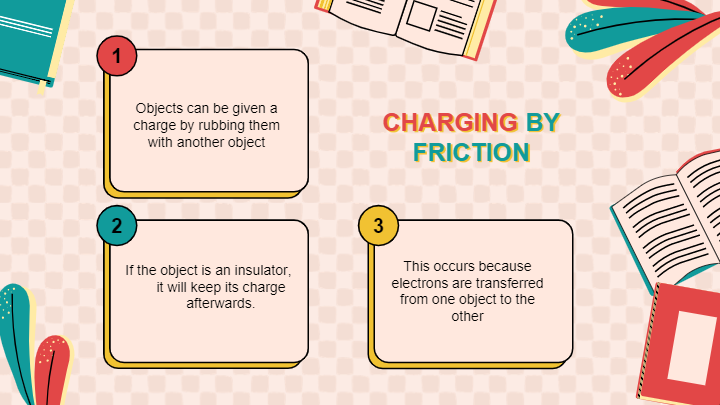
Charging by rubbing is due to -

1

Friction

2

Induction

3

Conduction

4

Contact

14

Multiple Choice

During a lab a balloon was rubbed with a wooly fabric. This is an example of which type of charging?

1

conduction

2

friction

3

induction

15

Multiple Choice

Ms Pippin rubbed two balloons with a piece of wool. What will happen when the balloons are brought near each other?

1

The balloons will repel each other.

2

The balloons will attract each other.

3

The balloons will become positively (+) charged.

4

The balloons will pop.

16

Multiple Choice

An object becomes positively charged by

1

losing protons

2

gaining electrons

3

losing electrons

4

gaining protons

17

Multiple Choice

An object becomes negatively charged by

1

losing protons

2

gaining electrons

3

losing electrons

4

gaining protons

18

Slide image

19

Multiple Select

Transferring a charge without touching is

1

Induction

2

Friction

3

Polarization

4

None of the above

20

Multiple Select

Charging by induction is when

1

A neutral object is charged by proximity to a charged object

2

A static build up of electrons quickly being discharged

3

No movement of electrons

4

Two objects rub together

21

Multiple Choice

If you bring a charged object near an electrically neutral surface without allowing the object to touch the surface, the charges in the surface are rearranged by

1

friction.

2

convection.

3

induction.

4

conduction.

22

Multiple Choice

A charged balloon is brought near an electroscope but DOES NOT touch the electroscope. This is an example of charging by

1

Conduction

2

Convection

3

Friction

4

Induction

23

24

Slide image

25

Slide image

Explaining Static Electricity

Slide image

Show answer

Auto Play

Slide 1 / 25

SLIDE