

EDUC B24: Exploring the Teaching Profession

Presentation
•
Education
•
University
•
Practice Problem
•
Easy

Jennifer Rachal
Used 53+ times
FREE Resource
13 Slides • 8 Questions
1
EDUC B24 Intro to Teaching
Exploring the teaching profession

2
Why do people become teachers?
Intrinsic Motivation
•Most teachers experience intrinsic rewards when their students finally grasp a concept or skill that they have been trying to teach.
•It is rewarding to bring students together as part of a learning community.
•It is exciting to try to meet the needs of each individual student.
•Teaching is never dull or boring and it is always changing.

3
Why do people become teachers?
Extrinsic Motivation
Extrinsic rewards come in the form of acknowledgments and praise from students, other teachers, administration, and parents.
Other extrinsic rewards are receiving promotions or awards.
Another extrinsic reward is a paycheck. While there is a salary and benefits for teachers, money is not a real motivator. You don’t enter the teaching profession to get rich!

4
Multiple Choice
Which is an example of intrinsic rewards?
Getting a raise
Seeing a student progress and improve their reading skills
Having a student say you are his favorite teacher
5
Multiple Choice
Which is an example of extrinsic rewards?
Receiving a diploma/degree
Learning a new skill
Helping a student succeed
6
the teaching profession: pros and cons
Pro/Con:
Teachers are bound by an ethical code as they serve the public. They are expected to be role models. School administrators, members of the school board, and state legislators usually set standards and rules for teachers.
Teachers need to remain active and involved in professional organizations at local, state, and national levels. You must recertify every few years to keep your credential valid.
Pro:
Teachers’ unions and teacher organizations provide professional development opportunities for teachers, help negotiate salary and benefit options, and advocate for the teaching profession.
Con:
Teaching doesn't end at 3:00 PM. Most teachers work nights and weekends to prepare for classes, grade student work, and get their classrooms in order.
Despite the many exams required to become a teacher, it is not viewed in the same class of professions as lawyers, doctors, engineers, and accountants
7
This graphic shows the most important reasons people went into teaching and why they chose to stay in teaching.
Do any of these answers surprise you?
Reason | Description |
Lifelong learning | Continuous opportunities for personal development |
Making a difference | Impacting the lives of students positively |
Job security | Relatively stable employment |
Career Outlook | Positive prospects for career advancement |
Transferable skills | Acquiring skills applicable in various fields |
Building relationships | Forming meaningful connections with students |
Contributing to society | Playing a role in societal development |
Every day is different | Dynamic and varied daily experiences |
Great for families | Work-life balance conducive for family life |
Love for a subject | Teaching a subject you are passionate about |
Loving Learning | Fostering a love for learning in students |
Make an impact | Influencing and shaping the future |
Role Models | Serving as positive role models for students |
Teachers are in demand | High demand for qualified educators |
Work independently | Autonomy and independence in teaching |
Good salary | Competitive and satisfactory salary |
Inspire the next generation | Motivating students to strive for success |
Opportunities to learn | Continuous professional development opportunities |
Passion for education | A deep passion and commitment to education |
Share your passion | Sharing enthusiasm for a subject with students |
8
Open Ended

Have you thought about why YOU want to be a teacher?
Consider some of these reasons and then write your response:
Job security, Inspire others, Motivated by another teacher, Make a difference, Help students who struggle, Have summers/holidays off, Get a paycheck, Seems like fun, Like to work with little kids, I'm not sure yet, Don't know what else to do, Share my knowledge of a subject, etc.
9
teachers matter
Teachers matter more to student achievement than any other aspect of schooling.
Many factors contribute to a student’s academic performance, including individual characteristics, family experience, and where they live. But research suggests that, among school-related factors, teachers matter most. When it comes to student performance on reading and math tests, teachers are estimated to have two to three times the effect of any other school factor, including services, facilities, and even leadership.

10
Open Ended
After watching this short video, write a few sentences about how teachers change lives. Then discuss how you hope to change lives as a teacher.
11
What makes a teacher effective?
Effective teachers are best identified by their performance, not by their background or experience.
Effective teachers are not identified by where they went to school or how long they've been teaching. The best way to assess a teacher's effectiveness is to look at their classroom performance, including how they engage students and how much progress their students make in their learning.
Keep in mind that standardized tests do not measure all the outcomes that teachers are responsible for instructing, so measures based on test scores provide incomplete information about teachers’ effectiveness.

12
Reflection is an essential teaching practice.
Self-reflection means examining our learning and our work and using that insight to plan our future actions.
Taking the time to consider how an activity, learning strategy, or assignment has helped you learn can enable you to identify what’s working, what’s not, and opportunities for improvement.
Successful teachers reflect on the success of each lesson and make adjustments and improvements. This is one of the reasons we practice "Reflections" in our course.
Reflective Teaching Practice

13
steps to become a teacher
High school diploma
College courses in education
Finish your Bachelor's Degree
Take credentialing courses
Participate in Student Teaching
Pass any required state tests
Obtain teaching credential

14
What do Teacher Candidates Need to Do?

Students who have completed their bachelor’s degree are prepared for a license to teach. They must then complete state requirements by taking further education and credentialing courses, participating in field experience, and observing and/or working in schools.
Prior to licensure, teacher candidates must also practice teaching under the supervision of a certified teacher - this is called "student teaching." Some education/credential programs can be completed online, and some programs (like this one!) can be started at community colleges.
After these courses are complete, states have differing requirements for testing or experience before receiving a license or teaching credential. The U.S. Department of Education provides incentives to colleges that recruit, select, train, coach, mentor, and retain teachers in high-need, hard-to-staff school districts. In California, these are called Title I Schools.

15
Reorder
What are the steps to becoming a teacher?
Put the answers in the correct order:
High school graduate
College Courses in Education
Earn a bachelor's degree
Complete Student Teaching
Obtain a teaching credential
16
teacher salaries
As teachers further their educations and gain experience in the field, they receive pay increases that reflect their dedication and hard work. Salaries vary between school districts, but the following are some examples of the salaries you can expect in California:
Experience | Bachelor’s | Master’s |
|---|---|---|
At 3 years | $49,815 | $50,662 |
At 6 years | $52,094 | $57,386 |
At 9 years | $58,818 | $64,110 |
At 12 years | $66,118 | $70,833 |
•Shortage: There is a current teacher shortage in most states, including California. The shortage increased during the pandemic. As a result, teaching posititions are projected to grow 4.9% by 2028. That's more than 300,000 new job openings.
17
Multiple Choice
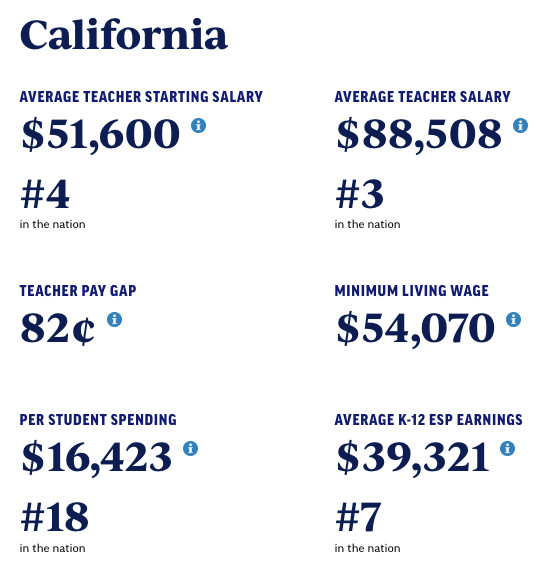
According to the previous chart, the average starting salary for a teacher in California is:
$88,508
$39,321
$51,600
18

Teaching Fields
Click here
If you are willing to teach math, science, English language learners, and students with disabilities, your opportunity of finding a job increases, since there is a shortage of teachers for those areas.
It’s important to remember that the type of community you grew up in may not be the area that needs teachers the most. Highly qualified teachers are always in demand in districts all across the United States.
19
Teaching Fields
Click here
Science, Technology, Engineering, and Mathematics (STEM)
The increase in federal funding for science, technology, engineering, and mathematics (STEM) programs is the result of data showing that fewer than 50% of U.S. high school students are ready to take college-level math and fewer than 40% are ready for college-level science.
Special Education
Special education teachers teach students with mental, behavioral, sensory, physical, and learning disabilities. Their jobs are very demanding and the burnout rate is high.
Urban school districts are in high demand for qualified special education teachers.
English Language Learners (ELLS)/Bilingual
There is also a shortage of culturally and linguistically diverse educators
20
Multiple Select
Which fields in teaching are always in need? Choose all that apply.
Social Studies
Special Education
Physical Education
STEM
English language learners
21
Multiple Select
All done - great work!
How did you like this Quizizz Reading Response? Please choose one answer.
Loved it! I really enjoy this type of activity and would like to do it again.
Liked it. It was a fun activity and I wouldn't mind doing it again.
It was okay. I don't know if I really like this type of activity.
Didn't like it. I prefer a different type of activity.
EDUC B24 Intro to Teaching
Exploring the teaching profession
Show answer
Auto Play
Slide 1 / 21
SLIDE
Similar Resources on Wayground

14 questions
Discuss career choices
Presentation
•
University
15 questions
Gratitude SEL Lesson
Presentation
•
KG - University
15 questions
The Strengths and Weaknesses of the Filipino Character
Presentation
•
University
16 questions
Simple Present
Presentation
•
University
15 questions
UNIV 1301
Presentation
•
University
14 questions
Quantifiers
Presentation
•
University
14 questions
Electron Math
Presentation
•
9th - 12th Grade
14 questions
HEALTH PROBLEMS
Presentation
•
University
Popular Resources on Wayground
6 questions
PRIDE Always and Everywhere
Presentation
•
12th Grade
20 questions
Lab Safety Quiz

Quiz
•
6th Grade
26 questions
KOR Review Kahoot Questions
Quiz
•
8th Grade
21 questions
Continents and Oceans
Quiz
•
6th Grade
12 questions
Unit Zero lesson 2 cafeteria
Presentation
•
9th - 12th Grade
20 questions
Parts of Speech
Quiz
•
5th Grade
10 questions
Riddles Riddles fun Riddles
Quiz
•
6th - 12th Grade
16 questions
Subject & Predicate
Quiz
•
5th Grade
Discover more resources for Education
10 questions
Soup, Salad, or Sandwich?
Quiz
•
1st Grade - Professio...
20 questions
Disney Trivia
Quiz
•
University
8 questions
Extracted Quiz
Quiz
•
University
23 questions
Subject Verb Agreement
Quiz
•
9th Grade - University
67 questions
Unit 3 Random Questions
Quiz
•
11th Grade - University
64 questions
USHC 4 Key Terms 22-23
Quiz
•
11th Grade - University
12 questions
This or That...
Quiz
•
1st Grade - University
25 questions
Comma CFA
Quiz
•
6th Grade - University