Search Header Logo
Plate Tectonic Review/Practice

Plate Tectonic Review/Practice

Assessment

Presentation

Science

9th - 12th Grade

Easy

NGSS
HS-ESS1-5, MS-ESS2-3, HS-ESS2-3

+7

Standards-aligned

Created by

Ashley Roe-Jones

Used 4+ times

FREE Resource

34 Slides • 27 Questions

1

Plate Tectonic Review/Practice

by Ashley Roe-Jones

Learning Targets​

I can identify examples of plate tectonic activity. (Knowledge)

I can describe the process of convection. (Knowledge)

I can identify the role of radioactive decay in the process of convection. (Knowledge)

I can identify the force(s) that cause most of the plate movement on Earth. (Knowledge)

I can identify the different types of plate tectonic settings. (Knowledge) 

I can identify subduction zones, continental collision, rift zones, and ocean basins. (Knowledge)

I can compare and contrast the different types of plate tectonic settings. (Reasoning)

2

media

3

media

4

media

5

media

6

media

7

media

8

media

9

media

10

media

11

media

12

media

13

media

14

Multiple Choice

Question image

This was the super continent, where all of the Earth’s continents were connected together

1

Beringia

2

Pantheon

3

Pangaea

4

Continentia

15

Multiple Choice

Question image

This German scientist first proposed continental drift theory

1

Harry Hess

2

Alfred Wegener

3

Archimedes

4

Thomas Warner

16

Multiple Choice

Question image

Wegener observed scratches from glaciers in Africa and India where it is currently too hot for glaciers to form. This is considered...

1

Fossil Evidence

2

Rock Formation Evidence

3

Climate Evidence

4

Objective Evidence

17

Multiple Choice

Question image

These are remains of dead plants or animals preserved in rock.

1

Glaciers

2

Dinosaurs

3

Bones

4

Fossils

18

Multiple Choice

Question image

Wegener noticed that the Appalachian Mountains and Caledonian Mountains line up and are made of the same rock types. This was a type of ....

1

Fossil Evidence

2

Rock Formation Evidence

3

Climate Evidence

4

Objective Evidence

19

Multiple Choice

Question image

How was Wegener's theory received by other scientists at the time?

1

They thought it was great

2

They did not accept it

20

Multiple Choice

Question image

Why was Wegener's hypothesis not accepted?

1

He could not explain what force was moving the continents

2

He was a meteorologists, so no one took him seriously

3

He did not have enough types of fossils to support his theory

4

Because scientists thought Harry Hess' theory was better

21

Multiple Choice

Question image

What is the correct order (starting from the surface) of Earth’s layers?

1

crust, outer core, inner core, mantle

2

mantle, outer core, inner core, crust

3

crust, mantle, outer core, inner core

4

outer core, inner core, crust, mantle

22

media

23

Multiple Choice

Question image

In sea-floor spreading, molten material rises from the mantle and erupts

1

along the edges of all the continents.

2

along mid-ocean ridges.

3

in deep-ocean trenches.

4

at the north and south poles.

24

media

25

Multiple Choice

Question image

The process by which the ocean floor sinks beneath a deep-ocean trench and back into the mantle is known as _______

1

convection.

2

continental drift.

3

subduction.

4

conduction.

26

media

27

Multiple Choice

Question image

Most geologists think that the movement of Earth’s plates is caused by _______

1

convection.

2

continental drift.

3

subduction.

4

conduction.

28

media

29

Multiple Choice

The geological theory of _______ states that pieces of Earth’s lithosphere are in constant, slow motion.

1

subduction

2

plate tectonics

3

deep-ocean trenches

4

sea-floor spreading

30

media

31

media

32

media

33

Multiple Choice

Scientists think that convection currents flow in Earth’s

1

continents.

2

mantle.

3

lithosphere.

4

inner core.

34

Multiple Choice

A place where two plates slip past each other, moving in opposite directions, is known as a _______

1

transform boundary

2

divergent boundary.

3

convergent boundary.

4

rift valley.

35

media

36

media

37

media

38

media

39

media

40

media

41

media

42

Multiple Choice

Question image

The place where two plates come together is known as a _______

1

transform boundary.

2

divergent boundary.

3

convergent boundary.

4

rift valley.

43

media

44

Multiple Choice

Question image

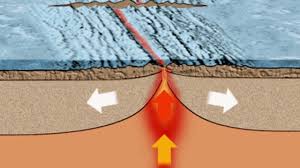
Below is a picture of sea-floor spreading. How are the ocean crusts moving?

1

Converging

2

Diverging

3

Sliding

4

No movement

45

media

46

media

47

media

48

media

49

media

50

media

51

Multiple Choice

The San Andreas Fault in California is known as an active earthquake area. What type of

boundary is it?

1

Converging

2

Diverging

3

Transform

4

Sea Floor Spreading

52

Multiple Choice

Question image
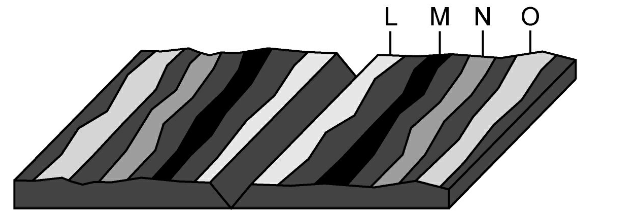
Where would the oldest rock be found?
1
L
2
M
3
N
4
O

53

Multiple Choice

How is it possible for new crust to be formed without increasing the surface area of the Earth?
1
Crust is destroyed at the same time it is created
2
New crust is underwater where it sinks
3
New crust breaks more easily than old crust

54

Multiple Choice

This layer of Earth is the thickest part
1
crust
2
outer core
3
mantle
4
inner core

55

Multiple Choice

What are the two types of crust
1
continental and oceanic
2
ocean and upper
3
lower and upper
4
pizza and subway

56

Multiple Choice

The Himalayas in Asia are an example of what type of plate boundary?
1
divergent
2
continent-to-continent convergent
3
ocean-to-continent convergent
4
transform

57

Multiple Choice

Question image
What type of boundary is the SAN ANDREAS FAULT on?
1
Covergent
2
Transformers
3
Divergent
4
Transform

58

Multiple Choice

Question image
What are Tectonic Plates?
1
A continent 
2
The Trees in Vietnam 
3
ThE PlaTES That MoVE uNdERGRound :)
4
The Plates that move the Continents

59

Multiple Choice

Question image
What is Pangaea?
1
the name of a German scientist
2
the name of the super-continent that existed millions of years ago
3
another name for continental drift
4
the name of an ancient fossil

60

Multiple Choice

Question image
What are the two types of crust?
1
continental and oceanic
2
ocean and basin
3
lower and upper
4
thick and thin

61

Multiple Choice

Mountains form from ...
1
plates sliding past one another
2
collision of plates
3
plates moving away from each other

Plate Tectonic Review/Practice

by Ashley Roe-Jones

Learning Targets​

I can identify examples of plate tectonic activity. (Knowledge)

I can describe the process of convection. (Knowledge)

I can identify the role of radioactive decay in the process of convection. (Knowledge)

I can identify the force(s) that cause most of the plate movement on Earth. (Knowledge)

I can identify the different types of plate tectonic settings. (Knowledge) 

I can identify subduction zones, continental collision, rift zones, and ocean basins. (Knowledge)

I can compare and contrast the different types of plate tectonic settings. (Reasoning)

Show answer

Auto Play

Slide 1 / 61

SLIDE