

BCE/CE

Presentation
•
Social Studies
•
6th Grade
•
Medium

Andrea Peters
Used 34+ times
FREE Resource
14 Slides • 17 Questions
1
Learning Objective: utilize timelines to identify the time sequence of historical data
2
Chronological: [adjective] (of a record of events) starting with the earliest and following the order in which they occurred.
Timeline: [noun] a graphic representation of the passage of time as a line.
3
BCE and CE help us place events in chronological order
Helps us compare different points in history
Helps us determine time between events
Two sets of terms used to organize time:
BCE and CE
BC and AD
4
The exact history is very vague, because it took hundreds of years for the concept to catch on.
Before it was determined, ancient cultures kept track of their years based on astrology, any important events, and/or how many years a leader had been ruling.
Eventually, a Christian came up with the timeline we use today, and it was adopted by the world over hundreds of years as a common way to keep track of and compare time.
5
Jesus was obviously incredibly important in Christian Europe.
in 525 A.D., a monk wanted to work out when exactly Easter would occur in the coming years. He formulated a new table of when the holiday would fall, starting from a year he called “532.”
He then used what he thought was the year of Jesus's birth, an important event for Christians, as year 1.
BC = Before Christ
AD = Anno domini - "the year of our lord"
6
Multiple Choice
BC means...
Before Christ
Before cheese
By chance
7
Multiple Choice
AD means...
After death
in the year of our lord
Among Dus
8
Though it took centuries for A.D. and B.C. to catch on, they stuck. However, some people didn't think it made sense to have religious meanings attached to a dating system used worldwide, especially in the last 30 years.
Therefore, you can now also say...
B.C. = BCE - “before the common era”
AD = C.E. “common era”
9
BCE = Before Common Era
CE = Common Era
Timeline is secular
Secular = not based on religion
We live in the Common Era (CE)
BC = Before Christ
AD = Anno Domini ("year of the lord")
Timeline is based around the birth of Jesus Christ
Current years are labeled AD
Both sets tell us the exact same thing and follow the same years.
10
Multiple Choice
CE means...
common era
come everyone
11
Multiple Choice
BCE means...
By Christian estimates
Before the common era
12
Multiple Choice
Another name for BC times is..
CE
BCE
13
Multiple Choice
Another name for AD times is..
CE
BCE
14
Year "Zero" does not exist
BCE
The higher the number, the earlier the event happened/the older the event is
Counts down to 1
CE
The higher the number, the more recent the event happened/the younger the event is
Counts up from 1
When discussing modern times in the Common Era, "CE" is often assumed and does not need to be included in the date
15
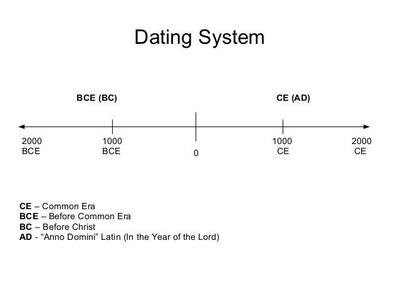
CE dates which are largest are closest to today (2020).
BCE dates get larger the further back in time they go.
16
Think of reading historical timelines like reading a math number line.
Reading BCE dates is sort of like reading negative numbers on a number line.

17
Multiple Choice

Which date is closest to today?
300 BCE
100 BCE
100 CE
200 CE
18
Multiple Choice
Which date is oldest?
100 BCE
200 BCE
200 CE
100 CE
19
Multiple Choice
Which date is oldest?
100 BCE
200 BCE
200 CE
100 CE
20
Multiple Choice
Which date is the oldest?
CE 45
2 BCE
CE 2019
5,000 BCE
21
Multiple Choice
Which date is closest to today?
12 BC
AD 345
AD 187
8,987 BC
22
IF both events are in BCE/BC...
Take the older event (larger number) and SUBTRACT the more recent event (the smaller number) from it
Example: If someone was born in 545 BCE and died in 445 BCE, they lived for 100 years
IF both events are CE/AD...
Take the more recent event (larger number) and SUBTRACT the older event (smaller number) from it
Example: if someone was born in 1910 CE and died in 2010 CE, they lived for 100 years.
23
Fill in the Blanks
How many years separate the following two events: the signing of the Declaration of Independence (1776 CE) and when American women gained the right to vote (1920 CE)?
Type answer...
24
Fill in the Blanks
How many years separate the following two events: the Battle of Marathon (490 BCE) and the end of the Roman Republic (27 BCE)?
Type answer...
25
Fill in the Blanks
The great philosopher Aristotle was born in 384 BCE and died in 322 BCE. How old was he?
Type answer...
26
Fill in the Blanks
President Franklin D. Roosevelt became President in 1933 CE. He presidency ended in 1945. How many years was he president?
Type answer...
27
IF the first event is in BCE/BC and the second event is in CE/AD...
ADD the two numbers together and then SUBTRACT the number 1 from that sum
Example: if someone was born in 50 BCE and died in 50 CE, they lived for 99 years
REMEMBER THE YEAR 0 DOES NOT EXIST AND WE MUST GET RID OF IT IN OUR CALCULATIONS
28
Fill in the Blanks
How many years separate the following two events: The invention of the first alphabet (1700 BCE) and the invention of the lightbulb (1879 CE)?
Type answer...
29
Fill in the Blanks
How many years separate the following: The founding of Rome (753 BCE) and the fall of the Western Roman Empire (476 CE)?
Type answer...
30

Construction of the Great Wall of China begins (221 BCE)
You are born.
Mexico receives its independence from Spain (1810 CE)
Kingdoms of Lower & Upper Egypt unite (3000 BCE)
31
Complete page 1 of your new folder pages
Once finished...
Complete any work that is missing/assigned during Remote
Make corrections/complete pages 1-5 if you were absent or given an extension
Practice one of the Seterra options from Google Classroom
Learning Objective: utilize timelines to identify the time sequence of historical data
Show answer
Auto Play
Slide 1 / 31
SLIDE
Similar Resources on Wayground

26 questions
The Middle Ages
Presentation
•
6th Grade
26 questions
The Roman Way of Life
Presentation
•
6th Grade
22 questions
Geography and the Early Development of Rome
Presentation
•
6th Grade
22 questions
Gupta Empire
Presentation
•
6th Grade
24 questions
Mahatma Ghandi
Presentation
•
6th Grade
25 questions
Continents & Oceans
Presentation
•
6th Grade
25 questions
Rome as a Republic
Presentation
•
6th Grade
23 questions
South Asia History
Presentation
•
6th Grade
Popular Resources on Wayground
21 questions
Continents and Oceans

Quiz
•
6th Grade
20 questions
Parts of Speech
Quiz
•
5th Grade
16 questions
Subject & Predicate
Quiz
•
5th Grade
25 questions
Multiplication Facts
Quiz
•
5th Grade
12 questions
Map Skills
Quiz
•
3rd Grade
22 questions
Continents and Oceans
Quiz
•
5th Grade
15 questions
Rounding Decimals
Quiz
•
5th Grade
20 questions
Brand Labels
Quiz
•
5th - 12th Grade
Discover more resources for Social Studies
10 questions
Exploring the Age of Exploration: Key Events and Figures

Interactive video
•
6th - 10th Grade
15 questions
Historical Inquiry Vocab Quiz
Quiz
•
6th - 8th Grade
17 questions
Timelines
Quiz
•
6th Grade
19 questions
Influencing Govt (Interest Groups-Media)
Quiz
•
6th - 8th Grade
50 questions
The 50 states of the U.S.A.
Quiz
•
6th Grade
17 questions
Mesopotamia: The Land Between the Rivers
Presentation
•
6th Grade
25 questions
Social Studies CA1 Review #2
Quiz
•
6th Grade
17 questions
Population and Migration Review
Quiz
•
6th Grade