Search Header Logo
Ocean Movement

Ocean Movement

Assessment

Presentation

Science

9th - 12th Grade

Easy

NGSS
MS-ESS2-6, MS-ESS2-5, MS-PS1-4

+2

Standards-aligned

Created by

Louise Salerno

Used 5+ times

FREE Resource

5 Slides • 30 Questions

1

media

2

Multiple Select

Which of these 2 are caused by wind? Choose 2:

1

surface currents

2

waves

3

deep currents

4

tides

3

Multiple Select

The 4 main factors that influence currents wordwide are...

1

Wind

2

Earth's rotation

3

Density difference

4

The Land

5

Ocean Life

4

Multiple Choice

The deflection of wind and water currents due to the rotation of the Earth is called...

1

The Coriolis Effect

2

The Cornea Effect

3

The Corona Virus

4

The Toyota Corolla

5

Equatorial Deflection

5

Multiple Choice

Question image

Which way does the Coriolis Effect cause currents to deflect in the Northern Hemisphere?

1

right

2

left

3

up

4

down

6

Multiple Choice

In the northern hemisphere, gyres rotate ____________, while in the southern hemisphere, gyres rotate ____________.

1

Clockwise; Counterclockwise

2

Counterclockwise; Clockwise

3

South; North

4

North; South

7

Multiple Choice

To help regulate Earth's temperature, warm water tends to travel towards the __________, while cool water travels towards the __________.

1

North and South Poles; The equator

2

North; South

3

East; West

4

The equator; North and South Poles

8

Multiple Choice

Question image

This Image represents...

1

Downwelling

2

Upwelling

3

Thermohaline circulation

4

Rip Current

9

Multiple Choice

Water becomes more dense when temperature _____________ and salinity ______________.

1

decreases, increases

2

decreases, decreases

3

increases, decreases

4

increases, increases

10

Multiple Select

Question image

Which factors can affect the movement of water around the world? (choose all that apply)

1

Radiation

2

Wind

3

Salinity Differences

4

Wildlife

5

Coriolis effect

11

Multiple Choice

Question image

Currents at the surface of the ocean are created by:

1

Wind

2

Salinity Differences

3

Temperature Differences

4

Continent placement

12

Multiple Choice

Question image

How long does it take water to circulate through the entire Thermohaline current?

1

100 years

2

500 years

3

1000 years

4

5000 years

5

10000 years

13

Multiple Choice

Question image

Which currents move faster?

1

Surface Currents

2

Deep Ocean Currents

3

They move at the same rate

14

Multiple Choice

The two properties that influence ocean currents are:

1

location and precipitation

2

speed and temperature

3

salinity and speed

4

salinity and temperature

15

Multiple Choice

Which of the following types of water would SINK the fastest?

1

warm and salty

2

cold and salty

3

warm and fresh

4

cold and fresh

16

Multiple Choice

Which term best describes the movement of warming water to the surface?

1

Upwelling

2

Ocean currents

3

Surface currents

4

Downwelling

17

Multiple Select

Question image

Based on the graph, which of the following statement(s) is(are) correct?

1

Warm water sinks to the bottom of the ocean

2

Warm water flows on the surface of the ocean

3

Cold water flows in the deepest part of the ocean

4

Cold water remains stationary in the deepest part of the ocean

18

Multiple Choice

Question image

What does the blue line represent in the Thermohaline circulation?

1

Warm salty water

2

Cold water

3

Warm water

4

Cold salty water

19

Multiple Choice

What is the formula for density?
1
density = mass x volume
2
density = mass / volume
3
density = mass + volume
4
density = mass - volume

20

Multiple Choice

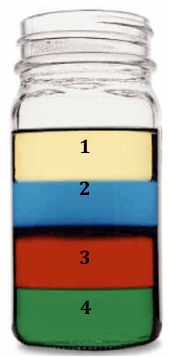
Question image
Put the liquids in order from most dense to least dense?
1
4, 3, 2, 1
2
1, 2, 3, 4
3
3, 4, 2, 1, 
4
4, 3, 1, 2

21

Multiple Choice

Question image
Which box has a higher density?  
1
Box A
2
Box B
3
cannot be determined
4
they are the same

22

Multiple Choice

Question image

Which layer would have the highest salinity?

1

surface mixed zone

2

transition zone

3

deep zone

23

media

24

media

25

media

26

media

27

Multiple Choice

Do sea breezes typically happen during the day or night?
1
Day
2
Night

28

Multiple Choice

How does the air move in a land breeze?
1
From east to west
2
From west to east
3
From the land to the ocean
4
From the ocean to the land

29

Multiple Choice

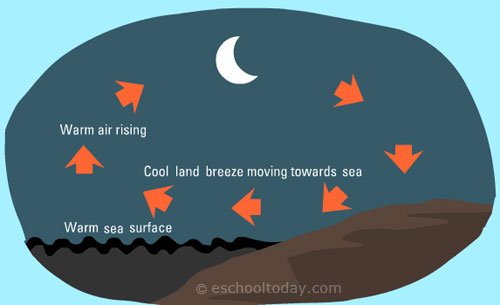
Question image
Is this a land or a sea breeze?
1
land breeze
2
sea breeze

30

Multiple Choice

The strength of a sea breeze depends on
1
the heat of the day
2
the difference between the temperature of the sea and the land
3
the wind speed
4
the amount of precipitation that day

31

Multiple Choice

During a sea breeze which way does the wind blow?
1
from the land to the sea
2
from the sea to the land

32

Multiple Choice

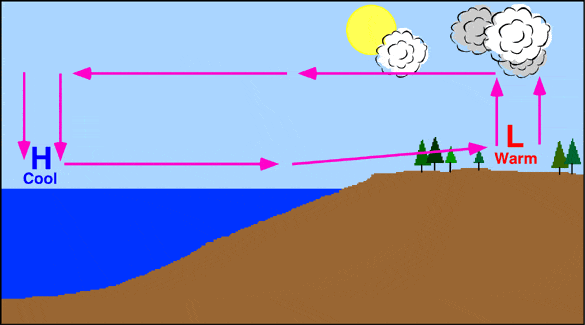
Question image
Is this a land or a sea breeze?
1
land breeze
2
sea breeze

33

Multiple Choice

Why do land breezes occur at night?
1
Land cools off slower than water, so the air above water is cooler.
2
Water cools off faster than land, so the air above land is warmer.
3
Land heats up slower than water, so the air stays cooler during the day.
4
Water cools off slower than land, so the air above water is warmer.

34

Multiple Choice

Do land breezes typically happen during the day or night?
1
Day
2
Night

35

Multiple Choice

In a sea breeze, the air is warmer above the _____.
1
land
2
ocean
3
sky
4
beach
media

Show answer

Auto Play

Slide 1 / 35

SLIDE