

Processes along Plate Boundaries

Presentation
•
Science
•
10th Grade
•
Practice Problem
•
Medium

JOESEL DARIAGAN
Used 10+ times
FREE Resource
14 Slides • 14 Questions
1
By: JOESEL DARIAGAN LPT, MS
2
Explain the different processes that occur along the plate boundaries
3
Open Ended

How Do Tectonic Plates Move?
4
Geomorphology is the scientific study of landforms and the processes that shape them.
5

6

On November 21, 2013, a new island dubbed as Nijima was born after an undersea volcanic eruption at the surface of the Pacific Ocean about 600 miles south of Tokyo, Japan.
7
When continental and oceanic plates collide, the thinner and denser oceanic plate is overridden by the thicker and less dense continental plate. The oceanic plate is forced down into the mantle in a process known as "subduction." As the oceanic plate descends, it is forced into higher-temperature environments. At a depth of about 100 miles (160 km), materials in the subducting plate begin to approach their melting temperatures and a process of partial melting begins.
https://geology.com/nsta/convergent-boundary-oceanic-continental.gif

8
Open Ended

What process if the denser oceanic plate moves under the continental plate?
9
Fill in the Blanks
What is the result of oceanic-continental convergence?
Type answer...
10
When a convergent boundary occurs between two oceanic plates, one of those plates will subduct beneath the other. Normally the older plate will subduct because of its higher density. The subducting plate is heated as it is forced deeper into the mantle, and at a depth of about 100 miles (150 km) the plate begins to melt. Magma chambers are produced as a result of this melting, and the magma is lower in density than the surrounding rock material. It begins ascending by melting and fracturing its way through the overlying rock material. Magma chambers that reach the surface break through to form a volcanic eruption cone. With continued development the islands grow larger, merge, and an elongate landmass is created.
https://geology.com/nsta/convergent-boundary-oceanic-oceanic.gif

11
Fill in the Blanks

When two oceanic plates converge, the denser plate is pushed under the lighter ne. In the process, trench is formed. Lining the trenches volcanoes formed under the ocean. What series of volcanoes formed?
Type answer...
12
In this type of convergent boundary, a powerful collision occurs. The two thick continental plates collide, and both of them have a density that is much lower than the mantle, which prevents subduction (there may be a small amount of subduction, or the heavier lithosphere below the continental crust might break free from the crust and subduct). Fragments of crust or continent margin sediments might be caught in the collision zone between the continents, forming a highly deformed mélange of rock. The intense compression can also cause extensive folding and faulting of rocks within the two colliding plates.
https://geology.com/nsta/convergent-boundary.gif

13
Open Ended

Mountain ranges are formed from continental-continental convergence. Give an example of mountain range
14
CONVERGENT = DESTRUCTIVE
15
Multiple Choice
What geologic features resulted from the collision of the two continental plates?
volcanic island arc
fault
mountain
earthquake epicenter
16
Multiple Choice
Which of the following is the result of the collision of two oceanic plates?
TRENCH
RIFT VALLEY
VOLCANO
FAULT LINE
17
Multiple Choice
Why does the oceanic crust sink beneath the continental crust at the subduction zone?
The oceanic crust has a greater density.
The oceanic crust is pulled downward by Earth’s magnetic field.
The oceanic crust is pushed from the ridge.
The continental crust has a denser composition.
18
Multiple Choice
When a convergent boundary occurs between two oceanic plates, what will happen to one of those plates?
The plate will subduct beneath to the other plate.
The plate will subduct toward to the other plate.
The plate will move away to the other plate.
The plate will move toward to the other plate.
19
DIVERGENT = CONSTRUCTIVE
20
https://geology.com/nsta/divergent-boundary-oceanic.gif

21
https://geology.com/nsta/divergent-boundary-oceanic.gif

22
23
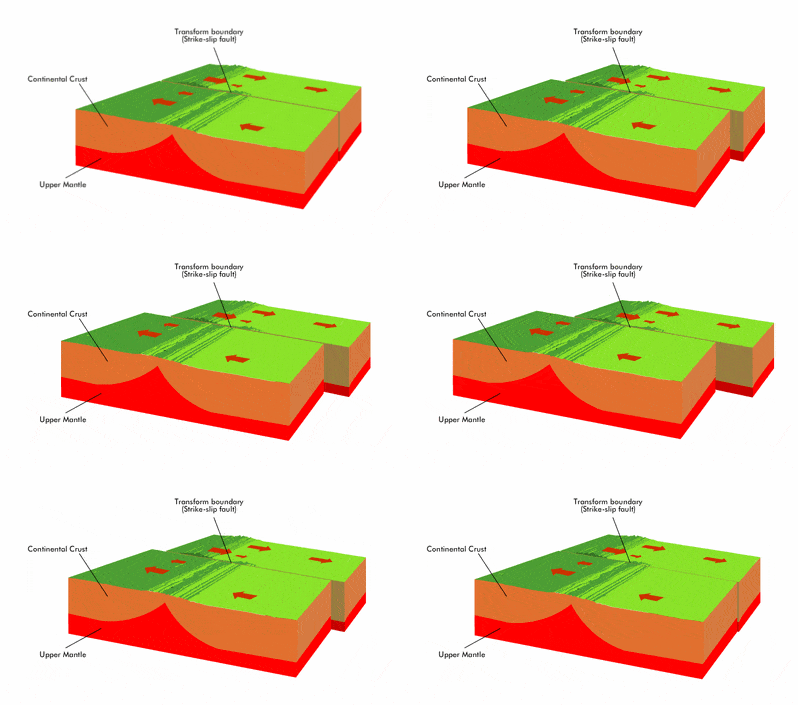
Transform Plates move past one another, sliding. They do not destroy or create land.
24
Multiple Choice
What geologic feature forms when a divergent boundary occurs beneath the oceanic lithosphere and there is a rising convection current below lifts the lithosphere?
mountain belts
volcanic arcs
mid-ocean ridge
afault line
25
Multiple Choice
Which of the following geologic features formed in the divergent plate boundary?
San Andreas fault
Mt. Himalayas
Sierra Madre
Great Rift Valley of East Africa
26
Multiple Choice
What topographic feature is formed in the divergent boundary?
fault
mountain
rift valley
volcano
27
Multiple Choice
Which of the following can we expect to find at a mid-ocean ridge?
relatively young rocks
very ancient rocks
reverse fault
the thick accumulation of sediments
28
Open Ended
Among the three plate boundaries, what is the most dangerous plates when they move?
By: JOESEL DARIAGAN LPT, MS
Show answer
Auto Play
Slide 1 / 28
SLIDE
Similar Resources on Wayground

23 questions
Potential (GPE) and Kinetic (KE) Energy practice
Presentation
•
9th - 11th Grade
21 questions
Introducing Oneself | Grade X | KD 3.1
Presentation
•
10th Grade
21 questions
El imperfecto
Presentation
•
10th Grade
21 questions
Addition and Subtraction
Presentation
•
KG
22 questions
Cross sections
Presentation
•
10th Grade
19 questions
Dihybrid Cross Lesson
Presentation
•
9th - 10th Grade
22 questions
FDAN - Endocrine system
Presentation
•
10th Grade
20 questions
Photosynthesis
Presentation
•
9th - 11th Grade
Popular Resources on Wayground
10 questions
Safety Day 2026 – Student Review

Quiz
•
9th Grade
21 questions
Continents and Oceans
Quiz
•
6th Grade
20 questions
Parts of Speech
Quiz
•
5th Grade
16 questions
Subject & Predicate
Quiz
•
5th Grade
25 questions
Multiplication Facts
Quiz
•
5th Grade
12 questions
Map Skills
Quiz
•
3rd Grade
22 questions
Continents and Oceans
Quiz
•
5th Grade
15 questions
Rounding Decimals
Quiz
•
5th Grade
Discover more resources for Science
10 questions
Exploring Chemical and Physical Changes

Interactive video
•
6th - 10th Grade
10 questions
Exploring the Electromagnetic Spectrum for Middle School Science
Interactive video
•
6th - 10th Grade
10 questions
Exploring Force and Motion Concepts
Interactive video
•
6th - 10th Grade
10 questions
Exploring Air Masses and Weather Fronts
Interactive video
•
6th - 10th Grade
10 questions
Exploring the States of Matter
Interactive video
•
6th - 10th Grade
10 questions
Exploring Forces: Net Force, Normal Force, Gravity, and Friction
Interactive video
•
6th - 10th Grade
10 questions
Differentiating Thermal Energy and Temperature
Interactive video
•
6th - 10th Grade
10 questions
Exploring the States of Matter and Thermal Energy
Interactive video
•
6th - 10th Grade