Search Header Logo
F4 Coordination & Response P1

F4 Coordination & Response P1

Assessment

Presentation

Science, Biology

8th - 9th Grade

Medium

Created by

MAANV LOGAN

Used 14+ times

FREE Resource

19 Slides • 19 Questions

1

media

F4 Coordination & Response P1

by MAANV LOGAN

2

media

3

4

1. stimulus (stimuli) : change that stimulates the response

​2. Two types of stimulus:

stimulus from external environment:

  • ​light

  • ​sound

  • ​smell

  • ​taste

  • ​surrounding temperature

  • ​pressure

  • ​touch

stimulus from internal environment:

  • ​blood osmotic pressure

  • ​body temperature

  • ​blood sugar level

  • ​Blood pH level

​12.1 Coordination and response

5

Multiple Choice

Which of the following are the external stimuli?

1

Sugar level

2

Light intensity

3

Osmotic pressure of blood

4

Cholesterol level

6

Multiple Choice

What do you understand about a response...

1

Any changes in the environment which can trigger response

2

Reaction to a stimulus

7

​components & pathway of human coordination

Receptor:

detects stimulus and convert it to nerve Impuls

​Control/integration centre:

​translates nerve impulse and coordinate an appropriate response

​Effectors: produces response

​Muscle: contract/relax

​gland: secretes hormones

media

8

media
media

Detecting and responding to an external environment

9

Multiple Choice

What is the generalised order during a nervous response?

1

Receptor → stimulus → neurones → effector → response

2

Response → receptor →neurones → effector → stimulus

3

Stimulus → receptor → neurones → effector → response

4

Stimulus → effector → neurones→ receptor → response

10

Multiple Choice

Question image

Which changes take place in the iris of the eye when a person moves quickly from darkness into bright light?

1

A

2

B

3

C

4

D

11

media

Detecting and responding to an internal environment

12

media

13

Multiple Choice

Name the type of receptors that can respond to changes in osmotic concentration of blood..

1

Osmoreceptor

2

Thermoreceptor

3

Chemoreceptor

4

Baroreceptor

14

Open Ended

Question image

State the stimulus

15

Multiple Choice

Question image

State the receptor involved

1

chemoreceptor

2

mechanoreceptor

3

nocireceptor

16

Multiple Choice

Question image

identify the neurone that transport nerve impulse from receptor to the brain 

1

sensory neurone

2

relay neurone

3

motor neurone

17

Open Ended

Question image

what is the role of the integration centre 

18

Multiple Choice

Question image

what is the effector involved 

1

gland

2

muscle

3

mosquito

4

pain

19

12.2 NERVOUS SYSTEM​

media
media

20

Multiple Choice

Name two type of human organ that related in central nervous system..

1

Spinal cord + Brain

2

Spinal cord + Cranial nerve

3

Brain + Spinal nerve

4

Spinal nerve + Cranial nerve

21

media

22

media

23

24

Multiple Choice

Damage to the cerebellum would most affect the career of
1
an architect
2
a teacher
3
an athlete
4
a librarian

25

Multiple Choice

Question image
The lobe responsible for making plans and evaluating consequences
1
Frontal Lobe
2
Temporal Lobe
3
Parietal Lobe
4
Occipital Lobe

26

media

27

Multiple Choice

Brainstorm!

A person suffering from a stroke is having difficulty in moving his left hand.

Which part of the brain is damaged?

1

right hemisphere

2

left hemisphere

28

Multiple Choice

If there are 3 apples and you take away 2, how many do you have ?

1

2

2

3

3

1

29

media

The function of the spinal cord:​

(a) process a few types of sensory information and to send responses through the motor neurones

(b) control reflex action

(c) connect the brain with the peripheral nervous system

30

Multiple Choice

Which of the following are involuntary actions?


A: Riding a bicycle

B: Heart beat

C: Taking this quiz

D: Peristalsis

1

A and B

2

A and C

3

B and D

4

C and D

31

media

32

media

33

media

34

media

​Two-neurone reflex arc

  • knee jerk or patellar reflex

  • ​reflex uses the two neurones nerve pathway

  • ​sensory neurone & motor neurone

  • ​to tests the effectiveness of someone’s nerve system

media

35

Multiple Choice

Question image

State the sequence of impulse transmission in the knee jerk reflex arc.

1

sensory neurone > Relay neurone

2

sensory neurone > Relay neurone> motor neurone

3

sensory neurone > motor neurone

36

Multiple Choice

Question image

how many neurones involves in the reflex action

1

1

2

2

3

3

4

more than 3

37

Multiple Choice

Question image

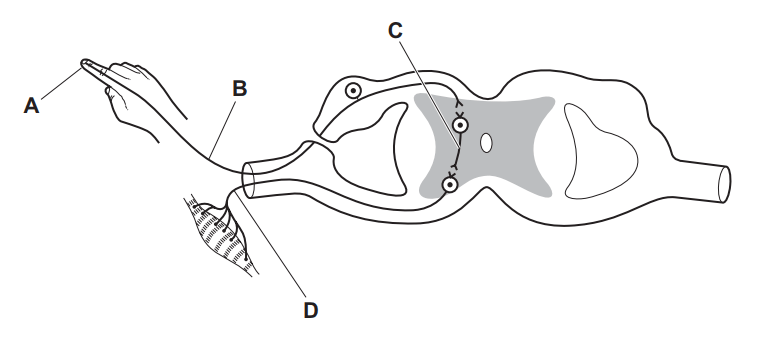
The diagram shows a simple reflex arc.

Which labelled part is the sensory neurone?

1

A

2

B

3

C

4

D

38

​Question

Someone who loses a leg due to a certain disease will still feel pain in the area where the limb was amputated. Explain why.

media

When a body part is amputated, the nerve connections from the periphery to the brain remain in place. The brain can misinterpret the information it's receiving or process the signals as the sensation of pain, even if the amputated portion has since been removed.

media

F4 Coordination & Response P1

by MAANV LOGAN

Show answer

Auto Play

Slide 1 / 38

SLIDE