

Solving Equations w/ Variables on Both Sides

Presentation
•
Mathematics
•
8th - 10th Grade
•
Hard

William Polascak
Used 1+ times
FREE Resource
5 Slides • 28 Questions
1
thanks to Big Ideas Math!
2
Distribute to remove parenthesis
Convert or eliminate fractions
Combine like terms on the same side of the equation
Move variables to one side (doesn't matter which but the smaller coefficient is best) using inverse of addition/subtraction
Move constants to the other side of the variable using invers of addition/subtraction
Isolate the variable by using the inverse of multiplication/division

3

4
Multiple Select
What is the first step in solving
-3x = 2x + 15
Distribute the x
Move the -3x using addition
Move the 2x using subtraction
Add 2x and 19
5
Multiple Choice
The best thing was to move the 2x since the only constant was already on the right side! Now what do you get when you subtract 2x from both sides?
-3x = 2x + 15
-2x = -2x
1x
5x
-1x
-5x
6
Multiple Choice
Since they were both a negative you ADD and KEEP the signs!
Now what do you do?
-5x = 15
Add 5 to both sides
Subtract 5 from both sides
Multiply both sides by 5
Divide both sides by 5
7
Multiple Choice
Since the last step is -5 TIMES x, you have to use the INVERSE and DIVIDE by -5
What is the final answer?
-5x = 15
/5 /5
x = 5
x = -5
x = 75
x = -75
8
Fill in the Blanks
Try this one on your own.
Just write the number of your answer with no spaces.
m - 4 = 2m
Type answer...
9
Fill in the Blanks
Try this one on your own.
Just write the number of your answer with no spaces.
3k - 2 = 7k + 2
Type answer...
10

11
Multiple Choice
What step would you do first to solve
2(n - 3) = 4n + 1
Distribute the 2 to the n - 3
Distribute the 2 to all the terms
Subtract n from 4n
Add 3 to + 1
12
Multiple Choice
Distribute the 2 to n - 3 to remove the ( ). What do you get?
2(n - 3) = 4n + 1
2n - 3
2n - 6
8n
4n
13
Multiple Choice
Remember to distribute to ALL numbers in the ( ).
What is the next step?
2n - 6 = 4n + 1
Add 2n to both sides
Subtract 2n from both sides
Combine the 2n and -6
Combine the 4n and 1
14
Multiple Choice
Moving the variables to one side is the best move.
You can move either, but most people like to move the smaller coefficient!
2n - 6 = 4n + 1
-2n -2n
-6 = 6n + 1
-6 = 2n + 1
4n - 6 = 6n + 1
4n - 6 = 2n + 1
15
Multiple Choice
You should now have the variables on one side only...so move the constants to the other side! How do we do this?
- 6 = 2n + 1
Add 1 to both sides
Subtract 1 from both sides
Add 6 to both sides
Subtract 6 from both sides
16
Multiple Choice
Watch your signs when doing these adding/subtracting steps!
- 6 = 2n + 1
-1 -1
-5 = 2n
5 = 2n
-7 = 2n
7 = 2n
17
Multiple Choice
Same signs mean ADD and KEEP. Now what do we do?
- 7 = 2n
Divide by -7
Divide by 2
Multiply by -7
Multiply by 2
A
18
Multiple Choice
You always divide by the coeffcient with the variable...that is the SECOND number you put in your calculator! What is our final answer?
7 = 2n
/2 /2
7
2
-3.5
3.5
19
Multiple Choice
Solve the equation
4x - 5x + 9 =5x - 9
x = -3
x = 9
x = 3
x = -9
20
Multiple Choice
8x - 8 = -4x + 16
8
16
24
2
21
Multiple Choice
24 = 2a - 6
a=-15
a=15
a= 9
a= -9
22
Multiple Choice
2 + (1∕4)a = 10
a= 32
a= 48
a= 2
a= -2
23
Multiple Choice
3 + a⁄3 = 6
a= 1
a= 3
a= 9
a= 15
24
Multiple Choice
50 = 28.1 + 0.15a
a= 150
a= 146
a= 6
a= 155
25
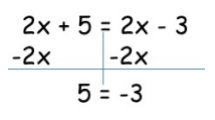
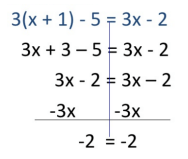
When you solve an equation and all the variables are eliminated you can NOT have one solution...but you have 2 other options
If the numbers left over make a TRUE statement; ex; 2 = 2 you say INFINITELY MANY SOLUTIONS
If the numbers left over make a FALSE statement; ex; 7 = -2 you say NO SOLUTIONS

26
Multiple Choice
Solve:
5x + 4 = 5x − 3
x = 4
x = -3
infinitely many solutions
no solutions
27
Multiple Choice
Solve:
2y − 3 = 2y − 3
y = 0
y = -3
infinitely many solutions
no solutions
28
Multiple Choice
Solve:
3(x − 2) = 3x − 6
x = 6
x = -6
infinitely many solutions
no solutions
29
Multiple Choice
Solve:
6(y + 4) = 6y + 10
y = 10
y = 24
infinitely many solutions
no solutions
30
Multiple Choice
What does it mean when an equation has one solution?
the equation is always TRUE when any value is substituted in for the variable
the equation will NEVER be true when any value is substituted in for the variable
only ONE solution will make the equation true
31
Multiple Choice
What does it mean when an equation has infinitely many solutions?
"To infinity and beyond"
the equation is always TRUE when any value is substituted in for the variable
the equation will NEVER be true when any value is substituted in for the variable
only ONE solution will make the equation true
32
Multiple Choice
33
Multiple Choice
thanks to Big Ideas Math!
Show answer
Auto Play
Slide 1 / 33
SLIDE
Similar Resources on Wayground

23 questions
Add Linear Expressions
Presentation
•
7th - 10th Grade
25 questions
Simplifying Radicals Review
Presentation
•
9th Grade
25 questions
Correlation Coefficient
Presentation
•
9th Grade
27 questions
Isosceles Triangles
Presentation
•
8th - 10th Grade
23 questions
Similarity in Right Triangles
Presentation
•
9th - 10th Grade
26 questions
Arc Length
Presentation
•
9th - 10th Grade
24 questions
Area and Perimeter
Presentation
•
7th - 10th Grade
22 questions
Solving Multi-Step Equations
Presentation
•
8th - 10th Grade
Popular Resources on Wayground
10 questions
Safety Day 2026 – Student Review

Quiz
•
9th Grade
21 questions
Continents and Oceans
Quiz
•
6th Grade
20 questions
Parts of Speech
Quiz
•
5th Grade
16 questions
Subject & Predicate
Quiz
•
5th Grade
25 questions
Multiplication Facts
Quiz
•
5th Grade
12 questions
Map Skills
Quiz
•
3rd Grade
22 questions
Continents and Oceans
Quiz
•
5th Grade
15 questions
Rounding Decimals
Quiz
•
5th Grade
Discover more resources for Mathematics
20 questions
Rational and Irrational Numbers
Quiz
•
8th Grade
20 questions
Add and Subtract Integers
Quiz
•
6th - 8th Grade
20 questions
Slope from a Graph
Quiz
•
8th Grade
15 questions
Adding and Subtracting Integers
Quiz
•
6th - 8th Grade
20 questions
Proportional vs. Non-Proportional
Quiz
•
8th Grade
12 questions
Absolute Value Equations
Quiz
•
9th Grade
14 questions
finding slope from a graph
Quiz
•
8th Grade
24 questions
Explore Rigid Transformations and Congruence
Quiz
•
8th Grade