Term 1 Final review Grade 7
Presentation
•
Science
•
7th Grade
•
Medium
+7
Standards-aligned
Danelle Ackerman
Used 2+ times
FREE Resource
11 Slides • 69 Questions
1
by Danelle Ackerman
2
3
Multiple Choice
What kind of matter is this?
Element
Compound
Mixture
4
Multiple Choice
What kind of matter is this?
Element
Compound
Mixture
5
Multiple Choice
What kind of matter is this?
Element
Compound
Mixture
6
Multiple Choice
What kind of matter is salt (NaCl)?
Element
Compound
Homogeneous Mixture
Heterogeneous Mixture
7
Multiple Choice
What kind of matter is soil?
Element
Compound
Homogeneous Mixture
Heterogeneous Mixture
8
Multiple Choice
What kind of matter is milk?
Element
Compound
Homogeneous Mixture
Heterogeneous Mixture
9
Multiple Choice
What kind of matter is Iron (Fe)?
Element
Compound
Homogeneous Mixture
Heterogeneous Mixture
10
Multiple Choice
What kind of matter is water (H2O)?
Element
Compound
Homogeneous Mixture
Heterogeneous Mixture
11
12
Multiple Choice
13
Multiple Choice
14
Multiple Choice
15
Multiple Choice
16
Multiple Choice
17
Multiple Choice
18
19
Multiple Choice
which of these example is a physical change?
20
Multiple Choice
is the picture chemical or physical
chemical
physical
21
Multiple Select
which one is not an indicator of a chemical change
formation of gas
formation of a solid
formation of liquid
change of colour
change in temperature
22
23
Multiple Choice
An ice cream cone melts in a kid's hand while walking outside on a hot summer day. What is this an example of?
Physical property
Chemical property
Physical change
Chemical change
24
Multiple Choice
A silver ring gets tarnished (becomes dull) as a result of being exposed to air and moisture. What is this an example of?
Physical property
Chemical property
Physical change
Chemical change
25
Multiple Choice
Water boils at 100˚C. What is this an example of?
Physical property
Chemical property
Physical change
Chemical change
26
Multiple Choice
Benzene is a compound that is highly flammable. What is this an example of?
Physical property
Chemical property
Physical change
Chemical change
27
Multiple Choice
28
Multiple Choice
29
Multiple Choice
Which of the following is NOT a clue that a chemical reaction has taken place?
Changing size
Changing color
A gas being formed
Formation of a precipitate (solid material forms in the solution)
30
Multiple Choice
31
Multiple Choice
32
33
Multiple Choice
All matter is made of ___________.
only protons
only neutrons
only electrons
atoms
34
Multiple Choice
An atom is the smallest unit of a substance that still has properties of a substance.
True
False
35
Multiple Choice
Which person in history believed that matter was made of earth, fire, water, and air?
Aristotle
Beethoven
Chadwick
Dalton
36
Multiple Choice
Which person in history stated that atoms of one element are identical to each other but different from atoms of other elements?
Aristotle
Beethoven
Chadwick
Dalton
37
Multiple Choice
What is an atom mostly made of?
air
empty space
neutrons
protons
38
39
Multiple Choice
What is the charge of a proton?
positive
negative
neutral
40
Multiple Choice
What is the charge of a neutron?
positive
negative
neutral
41
Multiple Choice
What part of an atom determines the element that it belongs to?
proton
neutron
electron
atomic mass
42
Multiple Choice
Mass Number = __________
protons + electrons
neutrons + electrons
protons + neutrons
protons - neutrons
43
Multiple Choice
Atomic Number = number of ______
protons
neutrons
electrons
protons + neutrons
44
Multiple Choice
Atoms of the same element can have different mass numbers?
true
false
45
Multiple Choice
If an atom has a positive or negative charge we call it a(an) ____.
excited atom
isotope
positive/negative atom
ion
46
47
Multiple Choice
What determines the order of elements on today's periodic table?
increasing atomic mass
decreasing atomic mass
increasing atomic number
decreasing atomic number
48
Multiple Choice
From this element key of Nitrogen, determine the atomic mass of nitrogen
7
7.01
14.01
21.01
49
Multiple Choice
Which is NOT a property of metals?
brittleness
conductivity
ductility
luster
50
Multiple Choice
Where are most metals on the periodic table?
on the left side only
on the right side only
in the middle only
on the left side and in the middle
51
Multiple Choice
The table above lists some information about certain elements in group 17. Which statement describes what happens to these elements as atomic number increases?
Both melting point and boiling point decrease.
Melting point increases and boiling point decreases.
Melting point decreases and boiling point increases.
Both melting point and boiling point increase.
52
Multiple Choice
What is the chemical symbol of this element?
8
O
Oxygen
15.999
53
Multiple Choice
What does A represent on an element box?
Element name
Element symbol
Atomic Number
Atomic Mass or Mass Number
54
55
Multiple Choice
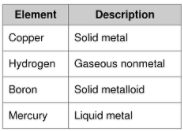
Use the table.
An unknown substance is a semi-conductor and is very brittle. This unknown substance could be which of the following elements form the table?
Copper
Mercury
Boron
Hydrogen
56
Multiple Choice
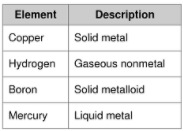
Use the Table.
An unknown substance takes the shape of its container and has a mirror like luster. This unknown substance could be which of the following elements from the table?
Mercury
Hydrogen
Boron
Copper
57
Multiple Choice
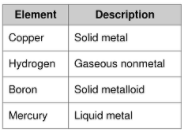
An unknown substance is a very good conductor of heat and electricity and can be bent and shaped easily. This unknown substance could be which of the following elements form the table?
Boron
Mercury
Hydrogen
Copper
58
Multiple Choice
The property of metals by which they can be beaten in to thin sheets is called
Sonority
Malleability
Ductility
None of the above
59
Multiple Choice
The property of metals by which it can be drawn into wires is
Malleability
Sonority
Lustrous
Ductility
60
Multiple Choice
Metals are good conductor of
Only heat
Only electricity
Heat and electricity both
None of the above
61
62
Multiple Choice
63
Multiple Choice
64
Multiple Choice
65
Multiple Choice
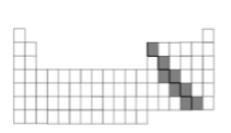
Elements in the shaded area can best be described as -
Semi-conductors
Insulators
Ductile
Siny
66
Multiple Choice
Elements in the shaded area can best be described as -
Shiny and brittle
Insulators
Good conductors
67
Multiple Choice
68
69
Multiple Choice
70
Multiple Choice
71
Multiple Choice
72
Multiple Choice
73
Multiple Choice
74
Multiple Choice
_______ is the length of the path between two points.
distance
reference
statistic
law
75
Multiple Choice
An object is in ____ if its position changes relative to another object.
motion
reference
gravity
stationary
76
Multiple Choice
Jeff is in a stationary school bus. Which is the best reference point for him to use to determine when the bus starts to move?
the front entrance of the school
the school bus sitting next to him
a car waiting to pick up another student
a student walking on the sidewalk
77
Multiple Choice
A ______ is a place or object used for comparison to determine if something is in motion.
reference point
potent potable
cross interestion
slope
78
Multiple Choice
79
Multiple Choice
80
Multiple Choice
If Mr. Deem is walking 3 m/s to the north and Mr. Silvio is walking 3 m/s to the west, then which of the following is true
They have the same speed and different velocities
They have the same velocity and different speeds
They have the same speed and velocity
They have different speeds and different velocities
by Danelle Ackerman
Show answer
Auto Play
Slide 1 / 80
SLIDE

Similar Resources on Wayground
74 questions
Intro to Binary Numbers
Presentation
•
6th - 8th Grade
74 questions
04 Unit: Mexican National Era
Presentation
•
7th Grade
74 questions
Middle East Environmental Issues
Presentation
•
7th Grade
78 questions
Science PMA 2 Review
Presentation
•
7th Grade
75 questions
Motion Gr 7
Presentation
•
7th Grade
76 questions
Quiz Review: Expressions, Equations and Inequalities
Presentation
•
7th Grade
76 questions
MEIOSIS REVIEW
Presentation
•
6th - 8th Grade
Popular Resources on Wayground
10 questions
Safety Day 2026 – Student Review
Quiz
•
9th Grade
21 questions
Continents and Oceans
Quiz
•
6th Grade
20 questions
Parts of Speech
Quiz
•
5th Grade
16 questions
Subject & Predicate
Quiz
•
5th Grade
25 questions
Multiplication Facts
Quiz
•
5th Grade
12 questions
Map Skills
Quiz
•
3rd Grade
22 questions
Continents and Oceans
Quiz
•
5th Grade
15 questions
Rounding Decimals
Quiz
•
5th Grade
Discover more resources for Science
10 questions
Exploring Chemical and Physical Changes
Interactive video
•
6th - 10th Grade
14 questions
Week 1 Falcon Flex Fast and Curious
Quiz
•
7th Grade
42 questions
Explore Plate Tectonics and Boundaries
Quiz
•
7th Grade
21 questions
Waves and Wave Properties
Quiz
•
6th - 8th Grade
16 questions
Photosynthesis and Cellular Respiration Review
Quiz
•
7th Grade
20 questions
Food Webs + Energy Pyramids
Quiz
•
7th Grade
9 questions
Biology: Cell Structure
Interactive video
•
7th Grade
8 questions
Diffusion and Osmosis Review
Presentation
•
6th - 8th Grade