

Science PMA 2 Review

Presentation
•
Science
•
7th Grade
•
Medium
+19
Standards-aligned

Jennifer Napolitano
Used 21+ times
FREE Resource
17 Slides • 61 Questions
1


Quarter 2
Science PMA Review
2


Types of
Waves
Need a medium
Sound waves, Water
waves, Seismic Waves
Mechanical Waves
Does not need a medium
Can move through space
Light waves, Radio waves,
Microwaves
Electromagnetic
Waves
3
Multiple Choice
Which of the following is true for sound waves?
They require a medium.
They are unrelated to vibrations.
They cannot travel through liquids
They can travel in a vacuum
4
Multiple Choice
How do electromagnetic and mechanical waves compare?
Mechanical waves can only travel through a vacuum, but electromagnetic waves can travel through a solid, liquid, or gas.
Mechanical waves can travel through a solid, liquid, or gas, but electromagnetic waves can only travel through a gas.
Mechanical waves can only travel through a solid, liquid, or gas, but electromagnetic waves can travel through a vacuum.
Mechanical waves can travel through a solid, liquid, or gas, but electromagnetic waves can only travel through a solid.
5
Multiple Choice
A student asks a series of questions about a wave. The answer to which question will allow the student to determine whether the wave is electromagnetic or mechanical?
Does it require a medium in order to travel?
Can it pass through air and water?
Does it have a measurable speed?
Does it have a measurable frequency?
6

Sound vs Light Waves
Sound Waves:
●Move like a longitudinal wave
● Is a Mechanical waves because
sound needs a medium
●Cannot travel in space
●Moves fastest in solid
●Move slowest in gas
Light Waves:
●Move like a transverse wave
●Is a Electromagnetic waves because it does NOT need a medium
●Moves fastest in space & gas
●Move slowest in solid
7
Multiple Choice
8
Multiple Choice
9
Multiple Choice

10
Multiple Choice
11
Multiple Choice

12
Multiple Choice
13
Multiple Choice
14


Wavelength & Frequency Relationship
As the wavelength increases, the frequency and the energy decrease.
As the wavelength decreases, the frequency and the energy increase.
15


The
ElectromagneticSpectrum
The visible light
spectrum is the
only one we can
see!
The energy and
frequency
increase from
Radio to Gamma!
16
Multiple Choice
In the electromagnetic spectrum, which of the following is true of waves with long wavelengths?
They have high frequencies
They have low frequencies
They have moderate frequencies
They have inconsistent frequencies
17
Multiple Choice
Sunscreen bottles often include the phrase: “Protects against UVA and UVB waves.” This refers to ultraviolet radiation coming from the sun. Which of the following is true of ultraviolet radiation?
Ultraviolet radiation has shorter wavelengths than x-rays, therefore it is more dangerous than xrays.
Ultraviolet radiation has longer wavelengths than infrared light, therefore it is more dangerous than infrared light.
Ultraviolet radiation has shorter wavelengths than visible light, therefore it is more dangerous than visible light.
Ultraviolet radiation has longer wavelengths than gamma radiation, therefore it is more dangerous than gamma radiation.
18
Multiple Choice
What part of the electromagnetic spectrum can be seen by humans?
Visible Light
Microwaves
Ultraviolet Waves
Infrared Waves
19
Multiple Choice

Which has a higher frequency?
Wave N
Wave O
Same frequency
There is no frequency
20
Multiple Choice
Our eyes detect light that lies only within a small region of the electromagnetic spectrum. This region is called visible light. Which of these statements describes the visible spectrum of light as seen by the human eye?
The lowest frequency appears red, and the highest frequency appears violet.
The lowest frequency appears green, and the highest frequency appears red.
The lowest frequency appears blue, and the highest frequency appears orange.
The lowest frequency appears yellow, and the highest frequency appears green.
21
Multiple Choice
How does the hazard level of electromagnetic waves change as the frequency of the waves increases?
Energy and wavelength increase; it becomes more hazardous.
Energy and wavelength decrease; becomes less hazardous.
Energy decreases, wavelength increases; it becomes less hazardous.
Energy increases, wavelength decreases; it becomes more hazardous.
22

W
E
D
Erosion
Deposition
Breaking down of rock into sediment by physical, chemical or biological processes.
Movement of sediment
by wind, water ice or gravity.
Sediment is dropped in another location creating a new landform.
Weathering
23
Multiple Choice
24
Multiple Choice
25
Multiple Choice
26
Multiple Choice

27
Multiple Choice

28
Multiple Choice
What formation results when a river deposits sediment and it slows down as it enters a large body of water?
dune
floodplain
delta
bay
29

Convergent Boundary
Divergent Boundary
The tectonic plates move
TOWARD each other.
The tectonic plates move AWAY from each other.
The tectonic plates move
PAST each other.
Transform Boundary
30


Metamorphic Rock
Forms when rock is exposed to high levels of heat and pressure due to being pushed under Earth at
convergent boundaries at subduction zones.
Igneous Rock
Forms when lava or magma cools.
Can be found on the ocean basin at divergent
boundaries and volcanoes.
Sedimentary Rock
Forms when sediments are compacted together.
Rocks can contain layers, fossils and small rocks.
31
Multiple Choice
32
Multiple Choice
33
Multiple Choice
34
Multiple Choice
35
Multiple Choice
36
Multiple Choice
37
Multiple Choice
Which events are most common along tectonic plate boundaries?
earthquakes and erosion
hurricanes and tsunamis
earthquakes and volcanoes
tidal waves and volcanoes
38


Earth’s Spheres
39
Multiple Choice
40
Multiple Choice
41
Multiple Choice
42


Water Cycle
Evaporation: Liquid to a gas.
Condensation: Gas to a liquid.
Precipitation: Rain, hail, sleet and
snow.
Transpiration: Evaporation from a
plant.
Percolation/Infiltration: Water moving into soil.
The sun powers
the water cycle!
43


The atmosphere protects the Earth &
keeps it warm! The troposphere is
where we live and weather occurs.
44
Multiple Choice
When water falls from clouds in liquid or solid form
precipitation
condensation
accumulation
evaporation
45
Multiple Choice
Warm water heats up to form water vapor in what process
evaporation
condensation
run off
46
Multiple Choice
What is evaporation?
Water freezes.
Water vapor meets cold air and changes back into liquid.
Water gets warm and changes from liquid water to water vapor.
Plants take in water from the soil.
47
Multiple Choice
What is the correct term for plants releasing water from their leaves, which then evaporates?
transpiration
precipitation
condensation
evaporation
48
Multiple Choice
49
Multiple Choice
50
Multiple Choice

51
Multiple Choice
52
Multiple Choice
53
Multiple Choice
54


Weather &
Climate Factors:
●Location near Equator or poles:
-Warmer near the Equator and Colder near the poles.
●Location near ocean/water or inland:
-More rain near the ocean and less temperature variation or changes.
●Location high in the mountains:
- Colder temperature & more rain
55


What moves weather around the globe?
The jet stream is a fast moving stream of air that move weather and warm/cold air masses around the globe.
56


How does wind form?
The warm air forms over
land due to radiation
from the sun.
The land heats faster than the water.
A sea-breeze can move
clouds and rain over the land.
57


Heat Transfer
Heat flows from Higher Temperatures (HOT) to
Lower Temperature (COLD).
58
Multiple Choice
What is weather?
average weather over a long period of time
average precipitation at a certain time and place
average temperature at a certain time and place
what's happening in our atmosphere at a certain time and place
59
Multiple Choice
60
Multiple Choice
61
Multiple Choice
62
Multiple Choice

63
Multiple Choice
What causes warm air to rise?
it's less dense than cold air
it weighs more than cold air
it has higher pressure than cold air
it's more dense than cold air
64
Multiple Choice
65
Multiple Choice
66
Multiple Choice
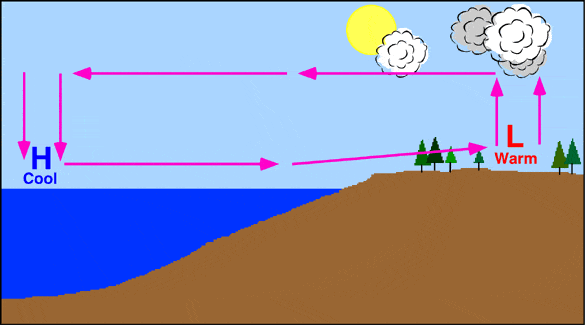
Is this a land breeze or a sea breeze?
land breeze
sea breeze
67




68


Infectious
Diseases
Food poisoning
Pneumonia
Strep thoat
Bacteria
Viruses
Fungi
Protist
Flu
Covid-19
Common Cold
Ringworm
Athletes Foot
Candidias
Malaria
Giardia
toxoplasmosis
69
Multiple Choice
Carries oxygen and nutrients to all parts of the body.
Integumentary
Nervous
Circulatory
Respiratory
70
Multiple Choice
Receives stimuli and transports impulses, coordinates actions and reactions in the body
Integumentary
Nervous
Circulatory
Respiratory
71
Multiple Choice
Supports and provides structure for the body
Skeletal
Muscular
Circulatory
Respiratory
72
Multiple Choice
Skin is what line of defense in the immune system?
First
Second
Third
Seventh
73
Multiple Choice
Breaks down food into tiny molecules to allow the body to
absorb nutrients
Skeletal System
Circulatory System
Respiratory System
Muscular System
Digestive System
74
Multiple Choice
Which 2 body systems work together to
produce and transport blood cells?
Circulatory and muscular
Digestive and Excretory
Skeletal and integumentary
Skeletal and circulatory
75
Multiple Choice
Which of these is not a physical barrier of your body to disease?
skin
mucous membranes
chemicals
hair
76
Multiple Choice
Bacteria are ________ -celled organisms
two
multi
one
77
Multiple Choice
Colds and the Flu are what type of pathogen?
Virus
Fungi
Protist
Bacteria
78
Multiple Choice
A protist that causes an infection of the blood is called ______________
athletes foot
ringworm
malaria
Quarter 2
Science PMA Review
Show answer
Auto Play
Slide 1 / 78
SLIDE
Similar Resources on Wayground

71 questions
Human Geography: Introduction to Maps
Presentation
•
7th Grade
74 questions
Cell Types
Presentation
•
6th - 8th Grade
71 questions
Struktur Bumi
Presentation
•
7th Grade
74 questions
Air Masses, Fronts, and Pressure
Presentation
•
6th - 8th Grade
72 questions
AKS 10 - Electricity and Magnetism
Presentation
•
8th Grade
76 questions
7th Introduction to Life ScienceSection 1- Science of Biology
Presentation
•
7th Grade
76 questions
Environmental Science Unit 1 Chapter 1 Lesson 3
Presentation
•
7th Grade
71 questions
Biotic vs Abiotic Factors
Presentation
•
6th - 8th Grade
Popular Resources on Wayground
10 questions
Safety Day 2026 – Student Review

Quiz
•
9th Grade
21 questions
Continents and Oceans
Quiz
•
6th Grade
20 questions
Parts of Speech
Quiz
•
5th Grade
16 questions
Subject & Predicate
Quiz
•
5th Grade
25 questions
Multiplication Facts
Quiz
•
5th Grade
12 questions
Map Skills
Quiz
•
3rd Grade
22 questions
Continents and Oceans
Quiz
•
5th Grade
15 questions
Rounding Decimals
Quiz
•
5th Grade
Discover more resources for Science
10 questions
Exploring Chemical and Physical Changes

Interactive video
•
6th - 10th Grade
14 questions
Week 1 Falcon Flex Fast and Curious
Quiz
•
7th Grade
42 questions
Explore Plate Tectonics and Boundaries
Quiz
•
7th Grade
21 questions
Waves and Wave Properties
Quiz
•
6th - 8th Grade
16 questions
Photosynthesis and Cellular Respiration Review
Quiz
•
7th Grade
20 questions
Food Webs + Energy Pyramids
Quiz
•
7th Grade
9 questions
Biology: Cell Structure
Interactive video
•
7th Grade
8 questions
Diffusion and Osmosis Review
Presentation
•
6th - 8th Grade