

Quarter 2 Mini-Lesson: Heat Transfer

Presentation
•
Science
•
6th - 8th Grade
•
Medium
+3
Standards-aligned

Carly MacMillan
Used 17+ times
FREE Resource
3 Slides • 10 Questions
1
SC.7.P.11.1 Recognize that adding heat to or removing heat from a system may result in a temperature change & possibly a change of state. (DOK 1)
SC.7.P.11.4 Observe and describe that heat flows in predictable ways, moving from warmer objects to cooler ones until they reach the same temperature. (DOK 2)

2
3
Heat is the movement of thermal energy from one object or substance to another.
Heat is transferred by conduction, convection, or radiation.
Conduction is the transfer of heat from two objects in direct contact with each other (touching). Heat moves from the warmer object or substance to the cooler. This is how you burn your skin if you touch something really hot!
Radiation is the transfer of heat in electromagnetic waves, or rays. This is the only way heat can move through a vacuum (empty space), therefore it is how the Sun's energy travels to Earth.
Convection is the transfer of heat throughout fluids (substances that flow, like liquids and gases). As fluids are heated their particles move faster and they become less dense and rise (away from their heat source) and then cool and sink, creating circular convection currents.
Water heats and cools more slowly than land and air, which creates land and sea breezes that keep coastal climates more moderate than their inland neighbors.

4
Multiple Choice
5
Multiple Choice
6
Multiple Choice
7
Multiple Choice
8
Multiple Choice
9
Multiple Choice
10
Multiple Choice
11
Multiple Choice
When heat is transferred during convection, heat will always move from _________ to __________ temperatures.
low to high
high to low
they don't move
12
Multiple Choice
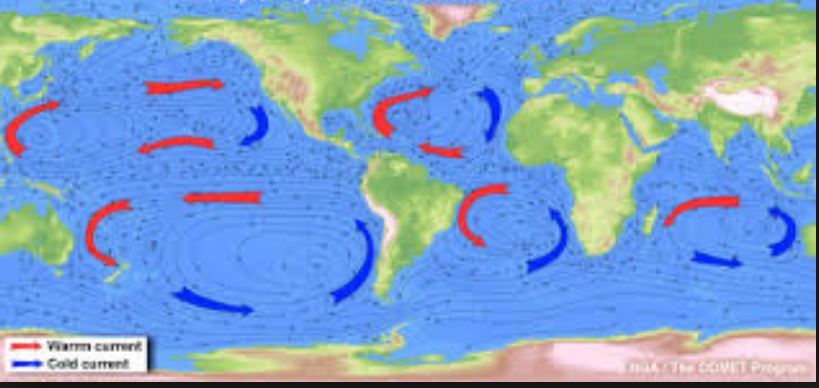
Analyze the image. What could explain why certain parts of the ocean have warmer temperatures?
the uneven heating of the Earth's surface
the rising of cold air and the sinking of warm air
hurricanes
13
Multiple Choice
The Sun warms the atmosphere and drives convection currents because
warm air is less dense and rises
warm air is less dense and sinks
warm air is more dense and rises
warm air is more dense and sinks
SC.7.P.11.1 Recognize that adding heat to or removing heat from a system may result in a temperature change & possibly a change of state. (DOK 1)
SC.7.P.11.4 Observe and describe that heat flows in predictable ways, moving from warmer objects to cooler ones until they reach the same temperature. (DOK 2)
Show answer
Auto Play
Slide 1 / 13
SLIDE
Similar Resources on Wayground

11 questions
Subatomic Particles
Presentation
•
6th - 8th Grade
11 questions
Potential and Kinetic Energy
Presentation
•
6th - 8th Grade
10 questions
Solubility
Presentation
•
5th - 8th Grade
10 questions
EGG LAB
Presentation
•
6th - 8th Grade
13 questions
5.1: Forms of Energy
Presentation
•
6th - 8th Grade
10 questions
Adding Rational Numbers
Presentation
•
6th - 8th Grade
10 questions
Energy Review
Presentation
•
6th - 8th Grade
9 questions
parts of speech
Presentation
•
6th - 8th Grade
Popular Resources on Wayground
10 questions
How much do you know about our Portrait of an Eagle?

Quiz
•
10th Grade
10 questions
Fast Food Slogans
Quiz
•
6th - 8th Grade
21 questions
Continents and Oceans
Quiz
•
6th Grade
20 questions
Parts of Speech
Quiz
•
5th Grade
16 questions
Subject & Predicate
Quiz
•
5th Grade
25 questions
Multiplication Facts
Quiz
•
5th Grade
12 questions
Map Skills
Quiz
•
3rd Grade
22 questions
Continents and Oceans
Quiz
•
5th Grade
Discover more resources for Science
17 questions
7.6D Aqueous Solutions
Quiz
•
7th Grade
20 questions
Scientific Method and Variables
Quiz
•
8th Grade
20 questions
Scientific method and variables
Quiz
•
8th Grade
27 questions
Counting Atoms - Subscripts
Quiz
•
8th Grade
10 questions
6.6D - Relative Density Review
Quiz
•
6th Grade
20 questions
Claim, Evidence and Reasoning (CER)
Quiz
•
6th - 8th Grade
18 questions
Counting Atoms
Quiz
•
7th - 8th Grade
20 questions
Density
Quiz
•
6th Grade